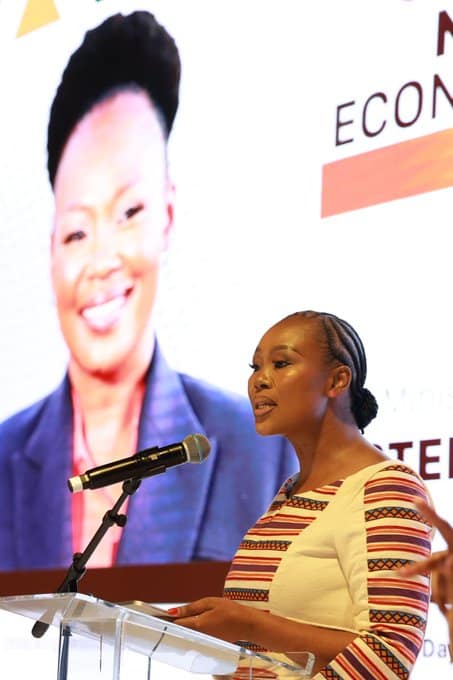
A crisp Wednesday morning at the Birchwood Hotel and OR Tambo Conference Centre saw a familiar figure take the podium early. Minister of Small Business Development, Stella Ndabeni-Abrahams, stood before a gathering of journalists, local government officials, and economic development practitioners to officially open the much-anticipated National Local Economic Development (LED) Summit.
But before the first panel discussion could begin, the Minister made a strategic move: a dedicated media briefing designed to set the tone for the two-day gathering. Flanked by senior officials from her department and representatives from the South African Local Government Association (SALGA), Ndabeni-Abrahams wasted no time framing the summit’s three non-negotiable pillars: jobs, growth, and accountability.
“We are not here for speeches,” she told the room, her voice firm above the low hum of air conditioners and distant airport traffic from the adjacent OR Tambo International. “We are here for implementation. Local economic development cannot remain a chapter in a policy document. It must become a lived reality in every ward, every township, and every small town across this country.”
The Birchwood Hotel, a familiar venue for government and private sector convenings on Johannesburg’s East Rand, buzzed with quiet urgency. More than 600 delegates — including mayors, municipal managers, traditional leaders, cooperative representatives, and development finance institution executives — had registered for the summit. The agenda, leaked to reporters the night before, promised no shortage of ambitious targets: accelerating township and rural economies, strengthening local supply chains, and — crucially — enforcing consequence management for municipalities that fail to spend their LED budgets.
It was that last point that dominated the Minister’s opening remarks and the subsequent Q&A with journalists.
“Accountability is not a buzzword,” Ndabeni-Abrahams said, leaning forward slightly as a Bloomberg reporter pressed her on underperforming districts. “We have municipalities that receive ring-fenced funding for local economic development and return it to Treasury unspent. Meanwhile, young people sit on street corners. That is a failure of leadership, and we will name names before this summit concludes.”
The Minister’s briefing revealed a three-pronged strategy to be finalized over the next two days:
- The Municipal LED Scorecard – A new public ranking system that will grade municipalities on job creation, SMME support, and procurement from local cooperatives.
- The Township Economy Fund – A proposed R1.2 billion blended finance mechanism, combining government grants with private sector loans, to be piloted in six districts.
- The Consequence Management Protocol – A binding agreement with provincial treasuries to flag and replace municipal LED officers who fail to submit expenditure reports for two consecutive quarters.
Reactions from the floor were mixed. Representatives from the South African Township and Village Economy Association welcomed the fund but questioned disbursement timelines. “We’ve heard promises before,” said association chair Thandi Mkhabela. “The difference this time? She mentioned accountability five times in ten minutes. That’s new.”
Opposition parties, notably the DA and ActionSA, were skeptical. In separate statements released during the briefing, they accused the Minister of “recycling old ideas” and noted that the Department of Small Business Development had itself underspent its own conditional grants to municipalities in the previous financial year. Ndabeni-Abrahams acknowledged the criticism without flinching. “We are not perfect. But this summit is not about defending the past. It is about redesigning the future.”
The two-day event will feature breakout sessions on informal economy integration, youth employment hubs, and the role of district development models. A high-level panel on Thursday afternoon will include the Director-General of the Department of Cooperative Governance and Traditional Affairs (CoGTA), as well as representatives from the Industrial Development Corporation (IDC) and the National Treasury.
For now, as the Minister stepped away from the microphone and toward the main plenary hall, the message was clear: the LED Summit is no longer a talking shop. Whether it becomes a turning point — or just another Johannesburg conference with a glossy report — will depend on what happens after the Birchwood’s doors close on Thursday evening.
Outside, under a highveld winter sun, delegates filtered toward coffee stations and breakout rooms. Some clutched thick folders of past strategies. Others carried only notepads and hope.
“Jobs, growth, accountability,” one municipal manager whispered to a colleague, repeating the Minister’s mantra. “Two out of three, we’ve tried. The third one? That’s the fight.”
The summit continues Thursday. South Africa is watching.
About The Author