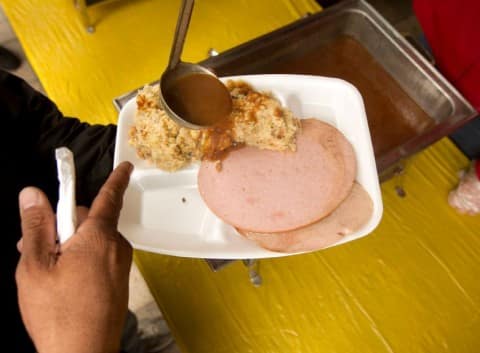
For three years, the numbers sat buried deep in spreadsheets, invisible to taxpayers, invisible to Parliament, invisible even to most of the officials who signed them off. But when the auditors finally pulled the thread, what unraveled was staggering: the Department of Correctional Services had been paying 25 times the market price for cooking oil intended to feed the country’s prison population.
Twenty-five times.
Not a clerical error. Not a decimal misplaced. A 20-litre bottle of cooking oil—the kind used in massive prison kitchens to prepare meals for thousands of inmates—was being billed at R726. The same bottle, available at any wholesale retailer, cost R29. That is a mark-up of nearly 2,400 percent.
And cooking oil was only the beginning.
Gravy powder, a staple in prison diets across the country, was being purchased at R3,735 per unit. The renegotiated price: R920. Other staples showed similar grotesque inflation. Milk powder. Maize meal. Canned vegetables. Every line item seemed to tell the same story: someone, somewhere, was making a fortune feeding South Africa’s inmates—and the state was paying the bill.
The revelations emerged during a tense parliamentary briefing this week, where the Portfolio Committee on Justice and Correctional Services grilled department officials over what committee chairperson Kgomotso Ramolobeng called “a catastrophic failure of supply chain management.”
“We are not talking about a few extra rands here and there,” Ramolobeng said, her voice rising. “We are talking about systematic, institutionalized overpricing that went undetected for years. How does cooking oil cost 25 times more in a government prison than it does in a private shop? Who was watching the till? The answer, it seems, is no one.”
The Discovery: How a Routine Audit Uncovered a Scandal
The overpricing was not discovered by a whistleblower or a journalist. It emerged from a routine internal review—a “price benchmarking exercise” ordered by new leadership within the Department of Correctional Services after concerns were raised about rising food costs. Officials compared what the department was paying against market rates from the National Treasury’s transversal contracts, the State Information Technology Agency (SITA), and major retailers.
The results were so shocking that the department’s own team initially assumed a data entry error.
“I remember the analyst coming to my office and saying, ‘You need to see this,'” a senior official told this reporter on condition of anonymity. “We thought the decimal point was in the wrong place. Then we checked the invoices. Then we checked again. It wasn’t a mistake. We had been robbed.”
The department immediately launched a renegotiation process with its 115 food suppliers across six regions. Those renegotiations, completed over several months, have now resulted in new five-year contracts beginning in April 2025. The new rates, set to take full effect on July 1, 2025, have slashed prices across the board.
But the damage—both financial and reputational—has already been done. Officials are now reviewing 4,600 transactions from the previous contract period, searching for patterns of overpayment and potential fraud. Preliminary findings suggest that the inflated prices were not isolated to a handful of suppliers but were widespread across multiple regions and product categories.
The Numbers That Shocked Parliament
During the committee hearing, department officials presented a grim table of old versus new prices. The contrast was dizzying:
| Item | Old Price | New Price | Overpayment |
|---|---|---|---|
| Cooking oil (20L) | R726 | R29 | 2,403% |
| Gravy powder (per unit) | R3,735 | R920 | 306% |
| Maize meal (bulk) | R1,250 | R480 | 160% |
| Milk powder (25kg) | R2,100 | R890 | 136% |
| Canned vegetables (case) | R890 | R410 | 117% |
These were not one-off anomalies. They were contract prices, approved by departmental officials, paid month after month, year after year. The cumulative overpayment, sources suggest, could run into tens of millions of rands—money that should have fed prisoners but instead fattened supplier margins.
“How is it possible that no one questioned a price of R726 for cooking oil?” asked MP Glynnis Breytenbach of the Democratic Alliance. “A child with a smartphone could have Googled the market price in thirty seconds. But the adults in charge of a multi-billion-rand budget apparently did not think to do that. That is not incompetence. That is willful blindness.”
The Minister’s Response: Fixes Acknowledged, Limits Cited
Correctional Services Minister Pieter Groenewald, who took over the portfolio after the 2024 elections, did not shy away from the gravity of the findings. In his testimony to the committee, he acknowledged “serious weaknesses” in the department’s procurement systems and praised the renegotiation team for securing better rates.
“The prices we were paying were indefensible,” Groenewald said. “As soon as we identified the problem, we acted. The new contracts represent a massive saving for the fiscus. That is the good news.”
But the minister also struck a defensive note, warning the committee that his powers to intervene in individual tenders are limited. Under South Africa’s procurement laws, ministers are not supposed to overrule tender processes or dictate supplier appointments. Doing so, Groenewald argued, would open the door to political interference and potentially violate the Public Finance Management Act (PFMA).
“I cannot stand over every procurement officer’s shoulder,” he said. “I cannot personally sign off every invoice. The system is designed to have checks and balances. Those checks failed. We are fixing them. But the idea that a minister can wave a wand and make corruption disappear—that is not how government works.”
Some committee members were unimpressed. “With respect, Minister, you are the political head of the department,” countered EFF MP Omphile Maotwe. “When a prison pays 25 times the market price for cooking oil, that is not a ‘system failure.’ That is a leadership failure. Somewhere up the chain, someone should have asked a question. No one did. That is on you.”
The Human Cost: Prisoners Eating Less for More
Behind the spreadsheets and parliamentary speeches lies a more visceral reality: prisoners have been eating worse food at higher cost to taxpayers. The inflated prices meant that for every rand spent, less actually reached the plate. Lower-quality ingredients. Smaller portions. Less variety.
Human rights organizations have long complained about prison food in South Africa, citing insufficient calories, poor nutritional value, and allegations of corruption in supply chains. The latest revelations appear to confirm the worst fears of prison reform advocates.
“Prisoners are entirely dependent on the state for their meals,” said Thandeka Mkhize, a researcher at the Civil Society Prison Reform Initiative. “They cannot shop elsewhere. They cannot refuse to eat. When the system overpays for cooking oil, it is not just stealing from taxpayers. It is stealing from inmates. That is not a procurement scandal. That is a human rights violation.”
The department has not yet quantified how much prisoners may have suffered due to the inflated prices. But officials acknowledged that the savings from the new contracts—estimated at hundreds of millions of rands over five years—will be redirected into food quality and nutritional programs.
“We have a duty of care to every person in our custody,” Groenewald said. “That duty was not being met. I am sorry for that. But sorry is not enough. We must do better. And we will.”
The Call for Lifestyle Audits
Perhaps the most explosive moment of the hearing came when committee chair Kgomotso Ramolobeng called for lifestyle audits of departmental officials involved in the procurement process.
“Somebody approved these prices,” she said. “Somebody signed these invoices. Somebody looked at R726 for cooking oil and said, ‘Yes, that seems reasonable.’ That person or persons needs to explain themselves. And if they cannot, their lifestyle needs to be examined.”
Lifestyle audits—the practice of comparing an official’s declared assets and income to their spending patterns—have been a politically sensitive tool in South Africa. While they are legally permitted, they are rarely enforced, particularly against senior civil servants. The committee’s recommendation, if acted upon, could lead to disciplinary action, criminal investigations, or both.
The department has not yet confirmed whether lifestyle audits will be conducted. But officials noted that the matter has been referred to the Special Investigating Unit (SIU), which has the power to probe corruption and recover misappropriated funds.
“The SIU is already looking at broader issues within the department,” Groenewald said. “If they find evidence of criminal conduct, we will act. No one is above the law. Not suppliers. Not officials. Not even ministers.”
The Broader Pattern: A Supply Chain in Crisis
The prison cooking oil scandal is not an isolated incident. It fits a troubling pattern of procurement failures across South African government departments. From personal protective equipment (PPE) during the COVID-19 pandemic to asbestos removal in the Free State, the same story recurs: inflated prices, weak oversight, and suppliers who seem to know exactly how to exploit the system.
Experts point to several structural causes. First, the preference for “panel contracts” that lock in prices for years, often without market testing. Second, the lack of skilled supply chain personnel in many departments. Third, the absence of real-time price monitoring systems. And fourth—perhaps most damaging—a culture in which asking questions is seen as “rocking the boat.”
“Procurement is where corruption goes to hide,” said forensic auditor Paul van der Merwe, who has consulted for multiple government departments. “It is complex. It is boring. It is hidden in spreadsheets. That makes it perfect for people who want to steal. You don’t need to bribe a minister. You just need to be friends with the person who signs the invoice. And in South Africa, that has been far too easy for far too long.”
What Happens Next
The Department of Correctional Services has committed to implementing the new rates by July 1, 2025. The 115 renegotiated contracts will run for five years, with built-in price review clauses to prevent a recurrence of the old inflation.
But the bigger question—how the overpricing happened in the first place and who is responsible—remains unanswered. The review of 4,600 transactions is ongoing. The SIU investigation is ongoing. And the committee has demanded a full forensic report within 90 days.
For now, the prison kitchens continue to operate. Meals are still being cooked. Cooking oil is still being poured. But every bottle now costs R29 instead of R726. That is progress. But it is not justice.
“The money that was stolen from the system is gone,” Ramolobeng said as she closed the hearing. “It is not coming back. But the people who took it—whether through negligence or design—must be held accountable. Because if they are not, nothing will change. And in five years, we will be sitting here again, looking at another spreadsheet, shaking our heads at another impossible price. That cannot happen. Not again.”
Outside the committee room, officials from the department slipped away quietly, their binders tucked under their arms. No one was smiling. The scandal had broken. And somewhere in the vast, labyrinthine halls of the Correctional Services headquarters, the person who signed off on R726 cooking oil—if they were still employed—knew that the noose was tightening.
About The Author