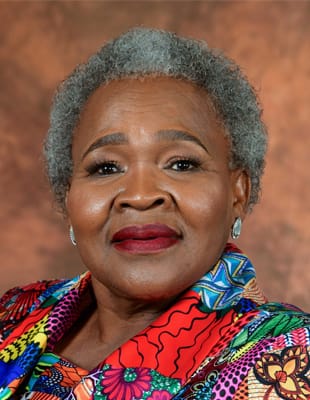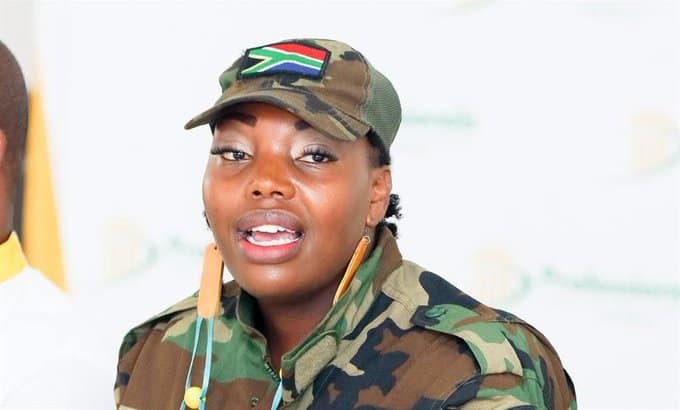
The fluorescent lights of the community hall in Soweto buzzed faintly overhead, but the room was otherwise silent. For nearly two years, Zandile Dabula had stood at that same podium, her voice sharp enough to cut through the noise of South Africa’s most explosive debate: immigration. But on Thursday, she stepped to the microphone not to rally supporters, but to say goodbye.
Dabula, who took over the leadership of Operation Dudula in 2023 following the high-profile tenure of founder Nhlanhla “Lux” Dlamini, announced her immediate resignation, citing irreconcilable differences over the movement’s future direction. The core of the clash, she explained, was a fundamental disagreement about whether Operation Dudula should remain a grassroots protest movement or transform into a formal political party.
“The movement is at a crossroads,” Dabula said, her voice steady but heavy. “I was elected to defend communities, to close down businesses hiring undocumented foreigners, to pressure government when it fails. I was not elected to become a politician. There is a difference between activism and politics. And that difference, I have come to realize, is a canyon we cannot bridge.”
Her resignation, which had been rumored for months amid whispers of internal divisions, leaves Operation Dudula in a state of uncertainty. The group, which rose to prominence in 2021 through high-profile pickets outside spaza shops, warehouses, and Home Affairs offices, has been a polarizing force in South African civil society. To its supporters, it is a necessary voice for citizens who feel overwhelmed by illegal immigration and the perceived failures of the state. To its critics, it is a vigilante movement that has fanned xenophobia and vigilantism.
Now, with Dabula’s departure, the question is no longer just about immigration. It is about identity, power, and the very soul of a movement that briefly became a household name.
A Leadership Born in Chaos
When Dabula took the reins in early 2023, Operation Dudula was already fracturing. Founder Nhlanhla Dlamini had stepped back amid legal troubles and internal disputes, leaving a vacuum that several factions tried to fill. Dabula, then a relatively unknown community organizer from Tembisa, emerged as a compromise candidate—a woman with a sharp mind, a calm demeanor, and a reputation for grassroots organizing rather than media grandstanding.
Her tenure was never easy. Under her leadership, Operation Dudula continued its hallmark activities: monitoring hiring practices at supermarkets, documenting businesses accused of employing undocumented migrants, and holding protest marches in Johannesburg and Pretoria. But she also attempted to soften the movement’s image, emphasizing dialogue with police and avoiding the more confrontational tactics that had marked earlier campaigns.
“I am not a hater of foreign nationals,” she said in a 2023 interview. “I am a lover of South African law. If a person is here legally, with papers, they are welcome. But if they are not, the law must be enforced. That is not xenophobia. That is accountability.”
That careful messaging won her some respect from civil society groups who had previously condemned Operation Dudula. But it also alienated the movement’s more radical fringe, who felt she was selling out. Behind the scenes, tensions grew. Meetings grew longer and louder. Accusations flew. And at the center of it all was the question of electoral politics.
The Party Politics Debate
According to multiple sources within the movement who spoke on condition of anonymity, a powerful faction within Operation Dudula has been pushing for the group to register as a political party and contest the 2024 national and provincial elections. The argument, they say, is pragmatic: protest movements can be ignored by government; political parties with seats in Parliament cannot.
“Why shout from the streets when you can shout from the National Assembly?” one senior member told this reporter last month. “We have the numbers. We have the anger. Let’s turn that into votes and actually change the laws.”
Dabula resisted. Repeatedly. Her position, as she laid out in her resignation speech, was that Operation Dudula’s power came from its extra-parliamentary nature—its ability to mobilize directly, to disrupt, to shame. Entering the electoral arena, she argued, would force the movement to compromise, to form coalitions, to play by rules written by the very system it sought to challenge.
“We are not a political party,” she said on Thursday. “We are a movement. A movement can say things a party cannot. A movement can act when a party is still debating. The moment we register as a party, we become part of the problem. We become another set of suits in Parliament, another group of people begging for votes. That is not why I joined. That is not why I led.”
Her words drew a mix of applause and stony silence from the audience. Some members nodded vigorously. Others folded their arms.
Months of Rumors and Fractures
The tensions had been public for months, if one knew where to look. In November 2023, an internal memo—purportedly written by a regional coordinator—leaked on social media, accusing Dabula of “diluting the struggle” and “coddling illegal foreigners.” In January 2024, a planned march in Pretoria was canceled at the last minute, with Dabula citing “organizational realignment.” In February, two provincial coordinators resigned without explanation.
Behind closed doors, the fighting was uglier. Supporters of the political-party faction reportedly began holding parallel meetings, bypassing Dabula’s leadership entirely. Funding sources grew nervous, unsure which faction to back. And the movement’s social media presence, once a unified roar, splintered into competing pages accusing each other of betrayal.
Dabula tried to hold the center. She proposed a compromise: a national convention to vote on the party question, with a binding result. But the faction pushing for electoral politics refused, fearing they would lose. Instead, they accelerated their efforts, reportedly approaching the Independent Electoral Commission (IEC) informally to explore registration requirements.
“We wanted to give her an ultimatum,” one pro-party member admitted, speaking on condition of anonymity. “Either she leads us into elections, or she steps aside. She chose to step aside. That is her right. But the movement will continue.”
A Return to School – But Not Surrender
In her resignation announcement, Dabula revealed another dimension of her departure: she plans to return to school. After years of full-time activism, she said, she needs to “re-equip” herself, both intellectually and personally. She did not specify a field of study but hinted at law or public policy.
“I am not a quitter,” she said firmly. “I am a learner. There is a difference. The fight against illegal immigration—the fight for the enforcement of our laws—does not end because Zandile Dabula steps back. But I have realized that I cannot fight with empty hands. I need tools. I need knowledge. I need to understand the legal system from the inside if I am going to change it.”
She emphasized that she remains committed to the core issues that animated Operation Dudula from the start: undocumented migration, crime linked to cross-border syndicates, and what she called “the failure of Home Affairs to secure our borders.”
“I am not abandoning the cause,” she said. “I am changing my uniform. That is all.”
The Movement’s Uncertain Future
With Dabula gone, Operation Dudula faces an immediate leadership vacuum. There is no clear successor. The pro-political-party faction is expected to move quickly to install an interim national coordinator, likely from Gauteng or KwaZulu-Natal, where the movement has its strongest support. A formal announcement is expected within days.
But the deeper uncertainty is strategic. If Operation Dudula transforms into a political party, it will enter an already crowded field of populist and nationalist movements. The Patriotic Alliance (PA), led by Gayton McKenzie, has already carved out a tough-on-immigration platform. The African Transformation Movement (ATM) and the newly formed African Content Movement (ACM) also compete for similar voters. There is no guarantee that Operation Dudula’s grassroots energy would translate into ballot-box success.
Moreover, a party registration would force the movement to disclose its funding, register its leadership with the IEC, and submit to electoral codes of conduct—all of which could expose internal divisions and legal vulnerabilities.
On the other hand, remaining a protest movement without Dabula’s stabilizing leadership risks further fragmentation. Already, splinter groups have broken away in recent months, including one calling itself “Dudula Direct Action” that has been linked to more aggressive tactics.
“It’s a classic activist dilemma,” said Dr. Precious Ndlovu, a political sociologist at the University of Johannesburg who has studied social movements. “Do you stay pure and powerless, or do you enter the system and risk co-option? Operation Dudula is not the first movement to face this question, and it won’t be the last. But the way they answer it will determine whether they remain relevant or become a footnote.”
The Broader Immigration Debate
The leadership crisis at Operation Dudula comes at a particularly sensitive moment in South Africa’s immigration politics. With national elections approaching (the original timeline of 2024, though note the current context may differ), immigration has emerged as a top-tier issue for a significant slice of the electorate. The Department of Home Affairs has been rolling out new digital systems and border controls, while Minister Aaron Motsoaledi has pledged a “major crackdown” on undocumented migration.
For many South Africans, especially in townships and informal settlements, the frustration is real: scarce jobs, overcrowded clinics, and housing shortages are often blamed—rightly or wrongly—on foreign nationals. Operation Dudula tapped into that frustration with extraordinary effectiveness. Whether any other leader or party can harness that same energy remains to be seen.
Dabula, for her part, offered a parting warning to her successors.
“Do not let the hunger for power destroy what we built,” she said. “The people who supported us—the domestic worker, the taxi driver, the unemployed graduate—they did not give us their time because they wanted us to become politicians. They gave us their time because they wanted us to act. If you forget that, you will lose everything. And more importantly, they will lose.”
What Comes Next
As of Thursday evening, Operation Dudula’s social media accounts had not yet acknowledged Dabula’s resignation. The movement’s website remained unchanged, still listing her as national leader. A statement is expected within 48 hours.
Outside the Soweto hall where Dabula spoke, a small group of supporters gathered, holding worn placards from past marches. Some wept quietly. Others debated heatedly. And a few simply stood in silence, watching the door where their leader had disappeared.
“She gave us a voice when no one else would,” said Mpho Radebe, 29, an unemployed construction worker who has attended Dudula actions since 2022. “I don’t know what happens now. Maybe we go to elections. Maybe we stay in the streets. But one thing I know: Zandile did not fail us. The people around her failed her.”
Dabula walked to her car alone, carrying a cardboard box of personal items from the office she would no longer occupy. She paused at the driver’s door, looked back at the hall, and then got in.
No tears. No waves. Just the quiet finality of a chapter closed.
The fight is not over. But the battlefield has changed. And for now, one of its most unlikely generals is heading back to the classroom—to learn, to wait, and perhaps, to return.
About The Author