The sun was merciless over the Limpopo lowveld, baking the red earth and wilting the maize crops that had not yet been abandoned. But inside the community hall of Giyani, a different kind of heat was building—the heat of frustration, of hope, and of a minister’s promise to finally confront one of South Africa’s most quietly devastating crises: the theft of water.
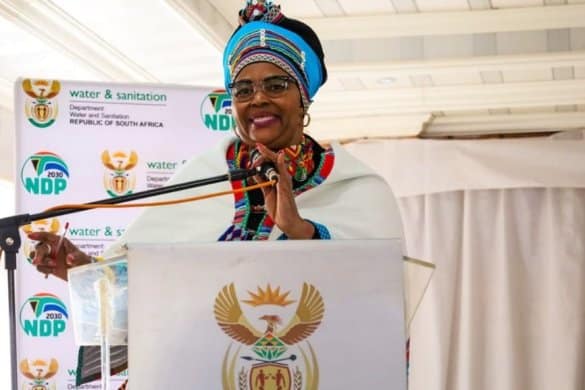
Water and Sanitation Minister Pemmy Majodina stood at a simple wooden podium, a map of South Africa’s river systems behind her, and announced a major nationwide audit of every bulk water user licence in the country. Not a sample. Not a抽查. Every single one.
“We are going to check every licence, one by one,” Majodina said, her voice amplified by crackling speakers but carrying the weight of a pledge. “We are going to verify every river abstraction point, every dam, every pipeline. If you are taking water illegally, we will find you. If you are taking more than your licence allows, we will stop you. The era of impunity in our water systems is over.”
The announcement, made during a community engagement event in Giyani—a town that has itself suffered decades of water shortages despite being located near several rivers—sent ripples through the agricultural, industrial, and mining sectors. For years, critics have warned that South Africa’s water licensing system is broken: licences are issued but rarely enforced; illegal abstractions go unpunished; and rivers run dry while powerful interests continue to pump.
Majodina’s audit aims to change that. And the stakes could not be higher. South Africa is a water-scarce country, ranked among the 30 driest nations on Earth. Climate change is expected to make rainfall more erratic and droughts more severe. Every drop counts. And for the millions of South Africans who still lack reliable access to clean water, the fight over licences is a fight for survival.
The Broken System: How Water Licences Became a Free-for-All
To understand the scale of the challenge, one must first understand how water licensing works in South Africa. Under the National Water Act of 1998, all water use—from irrigation to industrial cooling to mining dewatering—requires a licence. These licences specify how much water may be taken, from which source, for what purpose, and under what conditions. The Department of Water and Sanitation is responsible for issuing, monitoring, and enforcing these licences.
In theory, the system is robust. In practice, it has collapsed.
For years, the department has been underfunded and understaffed. Water licence compliance monitoring has been sporadic at best. Many licences have not been reviewed since they were issued, sometimes decades ago. New applications pile up unprocessed. And crucially, there is little to no real-time monitoring of actual water usage.
“The department simply does not have the boots on the ground,” said water policy expert Dr. Ferrial Adam of WaterAid. “There are something like 4,000 to 5,000 bulk water licences in this country, plus tens of thousands of smaller permits. The department has maybe a few dozen inspectors. The math does not work. People know they can take water without consequence, so they do.”
The result is a tragedy of the commons playing out in real time. In the Vaal River system, which supplies Johannesburg and Pretoria, illegal abstractions by farmers and industries have contributed to dangerously low dam levels. In the uMkhomazi River in KwaZulu-Natal, sugar cane farmers have been accused of taking water far beyond their licensed allocations, leaving downstream communities dry. In the Olifants River catchment in Mpumalanga, coal mines have been blamed for depleting and polluting water supplies while operating under loosely enforced licences.
“Water is not like gold or platinum,” Majodina said during her announcement. “You cannot make more of it. You cannot import it cheaply. What we have is what we have. And if we do not protect it, we will lose it—not in a hundred years, but in our lifetimes.”
The Giyani Context: A Community That Knows Thirst
Majodina chose Giyani for a reason. The town, the seat of the Mopani District Municipality in Limpopo, has become a symbol of South Africa’s water crisis. Despite being located near the Middle Letaba River and the Nandoni Dam, Giyani’s residents have faced chronic water shortages for years. Pipes are old and leaky. Pump stations break down. And when water does flow, it is often from trucks, not taps.
But the crisis in Giyani is not only about infrastructure. It is also about allocation. Upstream, large-scale agricultural operations—citrus, macadamia, and avocado farms—hold substantial water licences. Residents have long suspected that these farms take more than their share, leaving little for the town downstream. Proving it has been nearly impossible without an audit.
“The big farmers tell us they are following the rules,” said Nkhensani Shilubane, a community activist who attended the minister’s address. “But our taps are dry. Something does not add up. We want the minister to check. We want her to publish the findings. We want to see the numbers. If the farmers are legal, then fine—we will find another problem. But if they are cheating, we want justice.”
Majodina seemed to directly address that frustration. “I am not here to accuse anyone without evidence,” she said. “But I am here to say that we will get the evidence. Every licence holder will be audited. Every abstraction point will be inspected. And the results will be made public. No secrets. No hiding.”
The Audit: Scope, Methodology, and Timeline
The nationwide audit, which the minister said would begin immediately and continue for at least 12 months, is an enormous logistical undertaking. The Department of Water and Sanitation has allocated R450 million from its existing budget to fund the exercise, redirecting funds from non-critical programmes. An additional R200 million has been requested from the National Treasury for the next financial year.
The audit will be conducted in three phases.
Phase One: Licence Inventory and Digitization
For decades, the department’s licence records have been scattered across paper files, regional offices, and outdated databases. The first phase of the audit will consolidate every bulk water licence—defined as any licence authorizing the abstraction of more than 500,000 cubic meters per year—into a single, centralized, digital registry. This includes licences for agriculture, mining, industry, power generation, and municipal water supply.
“We cannot audit what we cannot find,” said Department Director-General Dr. Sean Phillips. “The first step is knowing exactly how many licences exist, who holds them, and what they authorize. That alone is a massive task. But without it, the rest cannot happen.”
Phase Two: On-the-Ground Verification
Once the digital registry is complete, inspection teams will fan out across the country to physically verify compliance. Each licence holder will be visited, their abstraction points inspected, their metering equipment checked, and their reported usage compared against actual flows. Where meters are missing or broken—a common problem—licence holders will be given a fixed period to install compliant monitoring equipment.
The department has announced plans to hire and train an additional 200 inspectors for the audit, many of them drawn from communities with water grievances. “We want local people to be part of this process,” Majodina said. “They know where the rivers are. They know when the water stops flowing. They will be our eyes and ears.”
Phase Three: Enforcement and Remediation
The final phase will be the most consequential. For licence holders found to be in compliance, no action will be taken beyond routine monitoring. For those found to be in breach—taking water without a licence, taking more than their licence allows, or violating licence conditions—a graduated enforcement response will follow.
Minor infractions may result in warnings and compliance notices. Moderate infractions could lead to fines, reduced allocations, or mandatory installation of monitoring equipment at the licence holder’s expense. Major infractions—especially where illegal abstraction has caused demonstrable harm to other users or the environment—could result in criminal charges, licence revocation, or both.
“We are not coming with a pillow,” Majodina said, using a township idiom meaning “we are not coming softly.” “We are coming with the full weight of the law. If you are stealing water, you are stealing from every South African. That is a crime. You will be treated like a criminal.”
The Reaction: Farmers, Miners, and Industry Speak
Unsurprisingly, the audit has been met with mixed reactions. Organized agriculture, through AgriSA, issued a cautious statement supporting “transparency and compliance” while warning against “unnecessary burdens on legitimate farmers.”
“South Africa’s farmers are already under immense pressure from load-shedding, rising input costs, and climate variability,” said AgriSA executive director Christo van der Rheede. “We welcome any initiative that ensures fair and sustainable water use. However, we caution against a presumption of guilt. Most farmers comply with their licences. They are not the problem.”
The mining industry, through the Minerals Council South Africa, similarly expressed support for “responsible water management” while noting that many mines have invested heavily in water recycling and treatment. “Mining uses a relatively small percentage of South Africa’s water, and much of it is returned to the system after treatment,” said spokesperson Mzila Mthenjane. “We are confident that our members will pass any audit.”
But environmental and human rights groups have been far more enthusiastic. “This audit is long overdue,” said Dr. Adam. “For years, the department has been asleep at the wheel. Now the minister has woken up. We will be watching closely to ensure that the audit is not just a paper exercise—that it leads to real enforcement, real penalties, and real changes on the ground.”
The Legal Landscape: What Powers Does the Minister Have?
Majodina’s authority to conduct such an audit is rooted in the National Water Act, which grants the minister sweeping powers to monitor, inspect, and enforce water use compliance. The Act allows the minister or her delegates to enter any property, inspect any water use, and demand any relevant records. Refusing to cooperate is a criminal offense.
However, the Act also provides for due process. Licence holders have the right to challenge enforcement actions in court, and many have the resources to do so. High-stakes legal battles over water licences have become increasingly common, with some cases dragging on for years.
“We must be prepared for litigation,” Majodina acknowledged. “Big water users have big lawyers. They will fight to keep what they have, even if it is not rightfully theirs. But we are not afraid of the courts. The law is on our side. The Constitution is on our side. The people are on our side.”
The Human Face of the Water Crisis
For all the talk of licences, audits, and enforcement, the water crisis ultimately has a human face. Children walking miles to collect water from communal taps. Mothers bathing their babies in plastic basins. Farmers watching their livestock die of thirst. Factories closing because they cannot secure reliable supply.
In Giyani, after the minister’s address, a elderly woman named Makhubela Masingita approached the podium. She did not speak English, so an interpreter translated her words. “I have lived in this village for 60 years,” she said. “When I was young, the river ran all year. We drank from it. We bathed in it. Now it is dry most of the year. The farmers upstream take it all. We are left with dust. Please, Minister, bring back our water.”
Majodina took the woman’s hand and held it for a long moment. “I cannot promise to bring back the river,” she said softly. “That is up to the rain. But I can promise that no one will take water that does not belong to them. That I can do. That I will do.”
What Happens Next?
The audit officially launched on the day of Majodina’s announcement, with the first phase—digitization of licences—already underway. The department has set up a dedicated task force, reporting directly to the Director-General, to oversee the process. Monthly progress reports will be submitted to Parliament and published online.
Civil society groups have been invited to participate as “audit observers,” attending inspections and reviewing findings to ensure transparency. The department has also launched a whistleblower hotline for citizens to report suspected illegal water use.
“I am calling on every South African to be a water watchdog,” Majodina said. “If you see a pipe that should not be there, report it. If you see a farmer irrigating when the river is low, report it. If you see a mine pumping water you do not know where, report it. This is not my fight alone. This is our fight.”
A Turning Point or Another False Dawn?
South Africa has seen bold announcements before, followed by little action. The water sector is littered with unfulfilled promises: the “War on Leaks” programme that trained thousands of plumbers but failed to fix the country’s crumbling infrastructure; the “National Water and Sanitation Master Plan” that gathered dust on shelves; the repeated pledges to invest in bulk water supply that never materialized.
Majodina seems aware of this skepticism. She did not promise that the audit would be easy or quick. She did not claim that it alone would solve the water crisis. But she insisted that without it, nothing else would work.
“You cannot manage what you do not measure,” she said. “For too long, we have not measured. We have not monitored. We have not enforced. That ends now. The audit is the first step on a long road. But it is a necessary step. And we are taking it.”
As the sun set over Giyani, the community hall emptied. Residents walked home through the dust, talking among themselves in low voices. Some were hopeful. Some were skeptical. All were watching.
The audit had begun. The question is not whether Majodina can check every licence. The question is whether, after the checking comes the changing. South Africa’s rivers—and its people—will hold their breath until the answer is clear.
About The Author