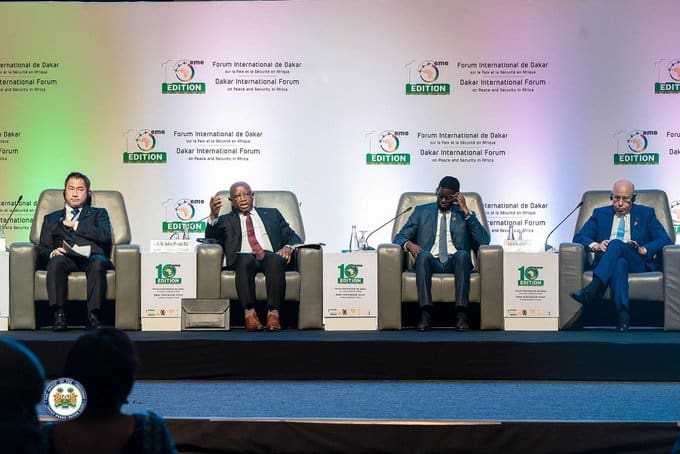
In a powerful joint address delivered on Tuesday at the ongoing Dakar International Forum on Peace and Security in West Africa, President Bassirou Diomaye Faye of Senegal and Sierra Leone’s President Julius Maada Bio issued a strong and united call for African-led peace initiatives to resolve the continent’s myriad conflicts. The two leaders urged their counterparts to take ownership of security matters, arguing that over-reliance on outside powers—including the United Nations, former colonial rulers, and private military contractors—has failed to bring lasting stability to Africa’s war-torn regions.
Speaking before an audience of heads of state, foreign ministers, and representatives from the African Union (AU) and the Economic Community of West African States (ECOWAS), Faye and Bio presented a sweeping vision of a continent that no longer waits for foreign intervention but instead builds its own capacity to prevent, manage, and resolve conflicts.
“The time for hand-wringing is over. The time for action is now,” President Faye declared, his voice echoing through the conference hall. “Africa’s problems require African solutions. Not because we are xenophobic. Not because we reject partnership. But because we understand our own realities better than any outsider ever can.”
The Context: A Continent in Flames
The call for homegrown solutions comes at a time when Africa is grappling with a resurgence of violent conflict across multiple regions. The Sahel belt remains a hotbed of jihadist insurgencies, with Mali, Burkina Faso, and Niger struggling to contain groups linked to al-Qaeda and the Islamic State. The ongoing civil war in Sudan has displaced over 9 million people and created one of the world’s worst humanitarian crises. The eastern Democratic Republic of Congo continues to be ravaged by rebel groups, including the M23, which is allegedly backed by neighboring Rwanda. Ethiopia’s Tigray region remains fragile after a brutal two-year war that killed hundreds of thousands. And in the Horn of Africa, Somalia continues to battle the al-Shabaab militant group.
Despite billions of dollars spent on foreign peacekeeping missions, UN interventions, and bilateral military assistance, the conflicts persist. In many cases, outside powers have been accused of pursuing their own strategic interests—access to resources, geopolitical leverage, or counter-terrorism agendas—rather than the genuine welfare of African populations.
“Foreign intervention has often been a bandage, not a cure,” President Bio said. “Sometimes it has made things worse. We have seen arms flow into conflicts, fueling them rather than ending them. We have seen peacekeepers withdraw before peace is achieved. We have seen conditionalities that serve donors more than the dying. Africa must do better. Africa can do better.”
The Faye-Bio Vision: A Five-Point Plan
In their joint address, the two presidents outlined a five-point plan for African-led peace and security, which they have submitted to the African Union’s Peace and Security Council for consideration.
1. An African Standby Force Fully Operationalized
The African Standby Force (ASF), a continental peacekeeping force first conceived in 2003, has never been fully operationalized due to lack of funding, political will, and logistical capacity. Faye and Bio called for an immediate, binding commitment from AU member states to contribute troops, equipment, and funding to make the ASF a reality within 24 months.
“We have talked about the ASF for over two decades. It is time to stop talking and start building,” Faye said. “We do not need a standing army of hundreds of thousands. We need a rapid deployment capability of 20,000 well-trained, well-equipped soldiers who can intervene within days, not months, when a crisis erupts. This is achievable. What is lacking is political will.”
The two leaders proposed a dedicated continental peace fund, financed by a small levy on natural resource extraction across Africa, to ensure the ASF is not dependent on unpredictable donor contributions.
2. An African Mediation Corps
The second pillar of the plan calls for the establishment of a permanent African Mediation Corps—a pool of trained diplomats, elders, religious leaders, and civil society figures who can be deployed at short notice to facilitate dialogue between warring parties.
“Too often, mediation efforts are ad hoc, under-resourced, and led by individuals with no formal training,” Bio observed. “We need a professional, standing mediation service that understands the cultural, linguistic, and political nuances of each conflict. Peace is not just about stopping bullets. It is about addressing grievances. And grievances are best understood by those who share the history.”
The proposed corps would be headquartered in Addis Ababa, with regional hubs in Dakar, Nairobi, and Pretoria. Initial funding would come from a combination of AU contributions and a new “Peace Fund” levy on member states based on GDP.
3. A Continental Early Warning System
The third pillar focuses on prevention. Faye and Bio called for the expansion and enhancement of the AU’s Continental Early Warning System (CEWS), which currently relies on a patchwork of national and regional monitoring centers. The leaders proposed a unified, real-time data platform that integrates satellite imagery, social media monitoring, open-source intelligence, and field reports to identify emerging conflicts before they escalate into violence.
“Most conflicts do not erupt without warning. There are signs—rhetoric, troop movements, arms flows, ethnic tensions. We need a system that reads those signs and triggers automatic mediation protocols,” Faye said. “We have the technology. We have the expertise. What we need is the political commitment to act on the warnings, even when they implicate powerful actors.”
4. An End to Foreign Military Bases and Proxy Wars
Perhaps the most controversial element of the plan is a call for a phased, continent-wide reduction of foreign military bases and the rejection of proxy wars fought by outside powers on African soil.
France, the United States, China, Russia, Turkey, and the United Arab Emirates all maintain military bases or significant troop presences in various African countries. In recent years, the Sahel region has become a battleground for competition between Western powers, Russia’s Wagner Group (now operating under other names), and regional actors.
“We are tired of being the battlefield for other people’s rivalries,” Bio said, drawing applause from the audience. “When Russia and the West fight in Ukraine, the war stays in Ukraine. When they fight in Africa, it is our children who die. We say: take your proxy wars elsewhere. Africa is not for sale.”
The leaders called for the development of a continental framework to regulate foreign military presence, including mandatory transparency agreements, time-limited deployment authorizations, and a prohibition on foreign forces engaging in domestic law enforcement or political interference.
5. Economic Integration as a Path to Peace
The final pillar of the plan addresses the root causes of conflict: poverty, inequality, and competition over resources. Faye and Bio called for accelerated implementation of the African Continental Free Trade Area (AfCFTA) as a peace-building tool.
“Trade creates interdependence. Interdependence creates incentives for peace,” Faye argued. “When two countries trade with each other, they are less likely to go to war. The AfCFTA is not just about economics. It is about security. It is about stability. It is about giving young Africans jobs instead of guns.”
The leaders also called for a continent-wide crackdown on illicit financial flows, which they estimated at over $80 billion annually, much of which is linked to conflict resources such as gold, diamonds, coltan, and timber.
“The bloodshed in eastern Congo is fueled by the demand for minerals that end up in your smartphones,” Bio said, addressing the international community directly. “We need a certification system that ensures African minerals are not financing African wars. And we need the cooperation of the countries that buy those minerals.”
Reactions from the Continent and Beyond
The Faye-Bio plan has drawn a range of reactions from African leaders, diplomats, and international partners.
African Union: AU Commission Chairperson Moussa Faki Mahamat issued a statement welcoming the initiative and promising that it would be discussed at the next AU Summit in Accra, Ghana, scheduled for July 2026. “The vision articulated by Presidents Faye and Bio aligns with the AU’s Agenda 2063 and its aspiration for a peaceful, integrated, and prosperous Africa. We will give this proposal the serious consideration it deserves.”
ECOWAS: The Economic Community of West African States, which has struggled in recent years to respond to coups in Mali, Burkina Faso, and Niger, expressed support for the plan but noted that regional bodies must be strengthened first. “We cannot have a continental standby force if the regional blocs themselves are weak,” said ECOWAS Commission President Omar Touray. “We need to walk before we run.”
South Africa: President Cyril Ramaphosa, who was not present at the Dakar forum but was briefed on the proposals, issued a cautious statement of support. “South Africa has long advocated for African solutions to African problems. We will study the Faye-Bio plan in detail and engage constructively with our continental partners.”
Kenya: President William Ruto, a vocal advocate for pan-Africanism, gave the plan his full backing. “This is exactly the kind of bold thinking Africa needs. We cannot keep outsourcing our security. Kenya stands ready to contribute troops, trainers, and resources to the African Standby Force.”
France: The French government, which has been forced to withdraw its military forces from Mali, Burkina Faso, and Niger in recent years following anti-French sentiment, responded coolly. A statement from the French Ministry of Foreign Affairs said: “France supports African-led peace initiatives and remains a committed partner in the fight against terrorism. We note the proposals made in Dakar and look forward to further discussion.”
Russia: Moscow has not yet issued an official response, but Kremlin-linked commentators have dismissed the plan as “naive” and “anti-Russian.” One Russian state media pundit said: “Africa cannot secure itself. It needs partners. Russia is that partner.”
China: Beijing expressed “support for African efforts to enhance their own peace and security capabilities” while noting that “international cooperation remains essential.”
Challenges and Skepticism
Despite the enthusiasm from many quarters, the Faye-Bio plan faces formidable obstacles.
Funding: The estimated cost of fully operationalizing the African Standby Force, the Mediation Corps, and the enhanced Early Warning System is approximately $5 billion annually—a sum that African nations have historically been unwilling or unable to contribute. The proposed levy on natural resource extraction would require a continental tax agreement, a politically fraught endeavor.
Political Will: Many African leaders are reluctant to cede sovereignty to a continental force or to allow the AU to intervene in internal conflicts. The principle of “non-interference” in member states’ internal affairs has long been a sacred tenet of the AU’s predecessor, the Organization of African Unity (OAU), and remains deeply embedded in the AU’s Constitutive Act, despite provisions for intervention in cases of war crimes or genocide.
Capacity Gaps: Even with funding, Africa lacks the logistical infrastructure—airlift capabilities, naval assets, intelligence networks, and medical evacuation systems—to deploy and sustain a credible peacekeeping force. Bridging these gaps would require years of investment and training.
Trust Deficits: Decades of rivalry between African nations, as well as suspicion of the AU’s leadership, have hampered past efforts at continental security cooperation. Some countries fear that a continental force could be used to enforce the interests of larger, more powerful nations against smaller neighbors.
The Role of Civil Society
Civil society organizations across Africa have largely welcomed the Faye-Bio initiative, while cautioning that peace cannot be imposed from above.
“We have seen too many peace processes that involve only presidents and generals, while women, youth, and civil society are excluded,” said Fatou Diop, a Senegalese peace activist who attended the Dakar forum. “Any African-led peace initiative must include grassroots voices. Peace is not just the absence of war. It is the presence of justice. And justice requires participation.”
Others have called for the plan to include specific provisions for addressing gender-based violence in conflict zones, which remains a pervasive but often overlooked aspect of African wars.
A Historic Moment or Just Another Declaration?
The Dakar forum concludes on Thursday, with a final communique expected to endorse the Faye-Bio plan in principle and refer it to the AU for further development. But many observers are reserving judgment.
“Africa is full of declarations. What we need is implementation,” said Dr. Ibrahim Kamara, a political scientist at the University of Dakar. “President Faye is new—he has only been in office for two years. President Bio is a veteran. They have credibility. But can they mobilize the continent? That remains to be seen.”
For his part, President Faye struck a tone of cautious optimism. “Rome was not built in a day. Neither will the Africa we dream of. But we must start. We must start now. And we must start together.”
President Bio added: “Our children are watching. History is watching. Let us not be the generation that talked while Africa burned. Let us be the generation that acted.”
As the sun set over Dakar, the conference hall emptied. Diplomats headed to their hotels. Journalists filed their stories. And somewhere, in a displacement camp in Sudan, a child who has known nothing but war slept fitfully, unaware that far away, leaders were debating her future.
The words have been spoken. The plan has been laid out. Now comes the hard part.
About The Author