For weeks, the warships had moved through the narrow strait like restless giants, their decks bristling with missiles and their crews on high alert. The newly launched naval operation—dubbed “Sentinel Shield”—was meant to be a show of force, a promise to the world’s shipping lanes that the United States would not abandon them to the threat of Iranian seizure or harassment. But late on the evening of May 5, President Donald Trump stood before a bank of microphones in the White House briefing room and announced a stunning reversal.
The operation was being paused. Indefinitely.
“We have made great progress toward a comprehensive agreement with Iran to end the ongoing conflict in the Middle East,” Trump told reporters, his tone uncharacteristically measured. “As a result of those talks, I have ordered a temporary halt to our naval escort operations in the Strait of Hormuz. We believe the threat has de-escalated sufficiently to allow commercial traffic to proceed without military accompaniment.”
The announcement, brief and carefully worded, sent shockwaves through defense circles in Washington, Tehran, and the Gulf capitals. For an administration that has spent years imposing “maximum pressure” on Iran—reimposing sanctions, assassinating General Qassem Soleimani, and repeatedly withdrawing from diplomatic frameworks—the sudden pivot toward de-escalation was nothing short of breathtaking.
The Operation That Was, and Wasn’t
Sentinel Shield had been operational for only 72 hours when Trump pulled the plug. The mission, announced just last week, was intended to be a direct response to a series of Iranian provocations in the strait—most notably the seizure of two commercial tankers in late April and a drone attack on a Japanese-owned cargo ship that left a hole in its hull but no casualties.
Under the operation’s framework, US Navy destroyers and patrol aircraft would escort groups of commercial vessels through the 21-mile-wide chokepoint, through which approximately 20% of the world’s oil passes daily. The escorts were to be offered primarily to tankers flying the flags of allied nations, but the Pentagon had left the door open for broader participation.
Admiral Craig Fallon, commander of US Naval Forces Central Command, had described the mission just four days ago as “a necessary and proportional response to Iranian lawlessness.” Now, his ships have been ordered to stand down.
“We are not withdrawing from the region,” a senior defense official clarified in a background briefing following Trump’s announcement. “The ships remain in position. The pause is operational, not strategic. We are simply halting active escort missions while we assess the diplomatic landscape.”
What Changed?
The question on every analyst’s lips is simple: what changed? According to sources familiar with the negotiations, the answer lies in a series of back-channel talks that have been quietly underway for nearly two months, facilitated by Omani and Qatari intermediaries.
The talks, which have not been formally acknowledged by either Washington or Tehran until now, are reportedly focused on a broad deal that would see Iran significantly curtail its nuclear enrichment program, cease its support for proxy militias in Iraq, Syria, and Yemen, and halt its harassment of commercial shipping. In exchange, the United States would ease key oil and financial sanctions, release frozen Iranian assets, and—crucially—provide written assurances that it will not seek regime change.
Trump’s mention of “ending the ongoing conflict in the Middle East” is being interpreted by insiders as a reference not just to the Hormuz situation but to the broader regional proxy war. A comprehensive agreement, if reached, could reshape the entire Gulf security architecture—something no American president has achieved in over four decades of hostility with the Islamic Republic.
But progress is not the same as a done deal. And that distinction has not been lost on critics.
Skepticism on All Sides
Within hours of Trump’s announcement, a chorus of skepticism emerged from both parties in Congress. Senate Minority Leader Chuck Schumer warned that “pausing military operations based on promises from a regime that has repeatedly broken its word is dangerously naive.” Senator Tom Cotton, a Republican hawk on Iran, went further: “We are rewarding bad behavior. Iran seized ships. We responded by sailing away. That is not diplomacy. That is capitulation.”
Republican Senator Lindsey Graham, usually a Trump ally on foreign policy, expressed “serious concerns” about the timing. “I need to see the text of any agreement before I believe Iran has changed its behavior. They have lied to every administration since 1979. Why should this one be different?”
On the Iranian side, reaction was predictably more celebratory but equally measured. State media quoted Foreign Ministry spokesman Nasser Kanaani as saying that “any reduction in American military aggression in our waters is a positive step,” but he stopped short of confirming that an agreement was imminent. “Discussions continue. The path remains long.”
The Strait’s Strategic Importance
To understand the magnitude of Trump’s decision, one must understand the Strait of Hormuz. At its narrowest point, the waterway is just 21 miles wide—barely two lanes of highway traffic. Yet through this slender throat flows the economic lifeblood of the Gulf states: crude oil. Saudi Arabia, Iraq, the UAE, Kuwait, and Iran itself all rely on the strait to export their most valuable commodity.
A single tanker carrying 2 million barrels of crude oil is worth roughly $150 million at current prices. Each day, nearly 20 such vessels pass through the strait. The financial exposure is staggering, which is why the US Navy has maintained a continuous presence in the region since the 1980s.
Iran, lying along the strait’s northern shore, has long threatened to close the waterway in response to hostile actions. It has the military means to do so—at least temporarily—through a combination of naval mines, small fast-attack boats, and anti-ship missiles. The threat is credible enough that global oil prices typically spike on any news of Iranian provocations in the strait.
When Trump announced Sentinel Shield last week, Brent crude futures jumped 3%. When he paused it tonight, prices dipped only modestly—suggesting that markets are taking a wait-and-see approach.
The View from the Bridge
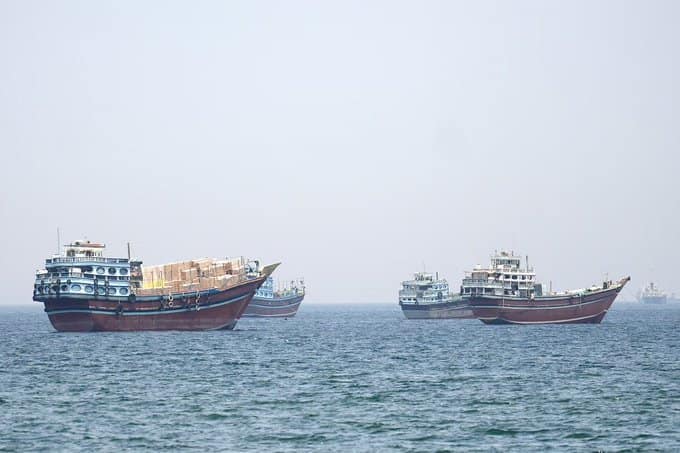
For the captains of the commercial vessels that transit the strait, the news of the pause was met with a mix of relief and worry. Relief because the presence of naval escorts, while protective, also created a sense of being a target—a painted bullseye sailing through dangerous waters. Worry because the escorts were, for many, the only thing standing between them and an Iranian patrol boat ordering them to change course.
“We are in a very strange position,” Captain Ahmed Al-Mansouri, master of a Liberian-flagged tanker, told maritime publication Lloyd’s List via satellite phone. “The American warships made us feel safe, but they also made us feel like part of a confrontation we did not ask to join. Now that they are gone, we feel exposed. But if the underlying diplomacy succeeds, perhaps we will feel something we have not felt in years: normal.”
What Comes Next?
The coming days will be critical. Trump is reportedly planning a joint press appearance with the leaders of Oman and Qatar within the next week, where a framework agreement could be unveiled. Details remain fluid, but sources suggest the deal would include phased sanctions relief in exchange for verifiable reductions in Iran’s uranium stockpile and a binding commitment to allow International Atomic Energy Agency inspectors into suspect facilities.
The naval pause, officials emphasized, is reversible. If Iran test the waters with a new provocation—an attempted seizure, a drone flyover, a missile test—the escorts could resume within hours. “This is not disarmament,” a White House official said. “This is a gesture of good faith. Gestures can be withdrawn.”
For now, the warships of the US Fifth Fleet remain on station, their crews peering at the horizon, their weapons cold but ready. The Strait of Hormuz is quiet tonight. The tankers move through the darkness alone, their lights reflecting off water that has seen centuries of conflict.
And somewhere, in a diplomatic suite in Muscat, negotiators from two nations that do not officially speak to one another lean over a draft document, crossing out lines and adding commas, trying to build a peace that might just hold.
The guns at sea are silent. But silence, in the Middle East, has never been a guarantee of safety
About The Author