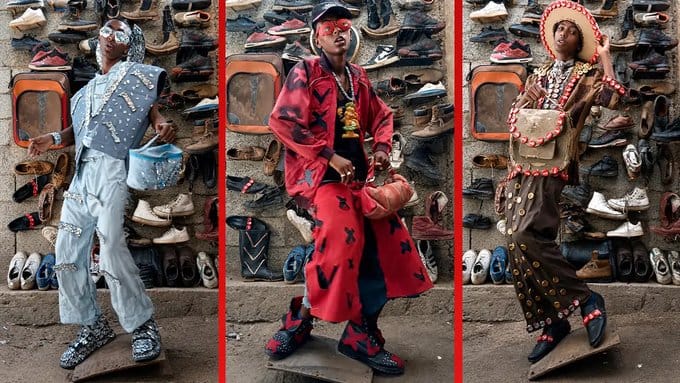
Just over a month ago, Kalu Putik was a name whispered only among the scrappy, creative corners of Addis Ababa’s burgeoning streetwear scene. He was the teenager with glue on his fingers and a vision in his head, the one who saw treasure where others saw trash—a shattered iPhone screen becoming a chest plate, a handful of bottle caps transformed into a shimmering epaulet, a discarded inner tube reincarnated as a belt that looked like it belonged on a dystopian runway. Then, the internet discovered him.
In 30 dizzying days, the 17-year-old, who posts under the handle @kaluputics, amassed over 4 million followers on Instagram. His Reels—low-budget, high-imagination productions filmed in the bustling streets and makeshift studios of Ethiopia’s capital—became a sensation. Fashion lovers, sustainability advocates, and curious teenagers from São Paulo to Seoul marvelled at his ability to conjure bold, avant-garde garments from the detritus of modern life.
But fame, even the overnight variety, comes with a shadow. This week, that shadow took the form of a video so convincing—and so convincingly fake—that it briefly fooled millions of his devoted fans.
The Hoax: A Dream Trip That Never Happened
The video appeared without warning, posted by an account that had cleverly mimicked the visual style of Kalu’s own content. In it, a young man who appeared to be Kalu walked through the gleaming corridors of an international airport, clutching a first-class boarding pass and surrounded by smiling handlers in blazers. Text overlays announced a “major luxury brand partnership” and an “all-expenses-paid trip to HQ” somewhere in Europe. The production value was slick. The lighting was cinematic. The promise was everything Kalu’s fans had been hoping for: their boy had made it.
Except he hadn’t.
Within hours, eagle-eyed users began picking apart the footage. The crowd movements in the background were subtly unnatural—people walking in loops, gestures repeating every few seconds, the telltale signs of generative AI video synthesis. Fingers blurred at the edges. A reflection in a glass door showed a face that was almost, but not quite, Kalu’s. The boarding pass shimmered in a way no real document ever would.
“Something felt off immediately,” said @fashiontech_ethiopia, a local influencer who was among the first to raise the alarm. “Kalu’s real videos have this raw, grounded energy. They smell like Addis—the dust, the light, the chaos. This airport video was too polished. It was trying too hard. And when you looked closely, the people in the background were basically glitching.”
The account that posted the video was swiftly deleted, but not before the clip had been viewed over 2 million times and shared across dozens of platforms. Comments sections on Kalu’s genuine posts filled with panicked questions: “Is it true?” “Are you leaving us?” “Did you really sign with (luxury brand)?” The fake news had spread faster than the truth could run.
The Real Kalu: Talent Needs No Forgeries
Hours after the hoax was exposed, Kalu Putik posted a short, characteristically low-fi video from his bedroom in Addis Ababa. He was wearing a vest made of recycled cassette tape ribbons and smiling in a way that suggested bemusement rather than anger.
“I saw the video,” he said, his voice calm. “It was not me. I have never been to that airport. I have never held that ticket. But I want to say thank you to the people who believed it—not because it was true, but because you believed I was capable of something that big. One day, I will be. But not today. Today, I am still here. Still making clothes from garbage. Still happy.”
The video, which has since been viewed over 10 million times, was classic Kalu: authentic, unpolished, and deeply human. In a digital age saturated with filters and fakery, his refusal to perform outrage or embarrassment was itself a kind of quiet revolution.
“He’s not angry because he doesn’t need the lie,” said Hanna Gebreselassie, a digital media lecturer at Addis Ababa University. “His real growth has come from genuine creativity, not from manufactured hype. The AI video was convincing, but it was also completely unnecessary. The real Kalu is already more interesting than any deepfake could ever be.”
The Rise of a Sustainable Fashion Sensation
Kalu’s meteoric rise to 4 million followers was not an accident, nor was it the result of a PR agency’s machinations. It was the organic flowering of a unique talent at the perfect intersection of several global trends.
First, there is sustainability. The fashion industry is one of the world’s largest polluters, and young consumers are increasingly turning away from fast fashion in favour of upcycled, recycled, and repurposed garments. Kalu’s entire aesthetic is built on waste. Broken electronics, scrap metal, discarded plastic, frayed fabrics—these are not his raw materials. They are his signature.
Second, there is accessibility. High fashion has long been the domain of the wealthy and the well-connected. Kalu, a teenager from a middle-class Addis neighbourhood, democratizes creativity. His Reels show him scavenging for materials, gluing pieces together by hand, and modelling his creations against the backdrop of his own street. There is no velvet rope. There is only work and vision.
Third, there is authenticity. In an era of curated perfection, Kalu’s willingness to show the mess—the failed designs, the glue stains, the uneven stitches—is refreshing. He is not a product. He is a process.
“I don’t have a factory. I don’t have a team,” he said in an interview with a local lifestyle blog last month. “I have my hands and my head and the things people throw away. That is enough. That has always been enough.”
The Brands Are Watching
Despite the hoax, or perhaps because of the attention it generated, Kalu’s star continues to rise. Multiple fashion brands have reportedly reached out to his representatives—he now has a small management team, mostly family friends with good organisational skills—to explore potential collaborations. None have been announced, and Kalu has been characteristically guarded about the details.
“What I can say is that people are interested,” his manager, a family friend who asked to be identified only as “Amanuel,” told this reporter. “But Kalu is not in a hurry. He is 17. He has time. And he will only work with people who respect his vision and his community. He does not want to become a billboard. He wants to become an inspiration.”
There have been no confirmed trips abroad. No luxury brand deals signed. The AI video lied about all of that. But the underlying truth—that Kalu Putik is a rising star with a global future—remains unchallenged.
The Deepfake Threat and the Authenticity Shield
The hoax video is a reminder of the world that Kalu and his generation must navigate. AI-generated content has become so sophisticated that distinguishing real from fake increasingly requires technical expertise and forensic attention. For a young creator without a dedicated digital security team, the risk of being impersonated, misrepresented, or simply erased by synthetic media is real and growing.
But Kalu may have an accidental shield: his style is so distinctive, so rooted in the specific textures and locations of Addis Ababa, that any departure from those signatures feels immediately suspicious to his most dedicated fans.
“The AI video showed him in an airport. But Kalu’s real videos are never in airports. They are on rooftops, in alleyways, in the back rooms of tailor shops,” said Gebreselassie. “The deepfake failed not because it was technically poor—it was actually quite good—but because it violated the visual grammar of his real life. That is a lesson for anyone trying to fake an authentic creator: you cannot fake the context. The context is the content.”
Looking Ahead
As of today, Kalu Putik has over 4.3 million followers on Instagram. His latest Reel, posted just hours after the hoax was debunked, shows him modelling a jacket made entirely from recycled rubber inner tubes and old bicycle chains. The video has 3 million views. The comments are filled with hearts, fire emojis, and messages of support from around the world.
He has not addressed the AI hoax again. He does not need to. His work speaks for itself—honestly, creatively, and without the need for any digital sleight of hand.
In a modest room in Addis Ababa, a teenage boy is cutting up a discarded tire with scissors. He hums as he works. On his desk lie the shattered remnants of an iPhone, a collection of mismatched buttons, and a sketch of something that does not yet exist. Outside his window, the city hums—a real city, with real dust, real noise, and real life.
The fake airport video has been forgotten by everyone except the archivists. But Kalu Putik is still here. Still making. Still real.
And that, it turns out, is more than enough.
About The Author