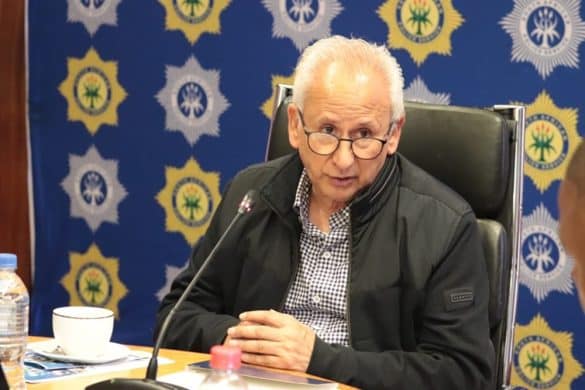
The Good Hope Chamber of Parliament, with its high arched windows overlooking the manicured gardens of the Parliamentary precinct, has witnessed no shortage of tense exchanges over the years. But few have been as delicately choreographed—and as politically charged—as the moment Acting Police Minister Firoz Cachalia rose to address the Portfolio Committee on Police this week.
Before him sat a horseshoe of lawmakers, their pens poised over notepads, their expressions a mix of skepticism and anticipation. Behind them, banked rows of officials and journalists watched in near silence. At stake was a simple question with extraordinarily complex implications: Had the acting minister discussed the Independent Police Investigative Directorate’s (IPID) report on the Phala Phala matter with President Cyril Ramaphosa?
Cachalia, a veteran opposition politician from the Democratic Alliance (DA) who has held the acting portfolio since April following a cabinet reshuffle, did not hesitate.
“I have never discussed the IPID report on the Phala Phala matter with President Cyril Ramaphosa,” he said, his voice measured but firm. “Not directly. Not indirectly. Not through intermediaries. Not once.”
The words landed like stones in still water. Ripples spread through the room. MPs shifted in their seats. A journalist typed furiously. And for a moment, the only other sound was the distant hum of air conditioning struggling against the Cape Town winter chill.
The Context: A Report That Won’t Go Away
To understand why Cachalia’s statement matters, one must go back to the origins of the Phala Phala saga. In February 2020, a burglary occurred at President Ramaphosa’s game farm near Bela-Bela in Limpopo. An undisclosed sum of foreign currency—reportedly $580,000 in US dollars—was stolen. The president has consistently stated that the money came from the legitimate sale of buffalo and other game. However, questions have persisted about whether the funds were properly declared, whether tax was paid, and—crucially—whether the president’s security detail acted appropriately in pursuing the alleged thieves.
The case eventually landed at IPID, the independent watchdog that investigates allegations of misconduct by South African Police Service (SAPS) members. IPID’s mandate does not extend to the president himself, but it does cover the police officers involved in the aftermath of the burglary. Over many months, IPID compiled a detailed report. That report, its contents largely confidential, has become a political grenade.
Opposition parties have demanded its full release. The African Transformation Movement (ATM) used the matter to trigger an impeachment process. President Ramaphosa has denied any wrongdoing. And throughout, a simmering question has lingered: Did the president—or his office—attempt to influence or access the IPID investigation?
It is that question that brought Cachalia to the witness chair.
The Parliamentary Exchange
The hearing was ostensibly about the police ministry’s budget and performance targets. But everyone in the room knew the real agenda. When DA MP Andrew Whitfield rose to ask a pointed question about Cachalia’s interactions with the presidency on the IPID report, the atmosphere tightened.
“Minister, given the sensitivity of the Phala Phala investigation and the clear public interest, can you confirm under oath whether you have discussed the contents, progress, or conclusions of the IPID report with President Ramaphosa at any time?” Whitfield asked.
Cachalia leaned into his microphone. “I can confirm, without hesitation, that I have never discussed the IPID report on this matter with the president. Not in cabinet meetings, not in private, not in written correspondence. The investigation has been handled by IPID as an independent statutory body. I have respected that independence absolutely.”
He added, almost as an afterthought: “Any suggestion to the contrary is simply untrue.”
The committee chairperson, Tina Joemat-Pettersson of the ANC, nodded slowly. She did not press further. But the unspoken tension remained. Cachalia, after all, is an opposition politician serving as acting minister in a cabinet led by a president from a rival party. His word carries weight, but his political position is precarious.
The Political Tightrope
Cachalia’s appointment as Acting Police Minister was itself a product of South Africa’s peculiar coalition politics following the 2024 elections (in the context of the original timeline). The DA and ANC, despite their fierce disagreements, entered a Government of National Unity (GNU) after no single party won an outright majority. As part of that arrangement, the DA was allocated several cabinet portfolios, including police—though the minister of police, Senzo Mchunu of the ANC, was on special leave, leaving Cachalia as acting minister.
This arrangement has produced moments of genuine cooperation, but also deep suspicion. ANC MPs watch Cachalia closely. DA MPs worry he is being used. And the presidency, for its part, has maintained a careful public distance.
Cachalia’s denial, therefore, serves multiple purposes. It reassures the public that the Phala Phala investigation has not been compromised. It protects his own political integrity. And it draws a clear line between the executive’s law enforcement functions and the president’s personal legal battles.
“I am not the president’s lawyer. I am not his spokesperson. I am the Acting Minister of Police,” Cachalia said later, during a break in the proceedings. “My duty is to the Constitution, to the law, and to the people of South Africa. That duty requires me to ensure that IPID does its work without fear, favor, or prejudice. That is what I have done. That is what I continue to do.”
Opposition Reactions
Reaction to Cachalia’s statement was predictably split along party lines. The Economic Freedom Fighters (EFF), which has been among the most vocal critics of President Ramaphosa on Phala Phala, expressed skepticism.
“An acting minister can deny anything,” said EFF MP Naledi Chirwa. “But the question is not just what he discussed. The question is what pressure was applied behind closed doors. The president has access to every levers of state. You expect us to believe he simply stayed away from IPID? That stretches credulity.”
The ATM, which initiated the impeachment process, took a more cautious tone. “We note Minister Cachalia’s statement,” said ATM leader Vuyo Zungula. “If it is true, it is welcome. But the broader issue remains: the full IPID report must be released to Parliament. Without it, we cannot verify anything.”
The DA, Cachalia’s own party, stood firmly behind him. “Firoz Cachalia is a man of integrity,” said DA shadow police minister Andrew Whitfield. “If he says he did not discuss the report with the president, we believe him. The real question is for the ANC: Why has the full IPID report been kept from Parliament for so long?”
The ANC’s Silence
Notably, the African National Congress did not issue an immediate statement on Cachalia’s testimony. Behind the scenes, however, party sources indicated satisfaction. “The president has always said he respects the independence of law enforcement,” one ANC MP said, speaking on condition of anonymity. “Cachalia’s statement confirms that. There is no scandal here.”
But others within the ANC are less comfortable. Some worry that the ongoing Phala Phala controversy—and the repeated parliamentary hearings it generates—distracts from governance and energizes the opposition. Others question why the DA’s Cachalia was allowed to be the one delivering these assurances.
“It’s a strange situation,” said a second ANC MP. “We have an opposition politician defending the president. That should be good for us, but it also highlights how fractured this GNU really is.”
What the IPID Report Actually Says
The contents of the IPID report remain confidential, save for fragments that have been leaked or alluded to in court papers. What is publicly known is that IPID investigated the conduct of the police officers who were part of President Ramaphosa’s security detail and who allegedly pursued the suspects in the Phala Phala burglary. Questions reportedly include whether the officers acted outside their legal mandate, whether any laws were broken in the pursuit, and whether the president’s office attempted to influence the police response.
IPID has submitted its report to the National Prosecuting Authority (NPA) for a decision on whether any criminal charges should follow. The NPA has not yet announced its decision.
Opposition parties argue that the report should be tabled in Parliament regardless of the NPA’s findings, citing the principle of transparency and the public’s right to know. The government has resisted, citing the sub judice rule and the need to protect the integrity of ongoing processes.
Cachalia’s testimony did not resolve that debate. But it did remove one potential flashpoint: the suggestion that the president improperly accessed the report through the acting police minister.
A Man Between Worlds
Firoz Cachalia is no stranger to political controversy. A veteran of the United Democratic Front (UDF) during the anti-apartheid struggle, he has served as an MP for over a decade, known for his sharp legal mind and his willingness to cross party lines on principle. His appointment as acting police minister was seen as a gesture of goodwill from the ANC to the DA—but also as a potential trap. The Phala Phala matter, more than any other issue, exposes the fault lines in the GNU.
By giving a clear, unequivocal denial, Cachalia has tried to step out of the crossfire. Whether he has succeeded is another matter.
“Every time I speak on Phala Phala, I am accused of either protecting the president or undermining him,” Cachalia told reporters outside the committee room. “That tells you everything you need to know about the state of our politics. People see everything through a partisan lens. But the truth is simpler: I have done my job. I have not crossed any lines. And I will continue to serve the law, not any individual.”
What Happens Next
The parliamentary hearing adjourned without further fireworks. But the Phala Phala matter is far from settled. The Section 89 impeachment committee continues its work. The NPA has yet to announce its decision on the IPID report. And the president, who has survived previous efforts to unseat him, faces an uncertain political future.
For now, Cachalia’s denial stands as a fact on the record. Whether it will be tested by future revelations—leaked emails, whistleblower testimony, or contradictory evidence—remains to be seen. But in the high-stakes game of South African politics, even a well-placed denial can be a weapon.
“Trust is a fragile thing,” Cachalia said as he gathered his papers and walked toward the parliamentary exit. “I have given my word. For some, that will be enough. For others, nothing will ever be enough. That is their burden, not mine.”
Outside, the Cape Town wind had picked up, rattling the flags above Parliament. The winter sun cast long shadows across the cobblestones. And somewhere in a secure government building, the IPID report sat in a locked cabinet, waiting for its next chapter to be written.
About The Author