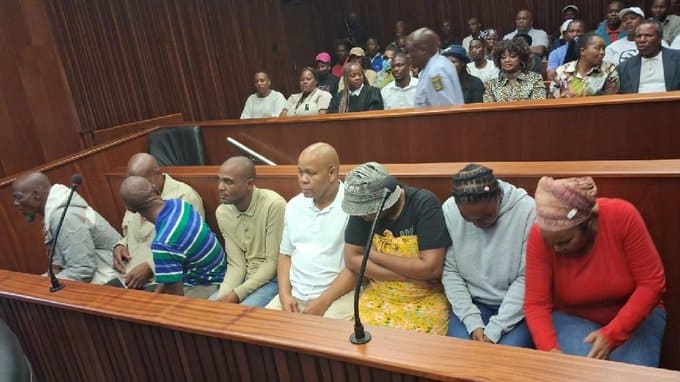
The heavy wooden doors of the Polokwane Magistrate’s Court swung open on Wednesday morning to admit a procession that has become grimly familiar to court officials: eight accused persons, linked to a shocking insurance-related murder and fraud syndicate, filing into the dock under the watchful eyes of heavily armed police. The bail application, now in its third week, showed no signs of concluding quickly as the state mounted an aggressive case against their release.
The accused—five men and three women—stand charged with multiple counts of murder, fraud, attempted murder, and contravention of the Prevention of Organised Crime Act (POCA). Their alleged crimes have sent shockwaves through communities across Limpopo, where families have been left shattered by deaths they once believed were accidents, illnesses, or tragedies of fate. Now, investigators allege, those deaths were anything but accidental.
Prosecutor Thabo Masethe, leading the state’s case, did not mince words as he addressed the court. “This is not a case of opportunistic crime,” he said, his voice echoing off the high ceilings. “This is a sophisticated, premeditated, and deeply cynical enterprise. Human lives were reduced to insurance payouts. And we will prove that beyond a reasonable doubt.”
Inside the courtroom, the atmosphere was tense. The public gallery, packed with relatives of both the accused and the alleged victims, watched in near silence. A woman in the third row clutched a faded photograph of her sister, who died under mysterious circumstances two years ago. She did not take her eyes off the dock.
The Syndicate’s Alleged Method: A Chilling Pattern
According to the indictment, the eight accused operated across multiple districts in Limpopo, targeting vulnerable individuals—often relatives, acquaintances, or neighbors—for life insurance policies that the syndicate would secretly take out. The accused would pose as concerned family members or good Samaritans, helping victims sign up for funeral coverage or savings plans. In reality, investigators allege, the policies named syndicate members as beneficiaries.
Once the policies were in place, the state claims, the murders began.
The methods varied. Some victims were poisoned, their deaths initially attributed to food poisoning or natural causes. Others died in staged vehicle accidents or house fires. In at least two cases, victims were pushed or thrown from moving vehicles, with the deaths recorded as pedestrian accidents. One victim, a 54-year-old woman from a village outside Tzaneen, was allegedly given a fatal dose of insulin—despite not being diabetic—and her death was ruled as organ failure until a second autopsy revealed the truth.
“These people did not just kill. They waited,” said Captain Riaan Phooko, the lead investigator, speaking outside the court. “They would take out policies, then wait months—sometimes over a year—before acting. They wanted the deaths to look natural. They wanted no questions asked. And for a long time, that worked.”
The syndicate is believed to have been active for at least five years, with investigators linking them to twelve confirmed murders and six attempted murders. The total value of insurance payouts fraudulently obtained is estimated to exceed R8 million, though the state believes the true figure may be higher.
The State’s Case Against Bail
As the bail hearing resumed on Wednesday, the state called its third witness—a forensic auditor who traced the financial trail linking the accused to multiple insurance claims. The auditor, Ms. Lerato Modise, presented a detailed analysis of bank records, policy documents, and claim forms.
“What we found was a pattern,” Modise testified. “In each case, a policy was taken out on the victim within three to six months before their death. The beneficiary was always one of the accused or a close associate. The claims were filed within days of the death. And the payouts were then split among the group using a complex web of cash withdrawals and third-party transfers.”
Defense lawyers for the eight accused have argued that the financial evidence is circumstantial and that their clients are being persecuted based on association rather than proof. During cross-examination, defense counsel Advocate Dumisani Ngwenya challenged Modise’s conclusions.
“You cannot prove that my client knew the policy existed, can you?” Ngwenya asked.
“It is unlikely that a beneficiary would not know they were named as a beneficiary,” Modise replied.
“But ‘unlikely’ is not proof, is it? The standard is beyond a reasonable doubt, not beyond a reasonable hunch.”
The exchange highlighted the central challenge of the state’s case: while the financial and forensic evidence is compelling, proving direct knowledge and intent for each of the eight accused will require witness testimony—including from alleged co-conspirators who have turned state witness.
The Accused: A Cross-Section of a Community
The eight accused come from varied backgrounds, but all lived within a 100-kilometer radius of Polokwane. They include a former insurance broker, a traditional healer, two taxi drivers, a nurse’s aide, a small-scale farmer, and two unemployed individuals.
The alleged ringleader, 47-year-old Johannes “Jojo” Molepo, is a former insurance salesman who used his knowledge of the industry’s loopholes to design the scheme, according to the state. Molepo has denied all charges and has applied for bail, arguing that he is not a flight risk and has deep roots in the community.
But the state has painted a different picture. “The accused have access to substantial hidden assets,” Masethe told the court. “They have demonstrated a willingness to kill for money. They have family and associates across the border in Zimbabwe and Mozambique. The risk of flight is not theoretical—it is acute.”
Also in the dock is 34-year-old Maureen Sithole, the only accused who has reportedly shown remorse. According to court documents, Sithole has provided investigators with a statement implicating several of her co-accused in exchange for a possible plea deal. Her bail application is being considered separately, with the state indicating it may not oppose her release under strict conditions.
The remaining six accused have maintained their innocence, with their lawyers arguing that they are being swept up in a case driven by public outrage rather than evidence.
The Human Toll: Families Left in Limbo
Outside the courthouse, a small group of victims’ families gathered, holding handwritten signs with names and dates. Among them was Maria Hlongwane, whose brother Solomon died in July 2023. His death was initially recorded as a heart attack. He was 49.
“My brother was healthy,” Hlongwane said, her voice trembling. “He worked on a farm. He walked five kilometers every day. He had no heart problems. But the first doctor said heart attack, and that was that. If it wasn’t for the police reopening the case, we would have buried him and never known.”
Solomon Hlongwane’s body was exhumed in January 2024. A second autopsy revealed traces of a rodenticide—rat poison—in his system. He is now one of the twelve confirmed victims linked to the syndicate.
“These people came to his funeral,” Hlongwane continued. “They sat in the back. They cried. They hugged us. And all the time, they had already collected his insurance money. That is not evil. Evil is too small a word.”
Another family member, who asked not to be named for fear of retaliation, described the agony of the prolonged legal process. “Every time we come to court, we hope for closure. And every time, it is postponed, or the lawyers argue, or someone is sick. Meanwhile, the accused sleep in beds. They get three meals. My mother cannot sleep at all. She sees my father’s face every night.”
The Community’s Reaction: Fear and Fury
In the villages and townships across Limpopo where the alleged crimes occurred, the case has ignited a mixture of fury and fear. Fury at the accused. Fear that other syndicates may be operating undetected.
“We trusted each other,” said Thabo Mashile, a community leader from a village outside Tzaneen where two victims lived. “That is the worst part. These were neighbors. People we greeted every morning. People who came to our funerals. And they were watching us, calculating, waiting. How do you go back to normal after that?”
Local police have increased patrols in affected areas and have urged residents to verify any unsolicited offers of insurance or financial assistance. The South African Insurance Association (SAIA) has also issued a warning, advising policyholders to check their beneficiary designations regularly and to report any suspicious changes.
“The industry has been shocked by the brutality of this case,” said SAIA spokesperson Lelani de Kock. “We are working closely with law enforcement to close the loopholes that allowed this syndicate to operate. No system is perfect, but we will not rest until these kinds of schemes are impossible.”
The Legal Battle Ahead
Magistrate Peter Mogano has indicated that a ruling on the bail applications is unlikely before the end of the month, given the volume of evidence and the number of accused. Each of the eight is being considered separately, though the state has asked the court to treat them as a single bloc for the purpose of opposing bail.
If bail is denied, the accused will remain in custody at the Polokwane Correctional Centre pending trial, which is not expected to begin until early next year. If granted, they will be released under strict conditions, likely including electronic monitoring, daily reporting to police, and surrender of travel documents.
The defense has argued that lengthy pre-trial detention would violate their clients’ constitutional rights. “My client is presumed innocent until proven guilty,” said Advocate Ngwenya outside the court. “He has been in custody for six months already. That is a punishment before trial. That is not justice.”
But the state remains unmoved. “In cases of this gravity—multiple murders, a sophisticated syndicate, overwhelming public interest—the presumption of innocence does not automatically entitle an accused to bail,” Masethe countered. “The court must balance the rights of the accused against the risk to society. Here, the risk is simply too high.”
A Community Holds Its Breath
As the court adjourned shortly after 3 p.m., the eight accused were led back to the holding cells below the courthouse. Some walked with their heads high, others with faces buried in their hands. One of the women glanced briefly at the public gallery, scanning faces until her eyes met those of a victim’s relative. Neither spoke. Neither looked away.
Outside, the afternoon sun beat down on the courthouse steps. Families gathered in small clusters, sharing cold drinks and warmer suspicions. The case has become the talk of Polokwane—at taxi ranks, at church gatherings, at shebeens and spaza shops.
“Everyone knows someone who knows someone,” said one elderly man, shaking his head. “We thought insurance was for peace of mind. Now we see it can be a death sentence. God help us all.”
The bail hearing will resume next week. The state is expected to call two more witnesses before closing its case against the accused’s release. After that, the defense will present its arguments. And then, finally, Magistrate Mogano will rule.
For the families of the twelve dead, the waiting continues. For the eight in the dock, the fight for freedom continues. And for Limpopo, the process of healing—of understanding how neighbors became killers and policies became death warrants—has only just begun.
About The Author