For two decades, it has been a ghost that haunted every corner of the Emirates Stadium. The ghost of Highbury. The ghost of invincibles past. The ghost of that rainy night in Paris in 2006 when Jens Lehmann was sent off, when Sol Campbell scored a disallowed goal, when Ronaldinho danced, and when Arsenal’s greatest European dream slipped through their fingers like water. For twenty years, Arsenal have wandered the wilderness of the Champions League—quarterfinal exits, round-of-16 heartbreaks, years of not even qualifying at all. On Tuesday night, that wilderness ended.
Bukayo Saka, the boy from Ealing who bleeds red and white, scored a 45th-minute goal that will be replayed in North London for generations, sending Arsenal to the Champions League final for the first time since that painful night in Paris. The 1-0 victory over Diego Simeone’s notoriously obdurate Atletico Madrid was not beautiful. It was not free-flowing. It was not the “cavalry charge” football that Arsène Wenger once promised. But it was effective. It was resilient. And it was enough.
Arsenal will now face the winner of Wednesday’s other semi-final between Bayern Munich and Paris Saint-Germain at Budapest’s Puskás Aréna on May 30. And if Saka gets his wish, he will face a familiar face: Harry Kane.
The Match: A First-Half Burst, A Second-Half Siege
The tie was delicately poised after the first leg in Madrid, which ended in a tense 0-0 draw. Atletico arrived at the Emirates with their trademark dark arts intact—time-wasting from the first whistle, tactical fouls, and a low block designed to absorb pressure and frustrate. For the opening half-hour, it worked. Arsenal dominated possession but could not find a way through.
Leandro Trossard, preferred on the left wing, was Arsenal’s most lively attacker, drifting inside and linking with Martin Ødegaard. But every time the ball found its way into the box, a red-and-white-striped shirt was there to block. Jan Oblak, the Slovenian goalkeeper who has been tormenting English clubs for a decade, looked untroubled.
Then, on the stroke of halftime, the moment arrived.
Trossard picked up the ball on the left edge of the box, cut inside onto his right foot, and unleashed a curling shot that seemed destined for the far corner. Oblak, as he so often does, produced a save of stunning athleticism—diving low to his left, getting a strong hand to the ball. But he could not hold it. The rebound spilled into the six-yard box, where Saka, racing in like a sprinter reacting to the starting gun, arrived ahead of two Atletico defenders. With his weaker right foot, he swept the ball home.
The Emirates erupted. A sound that was part joy, part relief, part twenty years of suppressed longing. Saka slid on his knees toward the corner flag, arms outstretched, a smile so wide it seemed to split his face in two. His teammates buried him. The stadium shook.
“It happened so fast,” Saka told CBS Sports after the match. “Trossard’s shot, the save, the ball just sitting there. I thought, ‘Don’t miss. Please don’t miss.’ I didn’t miss. I don’t really remember what happened next. I just remember the noise. The noise was incredible.”
The Second Half: David Raya Stands Tall
If the first half belonged to Saka, the second half belonged to David Raya. The Spanish goalkeeper, on loan from Brentford and the subject of endless debate among Arsenal fans, produced the performance of his career when his team needed him most.
Atletico, chasing the goal that would level the tie on aggregate and send the match to extra time, poured forward in the second half with an urgency that had been entirely absent in the first. Simeone threw on attacking substitutes: Correa, Depay, and the veteran Ángel Correa. Suddenly, Arsenal’s back line, so comfortable for 45 minutes, was under sustained siege.
Raya’s first major intervention came in the 54th minute, diving low to his right to push away a deflected shot from Antoine Griezmann. In the 67th, he produced an even more spectacular save, leaping to tip a header from substitute Memphis Depay over the bar. And in the 82nd minute, with the entire Arsenal crowd holding its breath, he made the save that secured the final.
Rodrigo De Paul, Atletico’s midfield engine, found space on the edge of the box and unleashed a venomous drive that was heading for the top corner. Raya, already moving to his left, adjusted mid-air and somehow got a hand to the ball, deflecting it onto the crossbar and out for a corner. The Emirates rose as one. It was a save that David Seaman—the Arsenal legend who made a similar stop against Sheffield United in the 2003 FA Cup semi-final—would have been proud of.
“David Raya was unbelievable tonight,” Arsenal manager Mikel Arteta said in his post-match press conference. “People have questioned him. I have never questioned him. Tonight, he showed why he is our goalkeeper.”
The Final Whistle: Tears, Triumph, and Twenty Years
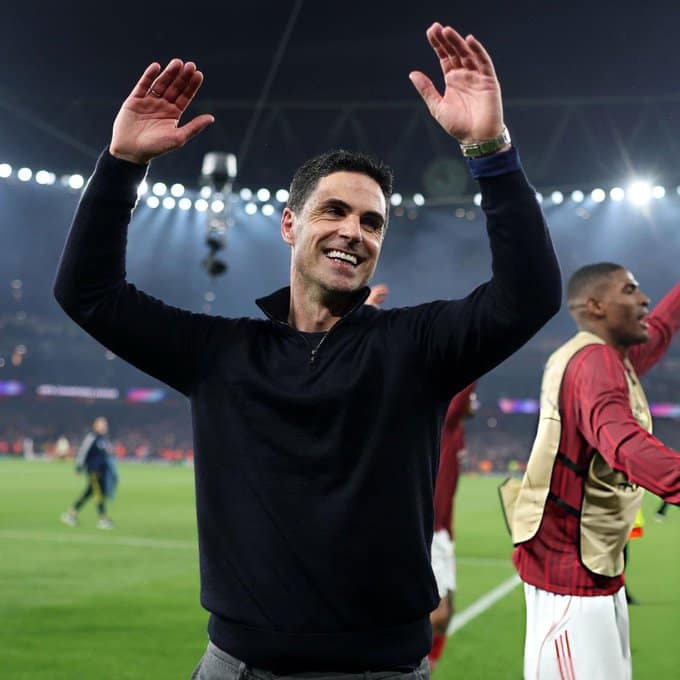
When the final whistle blew—four minutes of added time that felt like four hours—the scenes were chaotic and beautiful. Players lay on the turf, exhausted. Arteta embraced each of his coaching staff. Saka knelt at the center circle, head bowed, as if in prayer. In the stands, grown men wept. Strangers hugged. A banner unfurled in the Clock End: “20 Years. Worth the Wait.”
For a club with Arsenal’s history—13 league titles, 14 FA Cups—the absence from a Champions League final has been a gaping hole. The Invincibles of 2003-04 never even reached the final. The great teams of the late 2000s, led by Cesc Fàbregas and Robin van Persie, fell short. The later Wenger years brought repeated last-16 exits. The Unai Emery era brought a final—of the Europa League, not the Champions League.
Arteta, a member of that 2006 team that lost to Barcelona, knows the weight of the history better than anyone. He was the young left-back who watched Ronaldinho’s magic from the bench. Now, he is the manager who has returned the club to the promised land.
“I am so proud,” Arteta said, his voice cracking slightly. “These players, they have given everything. This club, these fans, they deserve this. But we are not finished. The job is not done. We want to win it.”
Saka’s Wish: Kane or Mbappé?
Inevitably, attention has already turned to the final. Arsenal will face either Bayern Munich or Paris Saint-Germain, who play their second leg on Wednesday night with the tie delicately poised at 1-1 after the first leg in Germany.
When asked after the match which opponent he would prefer, Saka did not hide.
“Bayern,” he said, grinning. “I want Harry Kane.”
The response sent social media into a frenzy. Saka and Kane have been England teammates for years, combining for goals at World Cups and European Championships. But they have never faced each other in a competitive club match of this magnitude. A final in Budapest, with the Champions League trophy on the line, would be the stuff of English footballing legend.
“I think Harry is the best striker in the world,” Saka added. “To play against him in a Champions League final… that would be special. But PSG have Mbappé. So either way, it’s a tough game.”
Kane, who left Tottenham for Bayern Munich last summer in search of silverware, has not responded publicly to Saka’s comments. But those close to the England captain say he is acutely aware of the narrative. He failed to beat Arsenal in 19 attempts as a Tottenham player. Now, in his first season away from North London, he has a chance to deny them the biggest prize in European football.
“Kane vs Saka for the Champions League trophy,” one fan wrote on X. “Scriptwriters, you have outdone yourselves.”
The Road to Budapest
The final will take place on May 30 at the Puskás Aréna in Budapest, a magnificent 67,000-seat stadium that has become a favorite host for UEFA finals in recent years. Arsenal’s traveling support is expected to be enormous, with the club already advising fans to book travel and accommodation even before the opponent is confirmed.
For Saka, the final will be the biggest match of his young career—and that is saying something for a player who has already scored in a European Championship final, a World Cup quarterfinal, and multiple North London Derbies.
“I was six years old the last time Arsenal were in a Champions League final,” Saka said. “I don’t remember it. My dad tells me about it. He tells me how sad everyone was. I want to give him a different memory. I want to give all of them a different memory.”
The Opponent: Bayern or PSG?
As of Wednesday morning, the other semi-final remained too close to call. Bayern, despite their domestic struggles this season, have the Champions League pedigree that few can match. Thomas Müller, Joshua Kimmich, and Kane himself know how to win on the biggest nights. PSG, by contrast, have spent over a billion euros chasing this trophy and have never caught it. Kylian Mbappé, almost certainly in his final season at the Parc des Princes, is desperate to deliver the one prize that has eluded him.
Arsenal’s coaching staff will watch Wednesday’s match closely, taking notes. But Arteta insisted that the focus must first be on recovery and preparation.
“We will watch the game as fans, not as analysts,” he said. “Tonight, we celebrate. Tomorrow, we work. But we cannot control who we face. We can only control ourselves.”
A Club Reborn
For Arsenal, reaching the final is validation of a project that began in earnest when Arteta took over in December 2019. The club was in disarray then: eighth in the league, a bloated squad, a disconnected fanbase. Arteta ripped up the culture, empowered young players, and demanded patience. Four years later, Arsenal have challenged for the Premier League title, returned to the Champions League, and now stand on the brink of European glory.
“People laughed when we said we were building something special,” Saka said. “Nobody is laughing now.”
As the Emirates emptied and the lights dimmed, a group of fans gathered outside the stadium, singing a chant that has not been heard in two decades:
“We’re on our way to Budapest, we’re on our way to Budapest,
Twenty years of hurt, never stopped us dreaming,
Saka took us there, Saka took us there.”
The final awaits. The opponent will be known by Thursday morning. And for the first time since 2006, Arsenal are back where they believe they belong: competing for the biggest prize in the world.
The ghost has been exorcised. The wilderness has been crossed. And Bukayo Saka, the boy from Ealing, has written his name into Arsenal legend.
Budapest, get ready. The Gunners are coming.
About The Author