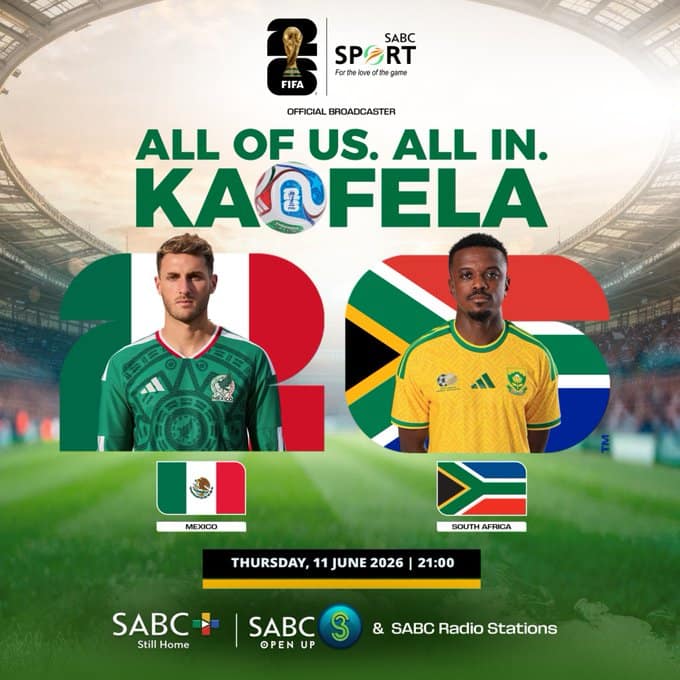
In a move that has sent waves of excitement rippling from the sprawling townships of Soweto to the rural villages of the Eastern Cape, the South African Broadcasting Corporation (SABC) announced on Thursday that it will broadcast 34 matches of the 2026 FIFA World Cup live and free-to-air—including the highly anticipated Bafana Bafana opener against Mexico in Mexico City on June 11. The deal, struck between the public broadcaster and FIFA’s rights distribution partners after months of tense negotiations, ensures that millions of South Africans who cannot afford subscription television will still have a front-row seat to the greatest show on Earth.
The announcement, made at a packed media briefing at SABC’s Auckland Park headquarters, was met with audible relief and jubilation from journalists and soccer fans in attendance. SABC Group CEO Nomsa Chabeli, her voice carrying a mix of pride and urgency, declared it “a victory for democracy, for access, and for the beautiful game.”
“When we say ‘free-to-air,’ we mean it,” Chabeli said, gesturing to a large screen displaying the World Cup fixture list. “No decoders. No monthly subscriptions. No data costs if you are listening on radio. Just a television set, a working aerial, and the pride of a nation cheering for Bafana Bafana. That is what public broadcasting is supposed to do. That is what we have fought to deliver.”
The Deal in Numbers
The agreement, which covers both television and radio platforms, is the largest World Cup rights package the SABC has secured since the 2010 tournament, which South Africa hosted. The 34 matches represent nearly half of the tournament’s 64-game schedule and include:
- All 3 Bafana Bafana group stage matches: South Africa vs. Mexico (June 11), South Africa vs. Czechia (June 17), and South Africa vs. South Korea (June 23).
- 8 group stage matches featuring African representatives (including Senegal, Morocco, Egypt, Nigeria, Cameroon, Ghana, Ivory Coast, and Tunisia).
- All 4 quarter-finals (both weekend fixtures).
- Both semi-finals (July 14 and July 15).
- The third-place play-off (July 18).
- The World Cup Final (July 19) live from the Estadio Azteca in Mexico City.
- A further 12 carefully selected group stage matches featuring top-tier nations such as Brazil, Argentina, France, England, Germany, and defending champions Argentina.
Notably absent from the free-to-air lineup are the Round of 16 (except those featuring African teams, which will be confirmed closer to the tournament) and the majority of early group stage matches that do not involve African or particularly high-profile teams. The SABC has confirmed, however, that SABC Sport’s digital platforms will provide daily highlights, analysis, and goal clips for all matches not aired live.
“We had to make strategic choices,” explained SABC Head of Sport, Leonard Makhanya. “We wanted to maximize the number of South Africans who could watch the knockout stages—when the tournament truly comes alive—while ensuring that every single Bafana Bafana match is available to every single South African with a television. We believe this balance serves the nation best.”
A Rocky Road to the Airwaves
The path to Thursday’s announcement was anything but smooth. For months, soccer fans had feared that World Cup matches would be locked behind a paywall, accessible only to DStv subscribers or those willing to pay for streaming services. In early 2025, FIFA had signaled its intent to maximize revenue from international broadcasting rights, and initial offers to the SABC had been described by insiders as “prohibitively expensive” for a cash-strapped public broadcaster.
Negotiations stalled in November 2025, with the SABC publicly stating that it would “not be held hostage” by rights holders. The impasse prompted an intervention from the Department of Sport, Arts and Culture, with Minister Gayton McKenzie personally lobbying FIFA’s regional office in Johannesburg. A breakthrough came in February 2026, when FIFA agreed to a tiered pricing model, allowing the SABC to purchase a partial package of 34 matches at a fraction of the full tournament cost.
“We never gave up,” Minister McKenzie said in a recorded video message played at Thursday’s briefing. “I told FIFA: ‘You cannot come to Africa, you cannot use our Bafana Bafana players in your marketing, and then tell South African families they must pay R799 a month to watch their own team. That is not right. That is not fair. Find a way.’ And they did. Credit where it is due—they listened.”
While neither party has disclosed the financial terms, sources close to the negotiations suggest the SABC paid approximately 4.5million(roughlyR85million)forthe34−matchpackage—asignificantsumforthestrugglingpublicbroadcasterbutfarlessthanthe15 million initially quoted for the full tournament. The SABC has funded the purchase through a combination of sponsorship revenue, a government guarantee, and internal cost-cutting measures across non-essential departments.
Bafana Bafana: The Extra Burden and the Extra Joy
For Bafana Bafana coach Hugo Broos and his squad, the SABC announcement adds an extra layer of pressure—and an extra reservoir of support. South Africa’s return to the World Cup after a 14-year absence (their last appearance was in 2010 as hosts) has already generated immense national expectation. Now, knowing that every match will be watched by millions of free-to-air viewers, the team’s every pass, tackle, and goal will be magnified like never before.
“Playing without the nation watching is one thing,” Broos said in a brief interview from the team’s training camp in Spain. “Playing when you know that grandmothers in QwaQwa and children in Khayelitsha are watching you live, for free, on their televisions… that is different. That is a responsibility. But it is also a gift. When the whole country is behind you, you run faster, you fight harder. We will not let them down.”
The SABC has also committed to extensive pre-match and post-match programming for all Bafana matches, including a one-hour studio show with analysts, retired players, and fan segments broadcast live from Soweto’s Vilakazi Street. The public broadcaster is also partnering with community radio stations across all nine provinces to provide match commentary in indigenous languages, including isiZulu, isiXhosa, Sesotho, Setswana, and Afrikaans.
“No South African should ever have to ask, ‘Where can I watch the game?'” said SABC Chief Operating Officer Ian Plaatjes. “Whether you are in a shack in Imizamo Yethu, a hostel in Mpumalanga, or a retirement flat in Gqeberha, if you have an SABC channel, you have the World Cup. That is our promise.”
The Radio Factor: The Unsung Hero
While television understandably grabs the headlines, the SABC’s radio network will play an equally vital role—especially in rural areas where television penetration remains lower or where electricity supply is unreliable. The public broadcaster’s 18 regional and community radio stations, broadcasting in 11 languages, will provide live ball-by-ball commentary of all 34 televised matches, as well as selected additional matches.
For millions of South Africans, radio remains the primary—and sometimes only—way to follow live sport. During the 2022 FIFA World Cup in Qatar, SABC radio audiences peaked at 7.4 million listeners for the final match. Expectations for 2026 are even higher, given the time zone advantage (Mexico is only seven hours behind South Africa, meaning many matches will air in the early evening South African time) and the emotional draw of Bafana’s participation.
“I grew up listening to SuperSport on the radio because we did not have a TV,” said 67-year-old retired teacher Johannes Radebe, speaking outside his home in Tembisa. “My father would sit by the wireless, turning the dial to find the clearest signal. Now, I have a television. But for the World Cup? I will still listen on the radio sometimes. There is a magic to it. The voice of the commentator, the crowd noise, your own imagination. The SABC understands that. They keep that magic alive.”
Sponsors and Commercial Opportunities
The SABC’s World Cup broadcast is expected to be a commercial bonanza for the struggling public broadcaster, which has faced perennial financial difficulties, including periodic struggles to pay staff salaries. Advertising slots during the 34 matches have been aggressively marketed, with rates reportedly ranging from R250,000 for a 30-second spot during a group stage match (non-Bafana) to R1.2 million for a 30-second spot during the final.
Major advertisers have already signed on, including MTN, Castle Lager, KFC, Shoprite, and Hyundai. Several of these brands have also committed to sponsoring viewer-centric competitions, including the “Mzansi’s 12th Man” campaign, which will see one lucky viewer flown to Mexico City for the Bafana vs. South Korea match.
“We expect to generate over R150 million in advertising revenue from the 34 matches,” Chabeli confirmed. “That money will be reinvested into local content, infrastructure, and—importantly—securing future sports rights. The World Cup is not just a sporting event for us. It is an economic engine. It helps keep the SABC alive for the other 340 days of the year when there is no World Cup.”
Critics and Concerns
Not everyone, however, is celebrating. MultiChoice, the parent company of SuperSport, has expressed disappointment that the SABC’s free-to-air package includes matches that SuperSport had hoped would drive subscriptions. In a carefully worded statement, MultiChoice said it “respects the public broadcaster’s mandate” but warned that the fragmentation of sports broadcasting rights could lead to “confusion for consumers and reduced investment in local sports production.”
Other critics have pointed out that the SABC’s 34-match package, while generous, still leaves 30 matches exclusively available on pay-TV or streaming services. For the approximately 40% of South African households without a DStv or streaming subscription, those matches—which include potentially exciting Round of 16 fixtures and some group stage matches involving top European teams—will remain inaccessible.
“The word ‘free’ is doing a lot of heavy lifting here,” said media analyst Thabo Mokoena. “Yes, 34 matches are free. That is better than zero. But it is not the full World Cup. If Bafana somehow reach the Round of 16, that match is not guaranteed to be in the free package—only if it is against a specific set of opponents or if FIFA reclassifies it. That ambiguity is a problem. Fans deserve clarity.”
The SABC has responded that it will “review the situation” if South Africa advances beyond the group stage, though no binding commitment has been made. In a worst-case scenario—should Bafana reach the Round of 16 and FIFA refuse to reclassify that match as a “premium African interest” fixture—the match could air exclusively on pay-TV, leaving free-to-air viewers to listen on radio only.
The Viewing Experience
For those who will watch on television, the SABC has promised a production quality on par with international standards. The public broadcaster has partnered with Host Broadcast Services (HBS), the FIFA-appointed production company, to receive a clean world feed of all 34 matches. In addition, the SABC will deploy its own studio team—anchored by veteran sportscaster Robert Marawa—to Mexico City for live pre-match, halftime, and post-match analysis.
“This is not your grandfather’s SABC,” said Marawa, who was present at Thursday’s briefing. “We are sending a full crew. We have graphics, we have augmented reality, we have pitch-side reporters, we have drone shots of the stadiums. We are treating this like the major event it is. South Africans deserve nothing less.”
The SABC has also committed to providing audio description for visually impaired viewers during Bafana’s three group stage matches, a first for South African sports broadcasting. A narrator will describe the on-field action between commentary phrases, allowing blind and partially sighted viewers to follow the flow of the game.
“Soccer is for everyone,” Chabeli said. “That is not a slogan. That is a design principle. If someone cannot see the ball, we will help them hear it. If someone cannot afford a decoder, we will put it on free-to-air. That is what public service means.”
A Nation Prepares
As the June 11 kickoff approaches, the SABC’s announcement has added to the growing sense of World Cup fever gripping the nation. Bafana Bafana merchandise is flying off shelves, travel agencies report a surge in bookings to Mexico (despite the high cost), and schools are already planning World Cup viewing schedules, with many intending to let students watch the Bafana matches during school hours.
In the dusty streets of Diepsloot, children have begun painting old soccer balls in the colors of the South African flag. In taverns in Mamelodi, owners are investing in larger televisions in anticipation of packed crowds. In retirement homes in the Cape Winelands, residents are forming World Cup brackets, pooling small change for a winner-takes-all prize.
“The World Cup is the only time my whole family gathers together,” said Naledi Dlamini, a 24-year-old waitress in Soweto. “My uncles come from the Eastern Cape. My cousins come from Durban. We bring chairs, we cook meat, we shout at the TV. And now, thanks to the SABC, we do not have to crowd into a neighbour’s house or go to a bar. We can watch in our own living room. That matters. That is dignity.”
The Final Whistle
As the press briefing drew to a close, SABC CEO Chabeli made a final, unscripted remark that drew spontaneous applause. “You know,” she said, her voice softening, “when I was a young girl in the Eastern Cape, we did not have a television. I listened to the 1995 Rugby World Cup on a crackling radio with my grandmother. She did not understand the rules. But she understood the joy. She understood that when South Africa won, we all won.
“Now, I am in a position to make sure that no grandmother—no child—has to miss a single moment of Bafana Bafana’s journey because of money. That is not just a broadcast. That is a promise. And promises, unlike soccer matches, do not have a final whistle. They last forever.”
Outside the SABC building, a small crowd of fans had gathered, waving flags and singing an impromptu version of “Shosholoza.” They were not there to protest. They were there to celebrate. Because on June 11, when the referee’s whistle blows in Mexico City, millions of South Africans—rich and poor, urban and rural, young and old—will be watching. For free. Together. As one nation.
The beautiful game, indeed.
About The Author