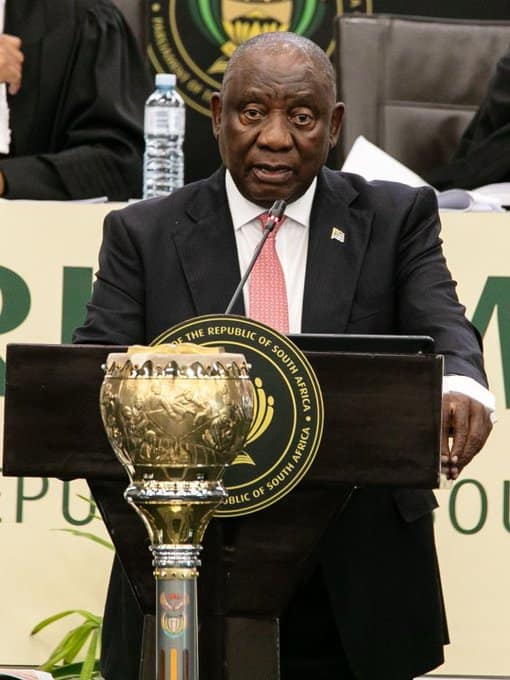
The old chamber of the National Assembly, with its high vaulted ceilings and the weight of a quarter-century of democracy pressing down from the public galleries, has seen its share of political theater. But on this particular Thursday afternoon, the atmosphere was different. There was no motion of no confidence. No impeachment proceedings. No scandal erupting in real time. Instead, President Cyril Ramaphosa stood alone at the dispatch box for a routine question-and-answer session—the kind of parliamentary ritual that, in a well-functioning democracy, should be unremarkable.
And yet, nothing about this presidency has been unremarkable.
For nearly two hours, Ramaphosa fielded questions from Members of Parliament across the political spectrum, updating the nation on key government programmes and responding to concerns that affect the daily lives of millions of South Africans. The questions ranged from the granular—pothole repairs in rural municipalities—to the existential: the future of the Government of National Unity (GNU) and the president’s own political longevity.
By the time the final bell rang and the Speaker’s gavel fell, Ramaphosa had covered electricity, logistics, crime, jobs, land reform, and the cost of a loaf of bread. But beneath the policy answers, a deeper narrative was playing out—one about a president who has survived multiple political near-death experiences, now trying to govern a fractious coalition while keeping his eye on the horizon.
The Setting: A Chamber Transformed
The National Assembly has changed since Ramaphosa first took the oath of office in 2018. The benches are less crowded now—the ANC lost its outright majority in the 2024 elections, forcing the party into a GNU that includes the Democratic Alliance (DA), the Inkatha Freedom Party (IFP), the Patriotic Alliance (PA), and several smaller parties. The front benches are a patchwork of different party colors, a visual reminder that the era of one-party dominance is over.
Ramaphosa seemed to acknowledge this new reality as he began his opening remarks. “This House represents the will of the South African people as expressed freely at the ballot box,” he said. “It is diverse. It is vigorous. And sometimes, it is difficult. But that is not a weakness. That is the strength of our democracy.”
The President’s tone was measured, almost pedagogical. He spoke without notes for the first ten minutes, recounting progress on the Energy Action Plan (now entering its third year), the Operation Vulindlela reforms, and the revitalization of Transnet. For those who have followed his presidency closely, the themes were familiar: fix the basics, build confidence, attract investment, create jobs.
But familiarity does not equal delivery. And the opposition MPs were quick to remind him of that.
The First Salvo: Load-Shedding and Eskom
The first question came from DA MP Ghaleb Cachalia, who asked about the recent resurgence of load-shedding after a five-month respite. “Mr. President, you promised us that Stage 6 load-shedding was a thing of the past. Yet last week, we returned to rolling blackouts. How many more promises must South Africans endure before they see reliable electricity?”
Ramaphosa’s answer was careful. He acknowledged the setback but pointed to structural improvements. “We have not had load-shedding above Stage 2 in over two months,” he said. “That is not a celebration. That is progress. But the reality is that Eskom’s fleet remains old, unreliable, and under-maintained after years of neglect. The turnaround will not be linear. There will be bumps.”
He then pivoted to the positive: the rapid expansion of rooftop solar (now exceeding 4,500 megawatts of private generation), the easing of licensing requirements for embedded generation, and the completion of two new transmission projects in the Eastern Cape. “We are building a new energy system while still running the old one. That is the hardest thing to do. But we are doing it.”
The answer satisfied some, but not all. EFF MP Omphile Maotwe rose next, accusing the President of “privatizing Eskom by stealth” through the unbundling of transmission and the encouragement of private generation. “You are dismantling the only tool we have for energy sovereignty,” Maotwe charged. “When will you admit that your solution is to sell the lights to the highest bidder?”
Ramaphosa shook his head. “That is simply not true,” he replied. “Eskom will remain state-owned. The unbundling is about efficiency, not ownership. We have learned from other countries—Germany, Brazil, even China—that a single monolithic utility is not the only model. We are adapting. We are not selling.”
The Economy: Jobs, Growth, and the Cost of Living
As the session moved into its second hour, the questions turned to the economy. South Africa’s unemployment rate remains stubbornly above 32%, with youth unemployment exceeding 45%. The cost of living has risen sharply, with food inflation and fuel prices squeezing households across the income spectrum.
IFP MP Mkhuleko Hlengwa asked what concrete steps the government was taking to create jobs, specifically in rural areas where economic activity has stagnated. “We cannot all move to Gauteng,” Hlengwa said. “People want to work where they live. What is the plan?”
Ramaphosa cited the Presidential Employment Stimulus, which he said had created or supported over 1.5 million work opportunities since 2020. “These are not permanent jobs, but they are wages in pockets,” he said. “They have kept families fed and children in school. The next phase will focus on skills training and placement in growing sectors—renewables, digital services, logistics.”
He also highlighted the new Special Economic Zone (SEZ) in the Eastern Cape and the expansion of the Namaqua SEZ in the Northern Cape. “We are targeting investment in areas that have been left behind,” he said. “But government cannot do this alone. We need private sector partners. We need communities to welcome investment. We need all of us to row in the same direction.”
Patriotic Alliance MP Marais Steyn pushed back, asking why the President continued to “blame the private sector” for not investing while failing to address crime and corruption. “Businessmen are not philanthropists,” Steyn said. “They will not invest where their trucks are hijacked, their warehouses are looted, and their invoices are never paid. What are you doing to fix the security situation?”
Ramaphosa’s answer was uncharacteristically blunt. “I agree,” he said. “Crime is a tax on the poor and a barrier to investment. That is why we have deployed 3,000 new police recruits to high-crime districts. That is why we are digitizing the National Prosecuting Authority. That is why we have established a specialized court for corruption cases. These things take time. But they are happening.”
The GNU Under Pressure
Behind the policy questions, a more delicate dance was unfolding. The Government of National Unity, which brought the ANC and DA together in an uneasy marriage of convenience, has been showing signs of strain. The DA has publicly clashed with the ANC over the National Health Insurance (NHI) Act, the Basic Education Laws Amendment (BELA) Act, and the proposed Expropriation Bill. Some DA leaders have openly questioned how long the GNU can survive.
When asked directly whether the GNU would last until the next election, Ramaphosa offered a diplomatic but telling response.
“The GNU was not formed out of affection. It was formed out of necessity,” he said. “The voters did not give any party a majority. That means we must work together. And despite our differences—which are real and important—we have found common ground on the urgent priorities: energy, logistics, crime, and jobs. As long as that common ground holds, the GNU will hold.”
He did not mention the NHI or the Expropriation Bill. Observers noted the omission.
DA leader John Steenhuisen, sitting in the front bench, was seen whispering to a colleague during the President’s answer. Later, outside the chamber, Steenhuisen told reporters: “The GNU is not a suicide pact. We will stay as long as it serves the national interest. But we will not be anyone’s doormat.”
Personal Politics: The President’s Future
Inevitably, the question came. Not from an opposition MP, but from a journalist—or rather, a dozen journalists—shouting questions as Ramaphosa walked through the parliamentary corridor after the session. “Mr. President, will you stand for a second full term in 2029?” “Is your health okay?” “Have you started planning your succession?”
Ramaphosa stopped, turned, and offered a smile that was equal parts amusement and exhaustion. “I am 72 years old,” he said. “I wake up every morning and I run. I eat well. My doctors say I am in good shape. But the future of this country is bigger than any one person. My job is to focus on today, on this term, on the reforms we are putting in place. The rest will take care of itself.”
It was not a yes. It was not a no. It was a graceful sidestep.
But those who follow the president closely noted something else: he did not rule it out.
The Human Moments
Amid the policy and the politics, there were smaller moments that reminded everyone in the chamber of the human stakes. Ramaphosa paused during one answer to acknowledge a question from an MP representing a rural constituency in KwaZulu-Natal where a bridge had collapsed, cutting off three villages. “I have seen the pictures,” the president said, his voice softening. “Children crossing a river on a fallen tree. That is not acceptable in 2026. I have instructed the Department of Transport to prioritize that bridge. It will be built.”
Later, when asked about the rising cost of bread, Ramaphosa cited his own recent visit to a bakery in Soweto. “The owner told me that the price of flour has doubled in two years,” he said. “He is not greedy. He is struggling. We need to look at the whole value chain—from the farmer to the miller to the baker to the shelf. That is work that is underway.”
These moments of empathy, however brief, are part of Ramaphosa’s political arsenal. He is not a firebrand. He does not do outrage well. But he can do decency. And in a political environment saturated with cynicism, decency still has its uses.
The Opposition’s Verdict
After the session, opposition parties offered their assessments, predictably split along ideological lines. The DA called the president’s answers “technically correct but politically insufficient.” The EFF said he was “a manager of decline, not a leader of transformation.” The ATM accused him of “evading accountability on Phala Phala.” The smaller parties—GOOD, ACDP, UDM—offered mixed reviews.
But even the critics conceded one point: Ramaphosa had answered the questions. He had not walked out. He had not resorted to insults or evasion. He had stood at the dispatch box for two hours and taken the heat.
“That is the bare minimum,” said EFF MP Naledi Chirwa. “But it is more than some of his predecessors ever did. So I suppose that is progress. Sad progress. But progress.”
The Road Ahead
As the session ended and the chamber emptied, Ramaphosa lingered for a few moments, chatting quietly with ANC Chief Whip Mdumiseni Ntuli and a few senior advisors. The next challenge was already on the horizon: a cabinet lekgotla next week to review GNU performance, followed by a state visit to China, followed by the mid-term budget. The presidency never rests.
Outside Parliament, the Cape Town wind was fierce, rattling the flags atop the Union Buildings’ sister complex. A small group of protesters had gathered at the main gate, holding signs about unemployment and housing. A police van idled nearby. Life, in all its messy complexity, continued.
Ramaphosa’s motorcade departed at 4:47 p.m., gliding through the gates and disappearing into the afternoon traffic. The president was heading back to the Union Buildings, back to the next meeting, back to the endless grind of governing a nation of 62 million people with limitless needs and finite resources.
About The Author