The countdown has begun. Across the nation, from the packed taverns of Soweto to the quiet living rooms of Gqeberha, from university residences in Makhanda to mining hostels in Rustenburg, a single question hangs in the air: Who will make the cut?
On Wednesday, May 27, that question will finally be answered. South African Football Association (SAFA) president Danny Jordaan confirmed on Tuesday that the final Bafana Bafana squad for the upcoming FIFA World Cup will be unveiled on that date, setting the stage for a tournament that has captured the imagination of a football-mad nation.
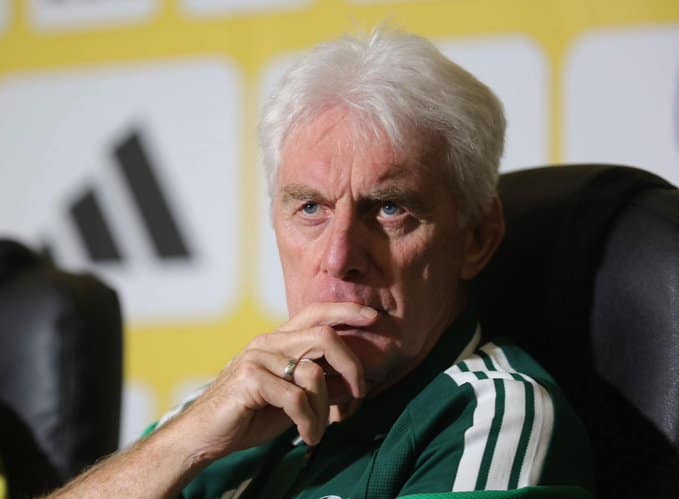
The squad, which will include between 23 and 26 players in line with FIFA’s updated regulations, must be submitted to world football’s governing body by the June 1 deadline. Head coach Hugo Broos, the pragmatic Belgian who has orchestrated a remarkable renaissance in South African football, has already submitted a provisional list earlier this month. But the final selection—the names that will actually board the plane, check into the team hotel, and walk onto the pitch at the Azteca Stadium in Mexico City—remains a closely guarded secret.
“We know the nation is eager,” Jordaan said at a press conference in Johannesburg, flanked by Broos and team captain Ronwen Williams. “We know every fan has an opinion. That is the beauty of football. But Coach Broos and his technical team have been meticulous. They have left no stone unturned. On May 27, the nation will see the results of that work.”
The announcement, timed precisely 15 days before Bafana’s opening group match against Mexico at the iconic Azteca Stadium on June 11, is intended to give the selected players ample time to prepare mentally and physically. But it also serves another purpose: to build momentum, to galvanize a nation, and to transform a squad announcement into a national event.
“May 27 will be a day of celebration and, yes, some heartbreak,” Broos said, his thick Flemish accent softening the bluntness of his words. “Twenty-three to twenty-six players will be heroes. Others—very good players, players who gave everything—will be left behind. That is the hardest part of this job. But we must choose the best. Not the most popular. The best.”
The Road to Mexico: A Renaissance Under Broos
To understand why this World Cup squad announcement carries such weight, one must rewind four years. When Hugo Broos took over Bafana Bafana in 2021, the national team was in disarray. Years of underperformance, coaching changes, administrative turmoil, and fan apathy had left South African football at its lowest ebb since the dark days of apartheid-era isolation. The team had failed to qualify for the 2018 World Cup in Russia. The 2022 World Cup in Qatar was also a distant dream. Fans had stopped filling stadiums. The famous green and gold jersey had become a relic, worn more out of nostalgia than hope.
Broos changed that. Slowly, methodically, without fanfare, he rebuilt. He jettisoned aging stars who had underperformed for years, infuriating some fans and pundits. He brought in young, hungry players from the domestic league—names few outside South Africa had heard of. He instilled tactical discipline, defensive organization, and a counter-attacking style that frustrated more fancied opponents.
The results spoke for themselves. Back-to-back Africa Cup of Nations (AFCON) semifinal appearances—first in Ivory Coast in 2023, then in Morocco in 2025—announced Bafana’s return to continental relevance. The team became difficult to beat, even when they weren’t always beautiful to watch. And then came the World Cup qualifying campaign: a tense, dramatic, nail-biting journey that ended with a 2-1 victory over Ghana in the final group match at the FNB Stadium, sending the nation into delirium.
“We have earned our place at this World Cup,” Broos said simply. “No one gave it to us. No one gifted it. We fought for it. Now we must show the world that South Africa is back.”
The Final Squad: Speculation and Debate
With the announcement now just days away, speculation has reached a fever pitch. Sports talk radio shows are flooded with callers arguing for their favorite players. Social media is awash with fan-made squad lists, tactical diagrams, and heated debates. Newspapers have dedicated daily features profiling the contenders and the “bubble players” who could go either way.
At the center of the speculation is captain and goalkeeper Ronwen Williams. The Mamelodi Sundowns shot-stopper has been a colossus for both club and country, producing save after save in crucial moments. His leadership on and off the pitch has been widely praised. There is no doubt he will be on the plane—and wearing the armband.
“He is the first name on the teamsheet,” Broos acknowledged. “Not just because he is a great goalkeeper—and he is, one of the best in Africa—but because he is a leader. When Ronwen speaks, the team listens. That is rare. That is precious.”
Alongside Williams, midfield star Teboho Mokoena is another certainty. The Sundowns playmaker has grown into one of the most complete midfielders on the continent, capable of dictating tempo, breaking up opposition attacks, and scoring spectacular goals. His left-footed strike against Egypt in the AFCON quarterfinal is already the stuff of legend.
“Mokoena is our engine,” said former Bafana captain and analyst Aaron Mokoena (no relation). “When he plays well, the team plays well. He has the vision, the technique, the physicality. He is world-class.”
But beyond the certitudes lie difficult choices. Broos is expected to name three goalkeepers, eight to nine defenders, eight to nine midfielders, and four to five forwards. With a deep pool of talent now available—thanks in part to the strength of the domestic league and the emergence of South African players in Europe—some deserving players will inevitably be left behind.
The Bubble Players: Who Is On the Edge?
Several names are the subject of intense speculation. Up front, the battle for striking spots is particularly fierce. Evidence Makgopa, the lanky Orlando Pirates forward, has been Broos’s preferred target man, holding up play and bringing others into the attack. But his goal-scoring record for the national team remains modest. Lyle Foster, now plying his trade in Belgium’s Jupiler Pro League, offers pace and movement but has struggled with fitness. And then there is the wildcard: Cassius Mailula, the young Toronto FC forward, whose electrifying form in Major League Soccer has caught Broos’s eye.
“Mailula is a talent,” Broos said cryptically when asked. “But the World Cup is not a development tournament. We need players who are ready now.”
On the wings, veteran captain of the attacking line, Percy Tau, is expected to be included despite a dip in form at his Egyptian club. His experience and big-game temperament are seen as invaluable. But younger challengers—like Monnapule Saleng and Oswin Appollis—are knocking loudly on the door.
In defense, the emergence of 19-year-old sensation Siyabonga Ngezana, now a regular starter for Romanian champions FCSB, has given Broos a headache—the good kind. Ngezana’s pace, composure, and ability to play out from the back offer something different from the more physical, no-nonsense style of veteran Rushine de Reckord.
“These are the decisions that keep me awake,” Broos admitted. “You have two good players. You can only take one. How do you choose? You look at the opponent. You look at form. You look at chemistry. And then you pray you are right.”
‘Bafana Fridays’: A Nation Unites in Green and Gold
Beyond the squad selection, SAFA has launched a nationwide campaign to build support for the team: “Bafana Fridays.” Every Friday between now and the start of the tournament, South Africans are urged to wear green and gold—the colors of the national team—to work, to school, to the shops, to church. The campaign, modeled on similar initiatives in countries like Argentina and Japan, aims to create a visible wave of national pride and to remind the players that they carry the hopes of 62 million people.
“Imagine walking into your office and everyone is wearing green and gold,” Jordaan said. “Imagine driving down the highway and every second car has a flag. Imagine your child’s school assembly, all the children singing ‘Shosholoza.’ That is the energy we want. That is the energy our boys need to feel.”
The campaign has already gained traction. In downtown Johannesburg on Tuesday, a group of office workers posed for a photo outside their building, all wearing Bafana jerseys. In Cape Town, a restaurant chain has announced a special “Green and Gold Burger” for the duration of the tournament. In Durban, a taxi association has pledged to decorate a hundred minibuses with Bafana colors.
“It’s not just about football,” said Thabo Mkhwanazi, a 34-year-old fan wearing a replica jersey outside SAFA House. “It’s about showing the world that South Africa is a country that can come together. We have our problems—everyone knows that. But when Bafana plays, we are one. That is powerful.”
The Group of Death? Mexico, Czechia, and South Korea
The squad announcement, however exciting, is only the beginning. Once the 23 to 26 names are finalized, attention will turn to the group stage—and what a daunting group it is.
Bafana have been drawn in Group C alongside Mexico, Czechia, and South Korea. The opening match against Mexico at the legendary Azteca Stadium—a cauldron of noise, altitude, and history—will be a baptism of fire. Mexico, a World Cup regular, will have the home crowd behind them and the expectation of advancing deep into the tournament.
“The Azteca is a monster,” said former Bafana defender Lucas Radebe, who played at the 1998 and 2002 World Cups. “Eighty thousand people, many of them right on top of you. The altitude. The noise. The heat. It can swallow you if you are not mentally strong. But if you can survive there, you can survive anywhere.”
After Mexico, Bafana face Czechia—a technically gifted European side with a proud footballing history—and South Korea, a fast, organized, and relentless Asian powerhouse. There are no easy games.
“We know the task,” Broos said. “We are not favorites. We are not expected to get out of the group. That is fine. Let others carry that pressure. We will prepare. We will fight. And we will see what happens.”
The Legacy of 1998 and 2002
For older fans, the mere fact of Bafana’s qualification evokes memories of the nation’s only two previous World Cup appearances: France 1998 and Korea/Japan 2002. In 1998, South Africa drew with Saudi Arabia and lost to France and Denmark, exiting in the group stage. In 2002, under coach Jomo Sono, the team came agonizingly close to the knockout round, beating Slovenia but drawing with Paraguay and losing to Spain—finishing third in the group on goal difference.
Those tournaments, while lacking in silverware, were formative moments for South African football. They introduced the world to players like Benni McCarthy, Quinton Fortune, and Lucas Radebe. They gave the nation moments of joy—McCarthy’s goal against Denmark, Fortune’s thunderous strike against Slovenia—that are still replayed today.
This generation has a chance to write its own history. And for many fans, just qualifying feels like a triumph. But the players want more.
“We are not going to Mexico to make up the numbers,” Captain Ronwen Williams said. “We are going to compete. We are going to give everything. And when we come back—whenever that is—we want South Africa to be proud of us. That is the goal.”
The Final Countdown
As May 27 approaches, the tension is palpable. Players who think they are on the bubble are checking their phones obsessively. Agents are making desperate calls to journalists, trying to gauge where their clients stand. Coaches are watching training videos, reviewing data, seeking second opinions.
And the nation waits.
On May 27, the list will be read. Some players will weep with joy. Others will weep with disappointment. Families will celebrate. Dreams will be realized. And then, just like that, the real work will begin.
Because a squad announcement is not a trophy. It is not a victory. It is simply permission to compete. And at the Azteca Stadium on June 11, when the whistle blows and the green and gold take the pitch, the only thing that will matter is what happens between the white lines.
Until then, South Africa wears green and gold on Fridays. And waits.
About The Author