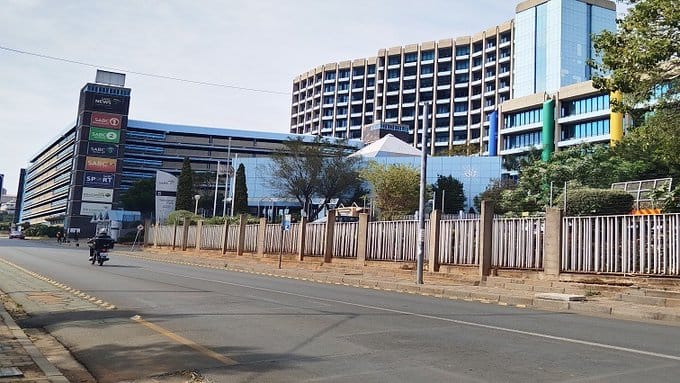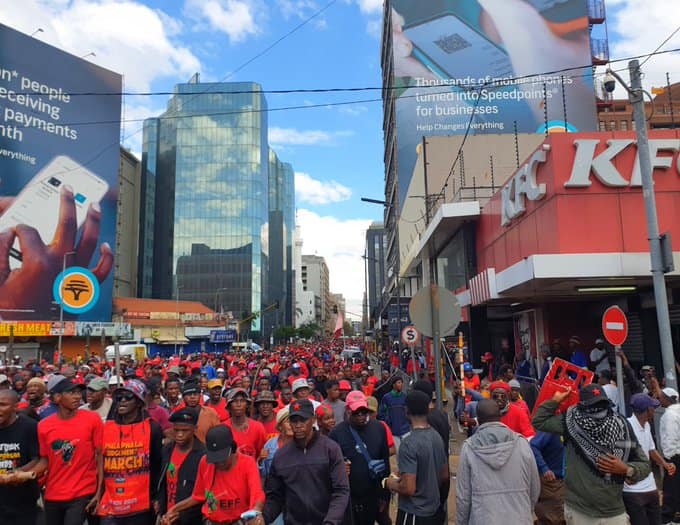
The morning rush hour in the Johannesburg Central Business District is normally a symphony of chaos: taxis honking, vendors shouting, hawkers wheeling their goods, and thousands of commuters pouring out of Park Station like a human river. But yesterday, there was only silence.
The city that never sleeps in Africa’s richest economy came to a virtual standstill as many shops, malls, and offices locked their doors and pulled down their shutters. The cause? A call from some Economic Freedom Fighters (EFF) members for a political shutdown to protest the sentencing of party leader Julius Malema, who was last month handed a five-year prison term for discharging a firearm in a public space — and who was granted leave to appeal and released on bail just days ago.
But the message of protest had already done its damage. By mid-morning, Bree Street — normally a bustling artery of informal trade and commerce — was eerily empty. The iconic Carlton Centre, once Africa’s tallest building, had its main entrances barricaded. The usually frenetic taxi ranks around Gandhi Square were dotted with only a handful of confused travelers. And at the heart of the CBD, the doors of major retail chains, independent boutiques, and street-side stalls remained firmly closed.
“It is like a ghost town,” said Thabo Ndlovu, a security guard stationed outside a shuttered clothing store on Commissioner Street. “I have worked here for seven years. I have never seen it like this. Not during COVID. Not during the riots of 2021. This is different. This is a protest of fear.”
The call that sparked a shutdown
The shutdown call did not come from the EFF’s official leadership. In fact, party deputy president Floyd Shivambu had urged supporters to “remain peaceful and focused” in the days following Malema’s sentencing. But on social media — particularly on X (formerly Twitter) and TikTok — a decentralized network of EFF-affiliated accounts began circulating flyers calling for a “Total Shutdown” of the Johannesburg CBD on Thursday.
“Close your businesses. Stay at home. Show them that the people are angry,” read one flyer, which featured a photograph of Malema raising a fist alongside the hashtag #FreeJulius. “No Malema, No Business.”
The call resonated with a segment of the EFF’s support base, particularly young, unemployed South Africans who see Malema as a revolutionary icon and the court’s verdict as a politically motivated attack on the party’s leadership. Within 48 hours, the flyers had been viewed millions of times. WhatsApp groups in Soweto, Alexandra, and Tembisa buzzed with messages urging participation.
Not all EFF members supported the shutdown. Some argued that it would hurt the very working-class communities the party claims to champion. Others pointed out that Malema himself had not called for a shutdown — and that the appeal process had already secured his release on bail.
But the shutdown happened anyway. And the consequences were felt immediately.
The economic toll: A city bleeds
The Johannesburg CBD is not just a collection of buildings. It is the economic engine of Gauteng, the province that generates more than a third of South Africa’s GDP. When the CBD stops, the entire country feels it.
The South African Informal Traders Alliance (SAITA) estimated that yesterday’s shutdown cost informal traders in the CBD alone approximately R25 million in lost revenue. For many of these traders — who operate on thin margins and live hand-to-mouth — a single day without income can mean a week without food.
“I sell fruit and vegetables on the corner of Pritchard and Kruis,” said Precious Mthembu, 34, a mother of two from Jeppestown. “Yesterday, I did not even unpack my cart. There were no customers. The streets were empty. I lost R800. That is my children’s school fees for the week. I don’t know what I will do.”
Formal businesses also suffered. Major retail chains, including Shoprite, Pick n Pay, and Woolworths, closed their CBD branches early or did not open at all. Banks reduced their hours. Office towers reported less than 20% staff attendance. The cumulative cost to the formal economy is estimated at over R100 million — a figure that does not include the long-term damage to investor confidence.
“When investors see images of a deserted city centre, they do not ask why. They ask whether it is safe,” said economist Dawie Roodt. “The answer they receive — whether fair or not — is that it is not safe. That perception will linger long after the streets fill up again.”
The workers caught in the middle
For many workers, the shutdown was not a political statement. It was a trap. Those who tried to get to work found the taxi ranks thin and the streets eerily quiet. Some turned back home. Others arrived at locked office doors.
“I took three taxis from Soweto to get here, only to find my building closed,” said Nomsa Dlamini, 28, a call centre agent who works in a building on Rissik Street. “No one told us not to come. My manager did not answer his phone. I wasted R60 on transport and lost a day’s pay. For what? For a protest about a man who is already out on bail? It does not make sense.”
Others were more sympathetic to the shutdown’s aims, even if they suffered personally.
“I understand the anger,” said Sipho Mokoena, 41, a courier driver who found his usual delivery points closed. “Malema is the only one who speaks for us. The rich get away with everything. He gets five years for a gun? It is not fair. So yes, I lost money today. But maybe it is worth it. Maybe they will listen now.”
Police response: A show of force — and restraint
The South African Police Service (SAPS) had been warned about the shutdown call days in advance. By Wednesday night, dozens of police vehicles had been deployed to strategic points around the CBD: the taxi ranks, the major intersections, and the entrances to key government buildings.
But the expected violence did not materialize. There were no reports of looting, no burning tyres, no confrontations with police. The shutdown was, by all accounts, peaceful — a fact that SAPS national spokesperson Brigadier Athlenda Mathe acknowledged in a statement.
“We respect the right to peaceful protest,” Mathe said. “Yesterday, the people of Johannesburg exercised that right without resorting to violence. We commend them for that. Our officers remained on standby to protect life and property, and we are grateful that their intervention was not required.”
Not everyone was satisfied. Some business owners accused the police of “standing by” while the CBD was shut down, arguing that a more proactive response could have kept businesses open.
“They could have cleared the streets. They could have escorted workers to their offices. They did nothing,” said Ahmed Cassim, who owns a electronics store on Eloff Street. “If this happens again, I will not reopen. I will move my business to Sandton. At least there, the police protect you.”
Political reactions: A divided response
The shutdown drew sharply divided reactions from South Africa’s political parties.
The EFF itself issued a carefully worded statement that neither endorsed nor condemned the action. “The people have spoken,” the statement read. “The sentencing of Commander-in-Chief Julius Malema has awakened a sleeping giant. The EFF calls for continued peaceful resistance against a judicial system that criminalizes the poor while protecting the rich.”
The African National Congress (ANC) condemned the shutdown as “economic sabotage” and called on the EFF leadership to “rein in its supporters.”
“Law-abiding citizens have a right to work,” said ANC national spokesperson Mahlengi Bhengu-Motsiri. “No political grievance justifies shutting down the economic heart of our country. The EFF must take responsibility for the chaos it has unleashed.”
The Democratic Alliance (DA) went further, calling for the arrest of anyone who “incited” the shutdown.
“This was not a protest. It was a shakedown,” said DA leader John Steenhuisen. “The EFF threatened businesses and workers into closing. That is intimidation. That is criminal. The police must identify the ringleaders and prosecute them to the fullest extent of the law.”
ActionSA, which governs Johannesburg in a fragile coalition, took a more measured tone. “We understand the anger,” said ActionSA leader Herman Mashaba. “But shutting down the CBD does not hurt the judges or the politicians. It hurts the people of Johannesburg — the very people the EFF claims to represent. There must be a better way.”
The Malema factor: A leader who divides and unites
The shutdown was, at its core, a reflection of Julius Malema’s enduring power to move masses of people — even from a distance, even while he is not in prison, even while he has not asked for it.
Malema, who was released on bail pending his appeal just days ago, did not comment on the shutdown directly. But in a brief address to supporters outside the Polokwane High Court following his release, he hinted at the unrest to come.
“They think a sentence will break us,” he said, his voice hoarse from emotion. “They do not know us. They do not know the people. The people are angry. And when the people are angry, nothing can stop them.”
Political analysts see the shutdown as a warning shot.
“Malema is testing the waters,” said Professor Susan Booysen, a political analyst at the University of the Witwatersrand. “He wants to know how much disruption his supporters are willing to cause — and how much the state is willing to tolerate. The answer, yesterday, was: quite a lot, and not very much. That is a dangerous combination.”
The human cost: Beyond the balance sheet
Behind the economic statistics and the political posturing, the shutdown had a deeply human dimension. For the workers who lost a day’s pay, for the traders who watched their perishable goods rot, for the parents who could not afford school fees, the cost was not theoretical.
“I have a small bakery in the CBD,” said Fatima Omar, 52, a mother of three from Fordsburg. “I bake bread every night and sell it in the morning. Yesterday, I baked as usual. But no one came. I threw away 200 loaves. That is food. That is money. That is my children’s future. All for a protest about a man who is not even in jail.”
Omar wiped tears from her eyes. “I am not political,” she said. “I do not care about Julius Malema. I care about my family. And yesterday, my family went hungry because of politics. That is not justice. That is cruelty.”
The road ahead: Will it happen again?
The immediate question on everyone’s mind is whether the shutdown was a one-off event or the beginning of a sustained campaign of disruption. The EFF has not announced further actions, but social media chatter suggests that more shutdowns could be planned — potentially targeting other major cities like Cape Town, Durban, and Port Elizabeth.
The police have promised to be “better prepared” for any future shutdowns, though they have not specified what that preparation would entail. The Johannesburg Metropolitan Police Department (JMPD) has announced that it will deploy additional officers to the CBD over the coming weeks, particularly on days when protests are anticipated.
Business leaders have called for an urgent meeting with the EFF leadership to de-escalate tensions. “We cannot afford another day like yesterday,” said Cas Coovadia, CEO of Business Unity South Africa (BUSA). “The economy is fragile. Confidence is low. Every day of shutdown pushes us closer to a recession. We need dialogue, not confrontation.”
A city holds its breath
As the sun set over the Johannesburg CBD yesterday evening, the streets remained quiet. A few brave vendors had set up their stalls in the late afternoon, hoping to salvage something from the day. A handful of pedestrians walked quickly, heads down, eyes darting. The usual evening energy — the music, the laughter, the chaos — was absent.
The shutdown was over. But the fear it created lingered.
“They say it was a protest,” said Ndlovu, the security guard, as he locked up his building for the night. “But a protest is when people march and shout and hold signs. This was not that. This was a ghost town. This was a city that was afraid. I do not know what happens tomorrow. But I know that today, Johannesburg lost something. I just hope we can find it again.”
The doors will open again today. The taxis will run. The vendors will return. Life will resume. But the memory of yesterday — the silence, the emptiness, the fear — will not fade quickly.
And somewhere, in the political calculus of the EFF, the success of the shutdown is being measured. Whether it emboldens the party to push harder — or reassures the state that the threat is manageable — will determine what happens the next time a court hands down a verdict that the red berets do not like.
Johannesburg is a resilient city. It has survived apartheid, recession, riots, and a pandemic. It will survive this. But survival is not the same as thriving. And for now, Africa’s economic heartbeat is skipping — waiting for the next shock, the next shutdown, the next silence.
The city holds its breath. And the world watches.
About The Author