The morning sun cast long shadows across the dusty parking lot of the Mmabana Arts Venture as a line of official vehicles pulled up shortly after 9 a.m. For the artists, dancers, and craftspeople who had gathered inside, the arrival of Free State MEC for Sport, Arts, Culture and Recreation, Ntombizanele Sefuba, was more than a routine government visit. It was a moment of recognition — and, they hoped, a turning point.
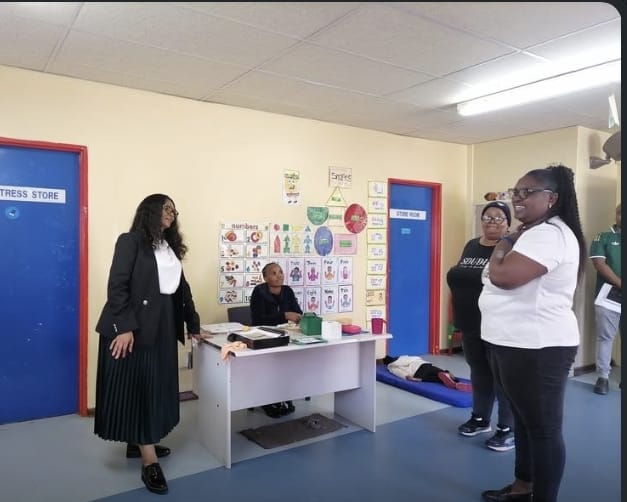
MEC Sefuba conducted an important oversight visit to the Mmabana Arts Venture in Thaba Nchu on Thursday, walking the halls, sitting in on rehearsals, and speaking directly with the creatives who depend on the centre for their livelihoods. The visit was designed to assess the facility’s operations, understand the challenges facing its users, and ensure that the centre continues to serve as a vibrant hub for talent development in the Free State province.
“This is not a photocall,” Sefuba told the assembled artists as she stepped out of her vehicle, dressed in a smart green blazer adorned with the provincial coat of arms. “I am here to see, to listen, and to act. Mmabana belongs to the people of Thaba Nchu. It must work for them. If it is not working, we will fix it. That is my promise.”
For the artists of Thaba Nchu — a historic town about 70 kilometres east of Bloemfontein that was once the capital of the Barolong boo Seleka people — the promise could not have come at a more critical time.
Mmabana Arts Venture: A history of hope and struggle
The Mmabana Arts Venture was established in the early 1990s as a community-based arts centre designed to provide training, workspace, and performance opportunities for artists in the Thaba Nchu region. At its peak, the centre hosted regular theatre productions, music recording sessions, dance competitions, and visual arts exhibitions. It was a beacon of creativity in a town that had few other cultural amenities.
But like many public arts facilities in South Africa, Mmabana has struggled in recent years. Budget cuts, deferred maintenance, and a lack of dedicated staff have taken their toll. The roof leaks. The sound system is outdated. The dance studio’s floor is warped. And the once-thriving pottery workshop has been reduced to a collection of dusty wheels and abandoned clay.
“The centre is alive, but it is not well,” said Thabo Mokoena, a veteran theatre director who has been using Mmabana’s facilities for nearly two decades. “We are grateful that it exists. But we are also frustrated. The potential here is enormous. But potential without resources is just a dream.”
MEC Sefuba’s visit was an acknowledgment of that frustration — and a signal that the provincial government is paying attention.
The oversight visit: Walking the halls
The MEC’s tour of the facility was thorough. She began in the main auditorium, a 200-seat space with faded curtains and a stage that has hosted everything from community plays to provincial cultural festivals. The centre’s manager, Dikeledi Morake, pointed out the worn-out lighting rig and the speakers that crackle unpredictably.
“We have a show coming up next month,” Morake explained. “A youth theatre production about the history of Thaba Nchu. The young people have been rehearsing for weeks. But we are not sure the sound will hold. We are not sure the lights will work. It is stressful for them. They deserve better.”
Sefuba listened intently, taking notes in a small leather-bound book. She asked questions: When was the last time the equipment was serviced? Has the department received a formal request for upgrades? What is the cost estimate for repairs? Morake answered each one, her voice careful but hopeful.
Next, the MEC visited the visual arts studio, where a group of local painters had set up their easels. Among them was Palesa Mofokeng, 29, a self-taught artist whose vibrant landscapes have gained a following on social media but who struggles to find a local market for her work.
“I paint the hills of Thaba Nchu,” Mofokeng said, showing Sefuba a canvas depicting the town’s iconic silhouette. “This is my home. This is my inspiration. But there is no gallery here. No one to buy. I sell online, but shipping is expensive. If Mmabana had a proper exhibition space, with lighting and security, I could invite buyers from Bloemfontein. I could make a living.”
Sefuba nodded. “I hear you,” she said. “Artists should not have to leave Thaba Nchu to find success. We must build the market here.”
The final stop was the dance studio, where a group of young performers had assembled to demonstrate their craft. Choreographed by 23-year-old Lerato Dlamini, the piece was a fusion of traditional Tswana dance and contemporary movement — a testament to the creativity that thrives in Thaba Nchu despite the odds.
The dancers moved with passion and precision, their feet pounding the warped wooden floor. When they finished, the MEC led the applause.
“That was beautiful,” Sefuba said, her eyes glistening. “You are the future of Free State arts. You must be supported. You will be supported.”
The artists’ demands: More than just words
After the tour, Sefuba convened a meeting with a representative group of artists, centre staff, and local community leaders. The conversation was candid, sometimes tense, but ultimately constructive.
The artists presented a list of demands and requests:
- Urgent repairs to the auditorium’s lighting and sound systems – Estimated cost: R450,000.
- Rehabilitation of the dance studio floor – Estimated cost: R180,000.
- Establishment of a formal exhibition space for visual artists – Estimated cost: R600,000.
- Regular monthly stipends for resident artists and instructors – Currently, most work on a voluntary or project-by-project basis.
- A dedicated marketing and bookings officer – To attract audiences and renters to the facility.
“We are not asking for luxury,” said Mokoena, the theatre director, who served as the artists’ spokesperson. “We are asking for basics. A roof that does not leak. Lights that turn on. A floor that does not injure our dancers. These are not unreasonable demands. These are the minimum requirements for a functioning arts centre.”
Sefuba responded by committing to a phased intervention. She announced that the provincial Department of Sport, Arts, Culture and Recreation would release an immediate R200,000 emergency allocation to address the most pressing maintenance issues — the leaky roof and the dance studio floor — within the next 60 days.
“These are small amounts, I know,” Sefuba said. “But they are a start. We will return to the provincial treasury with a full business case for the larger upgrades. This centre is too important to fail. I will not let it fail.”
The broader context: Arts funding in the Free State
The Mmabana Arts Venture is not the only cultural facility in the Free State struggling to stay afloat. Across the province, community arts centres, museums, and libraries have faced years of budget cuts as the provincial government grapples with competing priorities: health, education, and infrastructure.
The Free State’s total budget for arts and culture in the 2026/27 financial year is R312 million — a modest increase from the previous year but still far below what advocates say is needed. Of that, only a small fraction is allocated to community arts centres like Mmabana.
“The arts are always at the back of the queue,” said cultural activist and academic Dr. Thabo Mokoena (no relation to the theatre director). “When the budget is tight, sports and culture are the first to be cut. But the arts are not a luxury. They are a lifeline. They keep young people off the streets. They preserve our heritage. They create jobs. They heal trauma. We need to stop treating them as optional.”
MEC Sefuba, who has been in her position since 2024, has made arts funding a personal priority. A former teacher and community organiser, she has argued that the creative economy is an underutilised driver of economic growth in the Free State — particularly in rural areas where other industries are scarce.
“Thaba Nchu has talent,” Sefuba said during the meeting. “But talent without infrastructure is like a seed without soil. It will not grow. My job is to provide the soil. The artists will do the rest.”
Voices from the community: ‘We have been forgotten’
Outside the meeting room, a small crowd of community members had gathered, hoping to catch a glimpse of the MEC and perhaps share their own concerns. Among them was Gogo Nomsa Mofokeng (no relation to the painter), an 82-year-old grandmother who has lived in Thaba Nchu her entire life.
“Mmabana used to be the heart of this town,” she said, leaning on a walking stick. “We would bring our children here for music lessons. We would come to watch plays on weekends. It was a place of joy. Now, it is a place of struggle. The young people still come, but the building is tired. The spirit is still there, but the body is weak. I am old. I may not see it, but I hope my grandchildren will see Mmabana restored.”
Others were less patient.
“We have been forgotten,” said Thulani Nkosi, 34, a hip-hop artist who records his music in a makeshift studio in the centre’s basement. “Politicians come. They take photos. They make promises. Then they leave. Nothing changes. I hope MEC Sefuba is different. I want to believe. But I have been disappointed too many times.”
A moment of connection
Before she departed, Sefuba sat down with a small group of young performers — the same dancers who had performed for her earlier. She asked them about their dreams.
“I want to be a professional choreographer,” said Lerato Dlamini, the 23-year-old who had led the dance piece. “But there is no training here. No one to teach me. I learn from YouTube. I learn from my own mistakes. If Mmabana could bring in a choreographer once a month — just once a month — it would change everything.”
Sefuba reached out and held Lerato’s hand. “I will find a way,” she said. “I do not know how yet. But I will find a way.”
Lerato smiled — a small, tentative smile, as if she was afraid to believe.
What happens next
The MEC’s oversight visit is expected to generate a formal report, which will be submitted to the provincial cabinet within 30 days. The report will include a detailed assessment of Mmabana’s condition, a list of priority interventions, and a proposed timeline and budget for upgrades.
Sefuba has also committed to convening a “Thaba Nchu Arts Summit” in September 2026, bringing together artists, funders, and government officials to develop a long-term strategy for the centre.
“The summit will not just be about Mmabana,” Sefuba told the meeting. “It will be about the entire creative ecosystem of Thaba Nchu. How do we train artists? How do we support them? How do we connect them to markets? How do we ensure that the next generation has more opportunities than this one? These are the questions we must answer together.”
A ray of hope
As the MEC’s convoy pulled away from the Mmabana Arts Venture, the artists lingered in the parking lot. Some were sceptical. Others were hopeful. Most were somewhere in between.
“She seemed sincere,” said Mokoena, the theatre director. “But sincerity is not the same as action. We will wait. We will watch. And we will hold her to her promises.”
Inside the dance studio, Lerato Dlamini gathered her dancers for another rehearsal. The floor was still warped. The mirrors were still cracked. But the music played on. And the dancers moved.
“Today was a good day,” Lerato said, wiping sweat from her forehead. “Someone important came. Someone listened. That is more than we have had in years. Maybe nothing will come of it. But maybe something will. We have to keep dancing either way. That is what artists do.”
The Mmabana Arts Venture has weathered many storms. It has survived budget cuts, neglect, and indifference. It will survive this moment, too. But survival is not enough. The artists of Thaba Nchu want to thrive. And for one morning, at least, they felt seen.
Whether that feeling translates into repairs, resources, and real change is a question only time — and the Free State government — can answer.
For now, the dance continues. The paintings wait. The stage sits empty but ready. And in the dusty parking lot of Mmabana, a small seed of hope has been planted.
The question is whether anyone will water it.
About The Author