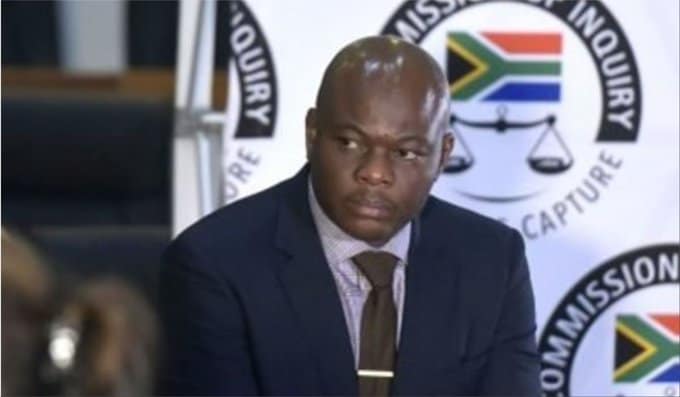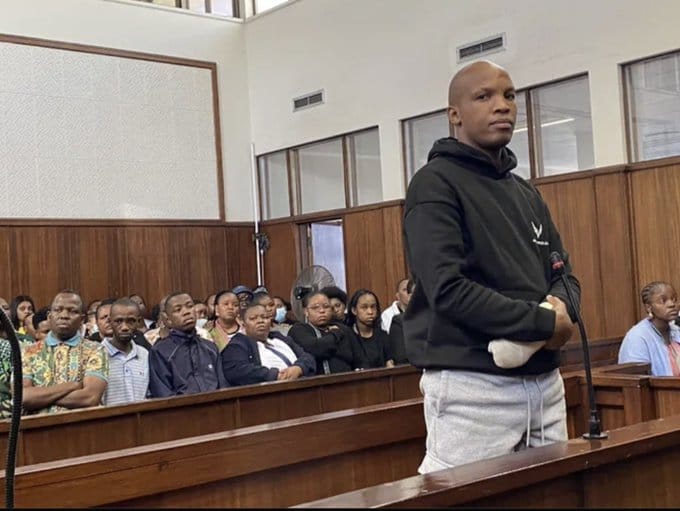
The heavy oak doors of the Durban High Court swung open just before 10 a.m. on Friday. Inside, a scene of profound grief and grim justice was unfolding. Qiniso Thulasizwe Sishi, a former eThekwini metro police officer, walked into the dock, his head bowed, his hands cuffed in front of him. He did not look at the public gallery. He did not need to. He already knew who was there: the mother of the woman he killed, the sisters who would never see their sibling again, the colleagues who once trusted him with a badge and a gun.
Sishi returned to court for his sentencing hearing after pleading guilty to the brutal murder of his wife, Thandokuhle Mkhize – a practising attorney, a daughter, a sister, and a woman described by those who loved her as “a rising star whose light was extinguished far too soon.”
The case has shaken Durban’s legal and law enforcement communities, not only because of the violence of the crime but because of the betrayal at its heart: a man sworn to protect and serve used his training, his access to a firearm, and his position of authority to end the life of the woman he had promised to love and cherish.
“Thandokuhle was not just a statistic,” prosecutor Advocate Nombuso Mkhabela told the court during her opening remarks. “She was a person. A professional. A protector of the law. And she was killed by the very person who should have kept her safe. The State will be seeking the maximum sentence. Anything less would be an insult to her memory.”
The crime: A brutal end to a troubled marriage
According to the statement of agreed facts read into the court record, Sishi and Mkhize were married in 2019. From the outside, they appeared to be a successful couple: he, a rising metro police officer; she, a sharp-minded attorney climbing the ranks at a respected Durban law firm.
But behind closed doors, the marriage was troubled. Friends and family later told investigators that Mkhize had confided in them about verbal abuse, controlling behavior, and, in the months before her death, physical violence. She had reportedly filed for divorce just weeks before she was killed.
On the night of 15 March 2025, Sishi and Mkhize were at their home in the quiet suburb of Westville. What exactly transpired in the hours before the killing remains known only to Sishi. But the facts he admitted to are chilling.
According to his own plea statement, Sishi retrieved his service pistol — a firearm he was entitled to carry as a metro police officer — and shot his wife multiple times. Forensic evidence presented to the court showed that Mkhize was struck four times: twice in the chest, once in the abdomen, and once in the arm, likely raised in a desperate attempt to defend herself.
She died at the scene. She was 34 years old.
After the shooting, Sishi called his mother. Then he called his lawyer. He did not call emergency services. It was a neighbor who heard the gunshots and alerted police.
When officers arrived, they found Sishi sitting on the front steps of the house, the pistol on the ground beside him. He did not resist arrest. He reportedly told the first officer on the scene: “I did it. I killed my wife. I am sorry.”
The guilty plea: A rare moment of accountability
Sishi’s decision to plead guilty — rather than force the state to prove its case at trial — was unexpected. Many domestic violence murder cases drag on for years, with accused killers maintaining their innocence or claiming provocation or self-defense.
But Sishi, through his legal team led by advocate Muzi Sikhakhane, waived his right to a trial and entered a full confession.
“I am guilty of the murder of my wife, Thandokuhle Mkhize,” Sishi’s plea statement read. “I take full responsibility for my actions. I know that nothing I do or say can bring her back. I am deeply sorry for the pain I have caused to her family, to my family, and to everyone who loved her.”
The guilty plea was welcomed by the prosecution and by Mkhize’s family, who said it spared them the trauma of a prolonged trial.
“At least he admitted what he did,” said Nomsa Mkhize, the victim’s mother, speaking outside the court after the hearing. “That is something. But it does not bring my daughter back. It does not undo the pain. He can say sorry a thousand times. It will never be enough.”
The sentencing hearing: State vs defense
Friday’s proceedings were the first day of the sentencing hearing, during which the court will hear evidence of aggravating and mitigating factors before Judge Nompumelelo Radebe hands down a sentence.
The prosecution is seeking life imprisonment — the mandatory minimum sentence for premeditated murder, unless substantial and compelling circumstances exist to deviate.
Advocate Mkhabela outlined the state’s aggravating factors:
- Premeditation – Sishi retrieved his firearm and shot his wife multiple times. This was not a spontaneous act of passion.
- Abuse of position – As a metro police officer, Sishi was trained in conflict resolution and firearm safety. He used his service weapon to commit murder.
- Domestic violence context – The killing occurred in the context of an abusive marriage, and the victim had taken steps to leave the relationship.
- Impact on the family – The state called several witnesses, including Mkhize’s mother and her law partner, to testify about the devastating impact of her death.
“Every morning, I wake up and for one second I forget she is gone,” Mkhize’s mother testified, her voice trembling. “Then I remember. And I cannot breathe. She was my child. She was my future. She was everything.”
The defense, in turn, will argue for a lesser sentence — likely 15 to 20 years — on the grounds of Sishi’s guilty plea, his apparent remorse, and what his lawyers describe as “mental health challenges” at the time of the killing.
“My client is not asking for mercy,” Sikhakhane told the court. “He is asking for justice. Justice must take into account his cooperation, his confession, and his genuine anguish. He will live with what he did for the rest of his life. That is a punishment in itself.”
The state rejected that argument.
“Remorse is not proven by words alone,” Mkhabela countered. “The accused took a life. A bright, beautiful, accomplished life. No amount of ‘anguish’ can justify a reduction of the sentence that the law prescribes. The only just outcome is life imprisonment.”
The victim: Who was Thandokuhle Mkhize?
Thandokuhle Mkhize was not just a victim. She was a force.
Born in Pietermaritzburg in 1991, she excelled in school and won a scholarship to study law at the University of KwaZulu-Natal. She graduated cum laude and was admitted as an attorney in 2017. By 2023, she had become a senior associate at a prominent Durban law firm, specializing in family law and gender-based violence cases.
“Ironically, she spent her career helping women escape abusive marriages,” said Zanele Dlamini, her law partner and closest friend. “She would sit with clients who had been beaten, who had been threatened, who were terrified. She would hold their hands and tell them: ‘You are strong. You can leave. You deserve better.’ And all along, she was living the same nightmare at home. She just never told us how bad it was.”
Dlamini testified at the sentencing hearing about the last conversation she had with Mkhize, just days before her death.
“She came to my office. She looked exhausted. She said, ‘Zanele, I’ve filed for divorce. He’s not going to take it well. If anything happens to me, promise me you’ll take care of my files. My clients need someone.’ I laughed. I thought she was being dramatic. I didn’t realize she was saying goodbye.”
Mkhize’s legal colleagues have since established the Thandokuhle Mkhize Foundation, which provides legal aid and counseling to women in abusive relationships. The foundation was present outside the court on Friday, holding placards with Mkhize’s photograph and the words: “Her legacy is our fight.”
The police connection: A betrayal of the badge
Sishi’s status as a former metro police officer has added an extra layer of outrage to the case. He joined the eThekwini Metropolitan Police Department in 2016 and was considered a competent, if unremarkable, officer. He had no prior disciplinary record. No red flags. No warning signs.
“How does a person with a badge and a gun become the perpetrator instead of the protector?” asked Brigadier Thandiwe Mkhabela (no relation to the prosecutor), head of the KZN police’s family violence unit. “That is the question we have been asking ourselves. The answer is uncomfortable: because abusers are everywhere. Even in uniform. Even in our ranks.”
The eThekwini Metro Police Department issued a brief statement following Sishi’s guilty plea, expressing “deep sorrow” and confirming that Sishi had been dismissed from the service following his arrest.
“Qiniso Sishi betrayed his oath, his uniform, and his marriage,” the statement read. “He does not represent the men and women who serve this city with honor. We extend our deepest condolences to the family of Thandokuhle Mkhize. Justice must now take its course.”
Domestic violence in South Africa: A national crisis
The murder of Thandokuhle Mkhize is not an isolated tragedy. South Africa has one of the highest rates of gender-based violence and femicide in the world. According to the latest police statistics, a woman is murdered in South Africa every three hours. In most cases, the killer is her intimate partner.
“Thandokuhle’s story is heartbreakingly familiar,” said Bontle Mafora, director of the gender justice organization #NotInMyName. “A professional woman. A successful career. A partner who seemed fine to the outside world. And behind closed doors, control, abuse, and ultimately murder. We have seen this story a thousand times. And we will keep seeing it until we treat gender-based violence as the national emergency it is.”
Mafora and other activists gathered outside the Durban High Court on Friday, holding a silent vigil as Sishi was led into the building.
“We are here for Thandokuhle,” Mafora said. “But we are also here for every woman who is currently trapped in an abusive relationship. We want them to know: you are not alone. There is help. There is a way out. And we will fight for you.”
The sentencing: What comes next
The sentencing hearing is scheduled to continue over the next two weeks, with the defense expected to call mental health experts to testify about Sishi’s psychological state at the time of the murder. The state will call rebuttal witnesses.
Judge Radebe is expected to deliver her sentence in early May.
If she imposes life imprisonment, Sishi will serve a minimum of 25 years before he can be considered for parole. If she imposes a lesser sentence, he could be eligible for release in as little as 15 years.
“The law is clear,” said legal analyst Nthabiseng Mokoena. “Murder is murder. And murder committed with a firearm, by a law enforcement officer, against an intimate partner — that is about as aggravated as it gets. I would be very surprised if the judge does not impose life imprisonment.”
Outside the court, Nomsa Mkhize, the victim’s mother, stood surrounded by family and supporters. She held a photograph of her daughter — a graduation photo, Thandokuhle in her black robes, smiling, confident, full of promise.
“I want him to go to jail for life,” she said quietly. “Not because I hate him. Because I loved her. And she deserves justice. She deserves to rest. She deserves to be remembered as the brilliant, beautiful soul she was — not as a victim. Not as a statistic. As my daughter.”
A legacy of hope
As the sun set over Durban on Friday evening, the candlelight vigil outside the courthouse continued. A small group of women — lawyers, activists, survivors — held hands and sang a hymn. The words floated up into the darkening sky: “We shall overcome. We shall overcome someday.”
The Thandokuhle Mkhize Foundation has already raised over R500,000 to support its work. Law firms across KwaZulu-Natal have pledged pro bono services. And a new generation of female attorneys has vowed to continue her fight.
“She would have wanted that,” said Zanele Dlamini, her law partner. “She would have said: ‘Don’t cry for me. Fight for them.’ So that is what we will do. We will fight. In her name. For as long as it takes.”
The sentencing hearing will resume on Monday. But for those who loved Thandokuhle Mkhize, the verdict has already been delivered: her life mattered. Her death will not be forgotten. And the man who killed her will face the full weight of the law.
Justice, delayed but not denied. For Thandokuhle. For all the Thandokuhles yet to come.
About The Author