The busy intersection of Walter Sisulu Drive and Church Street in Standerton is known for many things: the rush-hour traffic, the hawkers selling fruit at the robots, and, until Thursday, the unofficial toll gate. For months, motorists traveling through this central artery of Lekwa Municipality whispered among themselves about the two traffic officers who seemed to stop more cars than any others — and who, according to multiple complaints, rarely issued actual fines.
That ended on Thursday morning.
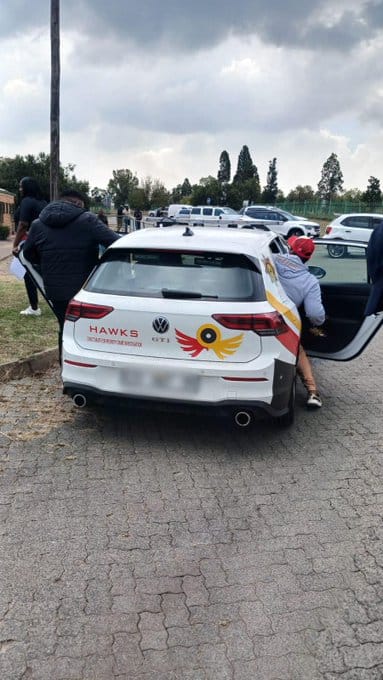
Two traffic officers from the Lekwa Municipality were arrested and handcuffed in full view of shocked motorists after they allegedly demanded bribes from drivers in exchange for not issuing traffic fines. The arrests, carried out by the Hawks’ Serious Corruption Investigation unit in conjunction with the Mpumalanga Road Traffic Inspectorate, followed a two-month undercover operation that recorded multiple instances of alleged bribery.
“We have been watching them for weeks,” said Brigadier Sydney Mkhize, head of the Hawks’ Mpumalanga office, speaking at a press conference outside the Standerton Police Station. “They thought they were untouchable. They thought the public would never speak up. They were wrong. Today, they learned that no one is above the law — not even those who are supposed to enforce it.”
The arrests: A sting in broad daylight
The operation unfolded shortly after 9 a.m. on Thursday. Undercover officers, posing as ordinary motorists, drove through a known hotspot where the two traffic officers — identified as Thabo Nkosi (42) and Sipho Dlamini (38) — were stationed.
According to a statement of facts released by the Hawks, Nkosi pulled over an unmarked vehicle driven by an undercover officer for an alleged “minor traffic violation” — a claim that the officer had not signaled before changing lanes. Instead of issuing a fine, Nkosi allegedly told the driver: “This can be arranged. R200 and you go. No paperwork. No points. No stress.”
The undercover officer paid the bribe using marked notes. Seconds later, a pre-arranged signal was given. A team of Hawks investigators emerged from a nearby building and arrested both officers on the spot.
“The second officer, Dlamini, was not directly involved in that specific transaction,” Brigadier Mkhize explained. “But he was present. He was aware. And our investigation shows that he has been engaging in similar conduct for months. He was arrested as an accomplice.”
Both officers were handcuffed and led away in full view of motorists who had stopped to watch. Some cheered. Others filmed on their phones. One motorist reportedly shouted: “It’s about time!”
The modus operandi: How the scheme worked
According to the Hawks’ investigation, Nkosi and Dlamini had developed a systematic method of extracting bribes from motorists, particularly targeting out-of-town drivers who were unlikely to challenge the officers or report them to authorities.
The typical routine, based on dozens of complaints and the undercover recordings, followed a pattern:
- The stop – The officers would pull over a vehicle for a minor or fabricated violation: a dim number plate light, a slightly worn tyre, a failure to signal.
- The offer – Instead of issuing a fine (which would carry a penalty of up to R1,000 plus demerit points), the officers would offer an “alternative”: a cash payment on the spot, typically between R100 and R500, depending on the driver’s apparent ability to pay.
- The transaction – The bribe would be handed over, often folded into a driver’s license or registration document to avoid detection. No receipt. No record. No fine.
- The release – The driver would be sent on their way, often with a warning to “drive safely” — and an implicit understanding that future stops might be more costly.
Over the course of the investigation, the Hawks documented over 40 separate incidents involving the two officers, with bribes totaling an estimated R15,000. The actual figure is likely much higher, as many victims never reported the encounters.
“These officers were not targeting rich people in fancy cars,” said Brigadier Mkhize. “They were targeting ordinary South Africans — taxi drivers, delivery drivers, domestic workers driving their employer’s car, young people who couldn’t afford a R500 fine. They were preying on fear. And they were making a living off it.”
The municipality’s response: ‘Zero tolerance’
The Lekwa Municipality, which governs Standerton and surrounding areas, issued a statement shortly after the arrests expressing “shock and disappointment.”
“These allegations are deeply troubling,” said Municipal Manager Thabo Mofokeng. “Traffic officers are entrusted with the safety of our roads and the integrity of our enforcement system. Corruption of any kind will not be tolerated. The municipality is cooperating fully with the Hawks’ investigation and will take appropriate internal disciplinary action.”
Mofokeng confirmed that both officers have been suspended pending the outcome of the criminal case and an internal disciplinary hearing.
“If found guilty, they will be dismissed,” he said. “There is no place for corrupt individuals in this administration.”
However, opposition councillors in Lekwa have accused the municipality of turning a blind eye to corruption for years.
“Everyone knew about these two,” said John Mkhabela, an opposition councillor who has repeatedly raised concerns about traffic department corruption. “Complaints were filed. Reports were made. Nothing was done. It took the Hawks — not the municipality — to finally act. That is a failure of leadership.”
The community’s reaction: ‘Finally’
In Standerton, a small industrial town known for its abattoirs and agricultural processing, the arrests have been met with a mixture of relief and anger.
“I was stopped by one of them six months ago,” said Maria Nkosi (no relation to the accused officer), a 34-year-old nurse who drives from Standerton to Secunda for work every day. “He said my licence disk was faded. It wasn’t. He said I could pay R300 or get a fine. I paid because I couldn’t afford to take a day off to go to court. I didn’t report it because I thought no one would believe me. Now I wish I had.”
A taxi driver who gave his name only as Bongani said he had been stopped by the same officers “at least ten times” over the past year.
“They know us. They know we can’t fight back. We are just trying to make a living. Every time they stop us, it costs us a day’s profit. Sometimes more. I am not happy that they were arrested. I am happy that they can’t do this to anyone else.”
Others expressed skepticism that the arrests would lead to lasting change.
“They will be back,” said Elias Msimang, a 58-year-old pensioner. “Maybe not these two. But others will take their place. The system is broken. You cannot fix corruption by arresting two officers. You have to fix the system that allows it to happen.”
The broader context: Corruption in Mpumalanga’s traffic departments
The arrest of the two Lekwa officers is not an isolated incident. Mpumalanga has seen a string of corruption cases involving traffic officials in recent years:
- In 2024, three traffic officers in Emalahleni were arrested for allegedly taking bribes from long-distance truck drivers.
- In 2023, a senior traffic official in Mbombela was convicted of corruption and sentenced to eight years in prison for running a “bribery syndicate” that allegedly collected over R1 million in illegal payments.
- In 2022, an undercover operation in Secunda caught four traffic officers on camera accepting bribes; all four were dismissed and later convicted.
“Traffic departments are particularly vulnerable to corruption because the transactions are small, frequent, and difficult to monitor,” said Professor Thabo Mbeki (no relation to the former president), a criminologist at the University of Mpumalanga. “A bribe of R200 here, R500 there — it adds up. And the victims are often the most vulnerable members of society: people who cannot afford to take time off work to fight a fine, people who do not know their rights, people who are afraid of authority.”
Mbeki called for systemic reforms, including body cameras for traffic officers, anonymous reporting hotlines, and more frequent anti-corruption audits.
“You cannot rely on the Hawks to catch every corrupt officer,” he said. “There are too many. You have to build systems that make corruption harder and consequences certain. That is the only way to change the culture.”
The legal process: What happens next
Nkosi and Dlamini appeared briefly in the Standerton Magistrate’s Court on Friday afternoon. They face charges of corruption and extortion under the Prevention and Combating of Corrupt Activities Act (POCA), which carries a maximum penalty of 15 years in prison.
Both officers were remanded in custody after the magistrate denied bail, citing the risk that they might interfere with witnesses or flee.
“The state argued that the accused are public officials who abused their positions of trust,” said Advocate Lindiwe Nkosi (no relation), the prosecutor handling the case. “They have access to resources. They have knowledge of the victims. They are a flight risk. The magistrate agreed.”
The case was postponed to 18 May 2026 for further investigation and the formal bail application. The Hawks have indicated that additional charges may be added as the investigation continues.
“We are still analyzing the evidence,” said Brigadier Mkhize. “There may be more victims. There may be more incidents. We encourage anyone who was stopped by these officers and asked for a bribe to come forward. No amount is too small. Every complaint helps.”
The victims: Speaking out
Since the arrests, the Hawks have set up a dedicated hotline for victims of Nkosi and Dlamini to report their experiences. Within 24 hours, the hotline had received over 80 calls.
“It’s overwhelming,” said Captain Pretty Mhlongo, who is managing the hotline. “People are calling from all over. Some are angry. Some are crying. Some just want to tell their story. We are recording everything. Every call is evidence.”
One caller, David Ndlovu, 45, a furniture delivery driver from Secunda, told his story to waiting reporters outside the police station.
“They stopped me last month. Said my load was not properly secured. It was. They said R500 or they would impound the truck. I would have lost a day’s work. I paid. I didn’t have a choice. Now I hear I am not alone. That makes me angry. But it also makes me feel less alone.”
Another caller, who asked to remain anonymous, said she was stopped while driving her late mother’s car.
“I was crying. My mother had just died. The officer — Nkosi — he didn’t care. He said R300 or he would issue a fine. I paid. I just wanted to go home. I will never forget his face. I hope he goes to jail.”
A message to corrupt officials
At the press conference announcing the arrests, Brigadier Mkhize had a clear message for any other traffic officers considering similar schemes.
“We are watching. We are listening. And we will find you,” he said. “You are not serving the public. You are stealing from them. And you will be held accountable.”
Mkhize also had a message for the public: “Do not pay bribes. I know it is hard. I know it feels like the easy way out. But every bribe you pay makes the problem worse. Report it. Record it. Call us. We will act.”
The Hawks have launched a public awareness campaign in Mpumalanga, including posters at major intersections and radio ads in isiZulu and English, urging motorists to report bribe demands.
“Corruption thrives in silence,” Mkhize said. “Break the silence. Break the cycle. We are on your side.”
The road ahead
For the people of Standerton, the arrests of Nkosi and Dlamini are a small but significant victory in a much larger war.
“We have been crying out for help,” said Nomsa Mthembu, 52, a chairperson of the Standerton Business Forum. “These officers were a menace. They made people afraid to drive through their own town. Now they are in handcuffs. It is a good day. But the fight is not over. There are more. We know there are more. The Hawks must keep going.”
The Lekwa Municipality has announced plans to install dashboard cameras in all traffic vehicles and to implement a random audit system for fines issued.
“We are taking this seriously,” said Municipal Manager Mofokeng. “One corrupt officer is one too many. We will not rest until our traffic department is clean.”
But for now, the people of Standerton are celebrating a small victory. The unofficial toll gate on Walter Sisulu Drive has been closed. The two men who ran it are behind bars. And for the first time in months, motorists are driving through the intersection without fear.
It is not the end of corruption in Mpumalanga. But it is a beginning. And for the people who have suffered in silence, that is enough.
🕊️ Standerton, 17 April 2026 – Justice, slow but not stopped. The fight continues.
About The Author