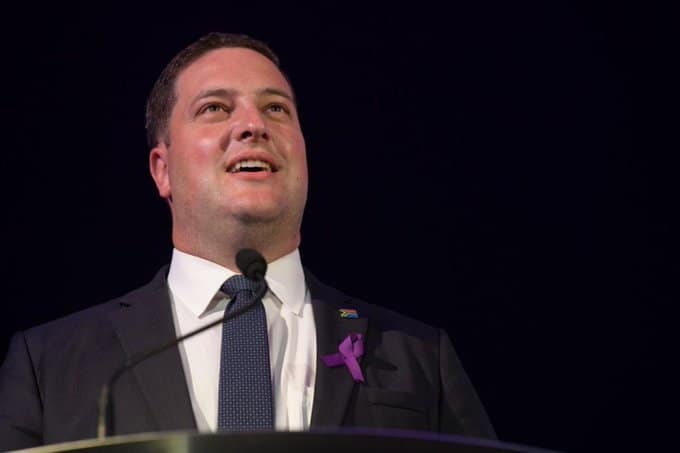
In a packed conference hall at the Cape Town International Convention Centre, where the air thrummed with a mixture of anticipation and nervous energy, Geordin Hill-Lewis was elected as the new Federal Leader of the Democratic Alliance (DA) on Saturday afternoon. And in a searing, defiant acceptance speech that drew repeated standing ovations—and a few sharp intakes of breath—the 38-year-old Mayor of Cape Town made it unequivocally clear that under his leadership, the official opposition would no longer settle for being a “junior partner” in national politics.
Flanked by his wife and two young children on stage, Hill-Lewis laid out an audacious, meticulously detailed plan to grow the DA from its current 22% national support base into the largest party in South Africa by the 2029 general elections. The target, he told a room of over 2,000 delegates, party members, and international observers, was nothing less than 35% of the national vote—a figure that would, in a fractured political landscape, potentially make the DA the kingmaker, if not the outright governing party.
“For too long, the Democratic Alliance has been content to play the role of the responsible opposition—polite, well-reasoned, and utterly ineffective at changing the lives of the poor,” Hill-Lewis said, his voice rising above the cheers. “For too long, we have been told to wait our turn, to be patient, to accept that South Africa is an ANC country and we are merely guests in its house. I am here to tell you today: that era is over. We will not be junior partners in our own country’s future. We will not be the footnote in someone else’s history. We are here to lead.”
The Leadership Contest: A New Generation Takes the Helm
Hill-Lewis’s election marks a generational shift for the Democratic Alliance. He defeated incumbent John Steenhuisen—who had led the party since 2019—by a decisive margin of 1,842 votes to 1,203 in the second round of voting, after a first-round elimination of third candidate and Shadow Finance Minister Dion George. Steenhuisen, 50, conceded graciously and endorsed Hill-Lewis from the podium, calling him “the future of this party and, I believe, the future of this nation.”
The leadership contest had been framed by political analysts as a battle between the old guard—associated with the DA’s traditional base of English-speaking, suburban, liberal voters—and a new, more assertive, more diverse generation that seeks to take the party into black townships, rural areas, and working-class communities where the DA has historically struggled to gain traction.
Hill-Lewis, who has served as Mayor of Cape Town since 2021, built his campaign on a simple premise: the DA cannot grow by being a “slightly more competent version of the ANC.” Instead, he argued, the party must offer a radical alternative: a state that works for citizens, not cadres; an economy that creates jobs, not bureaucratic bottlenecks; and a society where your race, your language, or your postal code does not determine your destiny.
His victory was powered by a coalition of younger delegates (under 40), branch-level activists from Gauteng and KwaZulu-Natal, and a significant number of women’s league representatives who were persuaded by his commitment to placing 50% of winnable parliamentary seats in the hands of female candidates by 2028.
The Speech: A Blueprint for 2029
Hill-Lewis’s acceptance speech ran for 47 minutes—long by political standards, but few in the hall seemed to notice. He moved seamlessly between policy detail and emotional rhetoric, between data-driven projections and personal anecdotes from his own childhood in a middle-class Durban home, where he watched his mother struggle to find work during the recession of the early 1990s.
The core of his address was a seven-point plan titled “The South African Spring: A DA Government for All.”
1. The 35% Target: A Mathematical Path to Power
Hill-Lewis argued that South Africa’s electoral landscape has fundamentally changed since the 2024 elections, which saw the ANC fall below 50% for the first time since 1994, forcing it into a Government of National Unity (GNU). He projected that by 2029, the ANC’s support could fall to as low as 38-40%, making a coalition government almost certain.
“If we reach 35%—and I believe we can—we will not be anyone’s junior partner. We will be the senior partner. We will set the agenda. We will write the budget. We will appoint the cabinet. The question is not whether South Africa will have a coalition government in 2029. The question is who leads it. And I am telling you now: it will be us.”
2. A “Contract with the Townships”
Acknowledging the DA’s historic weakness in black majority areas, Hill-Lewis announced a R500 million grassroots mobilization fund—to be raised from private donors and party contributions—that would establish permanent DA offices in all 213 townships across South Africa within three years. Each office would be staffed by full-time community organizers, not volunteers, and would offer free legal aid, job-seeking assistance, and grant application support.
“You cannot win votes from people whose children are hungry by sending them a glossy pamphlet once a year,” he said. “You win votes by being there on the Tuesday when the tap runs dry. By being there when the clinic has no medicine. By being there when the pothole swallows a child’s bicycle. We will be present. We will be useful. And then, only then, will we ask for their votes.”
3. Economic Freedom Through Opportunity
In a direct challenge to the Economic Freedom Fighters (EFF) and uMkhonto weSizwe (MK) Party’s messages of nationalization and expropriation without compensation, Hill-Lewis unveiled a pro-growth, pro-jobs platform focused on three pillars: removing red tape for small businesses (including a promise to cut licensing times from 90 days to 7 days), creating a national youth service corps that would pay young people to work on public infrastructure projects, and establishing a sovereign wealth fund from oil and gas revenues in the Karoo and off the west coast.
“We do not need to take land to create jobs,” he said, drawing some of the loudest cheers of the afternoon. “We need to take barriers down. We need to take corruption out. We need to take the opportunity in. The poor do not need handouts. They need a government that gets out of their way.”
4. Rebuilding Trust in the State
Hill-Lewis promised a “zero-tolerance” approach to corruption within the DA itself, including the establishment of an independent ethics commissioner with powers to investigate and expel members without party political interference. He also committed to a constitutional amendment—subject to public referendum—that would create a fixed five-year term for the president, removing the president’s power to dismiss ministers without parliamentary oversight.
“Trust in government is at an all-time low because the ANC has turned the state into a feeding trough for its cronies. But trust will not return simply because the DA replaces the ANC. Trust will return because we build institutions that are stronger than any individual leader, including me. I want a DA government that could survive me. I want a DA government that would fire me if I broke the rules.”
5. A Foreign Policy of African Leadership
In a notable departure from the DA’s traditional Western-aligned foreign policy stance, Hill-Lewis called for a “pragmatic, non-aligned” approach that prioritizes South African economic interests over ideological posturing. He criticized both Russia’s invasion of Ukraine (saying it “violated every principle of sovereignty”) and the West’s “hypocritical lecturing” on democracy while turning a blind eye to human rights abuses by allied nations.
“We will not be anyone’s pawn—not Washington’s, not Beijing’s, not Moscow’s. We are Africans first. We will trade with everyone who offers fair terms. We will speak truth to power, whether that power sits in the Kremlin or in the White House. And we will build a South Africa that is respected, not pitied; a leader, not a follower.”
6. A Unified DA: Ending Factionalism
Perhaps the most delicate section of the speech addressed internal party divisions. The DA has been plagued in recent years by factional battles between its liberal, conservative, and centrist wings, as well as allegations of racism within party structures. Hill-Lewis acknowledged the pain these divisions have caused and promised a “truth and reconciliation process” for the party itself.
“We have hurt each other. We have allowed our disagreements to become personal. We have forgotten that the enemy is not in this room. The enemy is out there—in Luthuli House [ANC headquarters], in the hollow promises, in the corruption that steals schoolbooks from children. Inside this party, from today forward, we fight clean. We disagree respectfully. And when the vote is done, we stand together. No exceptions.”
7. Personal Accountability: A Five-Year Pledge
In a closing gesture that drew gasps from the audience, Hill-Lewis announced that he would not serve more than two terms as DA leader—meaning he would step down by 2034 at the latest, win or lose. He also pledged to release his full tax returns annually and to subject his office to independent audits.
“I am asking you to trust me with the future of this party and, I hope one day, with the future of this nation. Trust is not given. It is earned. And I will earn it every single day—by showing up, by telling the truth, and by putting South Africa before Geordin Hill-Lewis.”
Reactions: Cheers, Skepticism, and a Warning
The speech was met with rapturous applause from the conference floor, with delegates chanting “2029! 2029!” as Hill-Lewis embraced his family. But outside the hall, reactions were more mixed.
Within the DA: Senior party figures expressed cautious optimism. Federal Council Chair Helen Zille, who had remained neutral during the leadership contest, told reporters: “Geordin has the energy, the intellect, and the discipline. But energy is not enough. He must now prove he can build a national machine that wins votes in Soweto and Umlazi, not just in Constantia and Sandton.”
Others were more openly skeptical. A former MP who asked not to be named said: “The townships plan sounds good on paper, but the DA has made similar promises before. The question is whether the party’s donors—who are overwhelmingly white and wealthy—will fund offices in Khayelitsha that may never deliver a single vote. And whether the party’s traditional voters will accept a leader who spends more time in Tembisa than in Table View.”
The ANC: The ruling party was quick to respond. ANC National Spokesperson Mahlengi Bhengu-Motsiri issued a statement within two hours of Hill-Lewis’s speech: “The DA can rebrand itself as many times as it likes. It can change leaders, change slogans, change its target voter. But it cannot change its fundamental nature: a party that has always served the interests of big capital, of privilege, of a minority that refuses to accept the democratic will of the majority. Mr Hill-Lewis’s ‘bold plan’ is the same old austerity, dressed in new clothes.”
The EFF: Economic Freedom Fighters leader Julius Malema, never one to miss an opportunity, took to X (formerly Twitter): “Hill-Lewis is a nice young man. Polite. Well-spoken. He would make an excellent branch manager at a bank. But a president? Of South Africa? The idea is laughable. The DA will never be a black party, no matter how many times its white leaders learn to say ‘shapa’ in a township. The future of the poor is red, not blue.”
Political analysts: University of Johannesburg political scientist Professor Susan Booysen offered a more measured assessment: “Hill-Lewis has done something remarkable: he has given the DA a credible story about the future. But 35% is a very high target. The DA has never broken 25% in a national election. To grow by 13 percentage points in three years would require a collapse of the ANC far beyond anything currently predicted, and a near-total absorption of smaller opposition parties. It is possible, but it is not probable. The real test will be the 2027 local government elections. If the DA can win metros like Johannesburg and Ekurhuleni outright, then 2029 becomes a conversation. If not, this speech will be remembered as beautiful rhetoric—and nothing more.”
The Man Behind the Plan: Who Is Geordin Hill-Lewis?
For those unfamiliar with the new DA leader, his biography is a study in carefully managed ambition. Born in Durban in 1988 to a Jewish father and a Christian mother, Hill-Lewis studied economics and law at the University of Cape Town before working as a researcher at the South African Reserve Bank. He entered Parliament at age 26 as a DA MP, quickly earning a reputation as a meticulous interrogator of ANC ministers during budget debates.
In 2021, he ran for Mayor of Cape Town on a platform of “clean governance and service delivery”—and won decisively. His tenure has been marked by both successes (reducing the city’s reliance on Eskom through independent power procurement, expanding the MyCiTi bus network into poorer areas) and controversies (a tense standoff with the national government over disaster management funding, accusations of sidelining older DA councillors).
He speaks fluent isiXhosa (learned during his university years) and Afrikaans (self-taught), and makes a point of conducting township walkabouts without a security detail—a calculated risk that has endeared him to grassroots activists but alarmed his security advisors.
He is married to Dr Sarah Hill-Lewis, a public health specialist, and they have two children, aged six and four. When asked during the leadership campaign about his political role models, he named Nelson Mandela (“for his capacity for reconciliation”), Margaret Thatcher (“for her willingness to take on entrenched interests”), and Lee Kuan Yew (“for proving that good governance is not a cultural inheritance but a set of deliberate choices”).
What Comes Next: The Road to 2029
Hill-Lewis will be formally inaugurated as DA Federal Leader at a ceremony in Johannesburg on 1 May 2026. His first major test will come within weeks, when Parliament debates the ANC’s Medium-Term Budget Policy Statement. The DA will need to decide whether to continue its informal cooperation with the ANC in the Government of National Unity or to withdraw and position itself as a full-throated opposition—a decision that will define the remainder of the parliamentary term.
Beyond that, Hill-Lewis has announced a “listening tour” of all nine provinces, beginning in the Eastern Cape on 10 May. He plans to hold open-air town halls in every major township, as well as smaller community dialogues in rural villages.
“The ANC has had 32 years to fix this country,” he said in his final words from the podium. “They have failed. Not because South Africa is ungovernable. Not because our people are lazy or our resources are scarce. But because they chose themselves over the nation. We will choose differently. We will choose you. And together, we will build a South Africa that works—for everyone.”
Whether that vision becomes reality or remains a speech on a conference screen will depend on the millions of South Africans who have, for three decades, voted out of habit, out of fear, or out of a sense that no alternative was truly possible. Hill-Lewis is betting that by 2029, they will be ready for something new.
About The Author