The low hum of frustration has become a permanent background noise in Viljoenskroon these days. Farmers trying to move livestock to market take detours that add two hours to their journeys. Parents driving children to schools on the other side of the Sand River wake up before dawn to beat the makeshift traffic. Ambulances responding to emergencies have learned to avoid certain routes altogether, rerouting through gravel roads that rattle bones and test suspensions.
At the center of this quiet crisis is a bridge—or rather, the conspicuous absence of one.
After years of community pleas and technical assessments, the long-awaited bridge construction project linked to the much-needed rehabilitation of the R59 and associated access roads in Viljoenskroon remains stalled. And now, the Free State Legislature’s Joint Committee on Public Accounts and Finance, together with the Portfolio Committee on Public Works, Infrastructure, Roads, Transport and Human Settlements, has run out of patience.
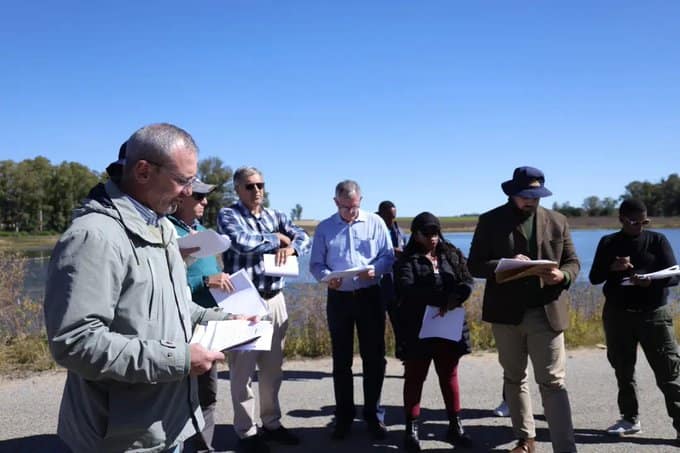
Following an oversight visit to the site earlier this week, the committee issued a sharply worded statement expressing “serious concern” over ongoing delays, warning that the prolonged inaction is not only costing taxpayers but also endangering the lives and livelihoods of the Viljoenskroon community.
“We are not here to point fingers for the sake of politics,” said Committee Chairperson Mpho Lengau, standing on a dusty embankment overlooking the incomplete structure. “We are here because a bridge that should have been carrying trucks, school buses, and emergency vehicles by now is still a skeleton of steel and concrete. This is unacceptable.”
A Project Frozen in Time
To understand the frustration, one must go back to the beginning. The R59 corridor, which runs through Viljoenskroon, serves as a critical artery connecting the northern Free State to the North West province. It carries thousands of vehicles daily—from maize trucks heading to silos to commuters traveling between small towns. But for years, a weak and flood-prone low-water crossing on the route has been a bottleneck in every sense of the word.
During the dry season, the crossing is merely inconvenient—a dip in the road that slows traffic to a crawl. But when summer rains come, the Sand River swells. The crossing becomes impassable. Communities on one side are cut off from hospitals, schools, and shops on the other. Farmers lose perishable goods. Children miss exams. The elderly skip medical appointments.
The solution seemed straightforward: a proper, raised bridge with reinforced foundations, designed to withstand seasonal floods. The project was budgeted, tendered, and awarded. Ground was broken with much ceremony. Local leaders posed for photographs holding shovels.
That was nearly three years ago.
Today, the site tells a story of stalled momentum. Steel reinforcement bars, now tinged with rust, poke out from partially poured concrete pillars. A solitary excavator sits idle under a tarp. Weeds have grown through the gravel access roads. A faded signboard still lists a completion date that has long since passed.
“Every time we ask, they say ‘next month,'” says Nomsa Dlamini, 54, who runs a small spaza shop near the crossing. “Next month came and went. Then next season. Now we don’t ask anymore. We just pray the rain is not too heavy.”
The Committee’s Findings
During their oversight visit, committee members walked the site, inspected documentation, and interviewed local residents, contractors, and municipal officials. Their findings painted a picture of administrative paralysis.
According to a draft report seen by this publication, the primary delays stem from a combination of contractor performance issues, late payments from provincial treasury, and disputes over engineering specifications. The original contractor reportedly walked off the site eight months ago citing non-payment. A replacement contractor was appointed but has yet to mobilize fully.
“We found that the project management unit lacks capacity,” said committee member Thabo Mofokeng. “There is no clear escalation matrix. No one can tell us definitively who is responsible for the next step. That is not just incompetence. That is negligence.”
The committee also noted that at least R18 million of the allocated budget has already been spent—on design, site clearance, and partial foundation work—with no usable asset to show for it. If the project continues to bleed money without progress, the total cost could exceed the original estimate of R42 million by a significant margin.
“Every week of delay adds interest, inflation adjustments, and security costs to protect the idle equipment,” Lengau explained. “The people of Viljoenskroon are paying for a bridge they cannot cross. That is the definition of wasteful expenditure.”
Voices from the Ground
Back in the town, residents have stopped waiting for official announcements. They have built their own informal systems: a WhatsApp group to share river level updates, a volunteer ferry service using a tractor and trailer during moderate floods, and a petition with over 1,200 signatures that has been sent to the Premier’s office three times without a substantive response.
“We feel forgotten,” says Johannes Smit, a third-generation farmer whose dairy operation lies on the eastern side of the crossing. “In the winter, I lose about 15% of my milk production because the tanker cannot guarantee a crossing. In the summer, it’s worse. Last February, I lost a calf because the vet could not get through. That is not just money. That is a life.”
Local taxi operators have also felt the pinch. The rank in Viljoenskroon used to see minibuses depart for Kroonstad and Parys every hour. Now, with the detour adding 40 kilometers per trip, drivers have reduced frequencies and raised fares.
“My passengers are angry,” says taxi owner Thabo Molefe. “They say I am greedy. But the fuel does not pay itself. And the road does not fix itself. When will they understand?”
What Happens Next?
The committee has given the Free State Department of Public Works and Infrastructure 14 days to submit a detailed recovery plan for the bridge project. The plan must include:
- A revised timeline with clear, enforceable milestones
- A financial reconciliation showing exactly how the R18 million was spent
- A risk assessment for the upcoming rainy season
- The name and qualifications of the project manager currently responsible
Furthermore, the committee has recommended that the MEC for Public Works appear before the legislature personally to explain the delays—and to confirm whether any officials have been held accountable.
“We are not looking for scapegoats,” Lengau said. “We are looking for solutions. But accountability must start somewhere. If no one is responsible, then everyone is responsible, and that is exactly how projects die.”
The provincial department has responded with a brief statement acknowledging the committee’s concerns and promising “full cooperation.” No timeline for the project’s completion was provided.
A Bridge to Somewhere
As the oversight committee packed up and drove away, their convoy of official sedans disappearing over the horizon, the people of Viljoenskroon did not celebrate. They have seen too many committees come and go.
Instead, they returned to their rhythms: checking the river gauge, filling sandbags, and telling their children to be careful near the water. They have learned to live with uncertainty. But they have not stopped hoping.
“You know what a bridge really is?” asks Nomsa Dlamini, folding her arms against the afternoon chill. “It’s a promise. A promise that no matter what happens—rain, flood, or politics—you can get from one side to the other. Right now, that promise is broken. But we are still here. We are still waiting. And one day, maybe, someone will keep it.”
Until then, the Sand River flows on. The rust grows on the steel. And the people of Viljoenskroon keep finding detours—because they have no other choice.
About The Author