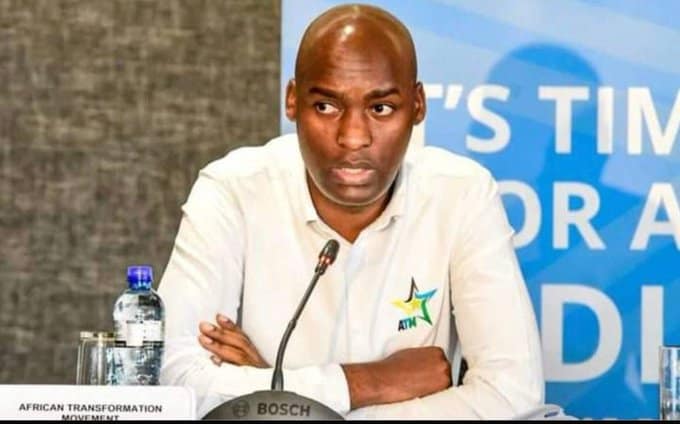
In the polished corridors of Parliament, where the language of procedure often masks the raw currents of political survival, a new stage has been set. The 31-member impeachment committee—formally known as the Section 89 Independent Panel Review Committee—has been constituted to examine the Phala Phala matter involving President Cyril Ramaphosa. And even before its first gavel has fallen, the warnings have begun.
The African Transformation Movement (ATM), the small but increasingly vocal opposition party that first brought the motion to Parliament, has offered a measured welcome to the committee’s formation. But behind that welcome lies a razor-sharp edge.
“We welcome the establishment of this committee,” said ATM leader Vuyo Zungula, speaking outside the National Assembly ahead of a scheduled procedural briefing. “But let us be clear: the real test is not whether we have 31 members sitting around a table. The real test is whether this process will be conducted with full integrity, transparency, and—most critically—without political interference.”
Zungula’s words hung in the Cape Town air, heavy with implication. For the ATM, which has positioned itself as an unlikely but persistent thorn in the side of the ruling African National Congress (ANC), the Phala Phala matter is not merely a legal question. It is a moral one. And in their view, the moral answer cannot be decided by party loyalty.
The Phala Phala Matter: A Recap
For readers who may have followed the saga through fragmented headlines, a brief reminder: The Phala Phala matter stems from allegations that a large sum of foreign currency—reportedly $580,000 in US dollars—was stolen from President Ramaphosa’s game farm in Limpopo in February 2020. The president has stated that the money came from proceeds from the sale of buffalo and other game. Critics, however, have questioned whether the source of the funds was properly declared, whether tax was paid, and whether the president’s subsequent handling of the matter—including the involvement of his security detail in pursuing the alleged thieves—constituted misconduct or even a breach of his oath of office.
The ATM seized on the issue early, filing a motion that eventually led to the appointment of an independent panel chaired by former Constitutional Court Justice Khathu Ramaimela. That panel found that there was prima facie evidence that the president may have violated certain sections of the Constitution, warranting further investigation by Parliament.
Thus, the 31-member committee was born.
A Committee Under Scrutiny
The committee’s composition reflects the balance of power in Parliament: the ANC holds the majority of seats, followed by the Democratic Alliance (DA), the Economic Freedom Fighters (EFF), and smaller parties including the Inkatha Freedom Party (IFP), the Freedom Front Plus (FF+), and the ATM itself. By the numbers, the ANC’s representatives could potentially shield the president—if they vote along party lines.
That is precisely what worries the ATM.
“The majority party will control the majority of votes on that committee,” Zungula explained in a subsequent interview. “That is the arithmetic of democracy. But arithmetic does not have to mean automatic acquittal. If ANC members on that committee act as defense lawyers rather than impartial arbiters, the process becomes a farce. And the South African people are not fools—they will see it.”
The ATM has called for several safeguards: that committee proceedings be televised live (a rare step but not unprecedented), that witnesses be called under oath, and that the committee be empowered to compel the production of all relevant documents, including bank records and communications between the president’s office and the South African Police Service.
“Sunlight is the best disinfectant,” Zungula said. “Let the nation watch. Let the nation judge. If the president has nothing to hide, then transparency will only strengthen him.”
Political Interference: Real Threat or Rhetorical Weapon?
The phrase “political interference” is loaded in South Africa’s current political climate. In recent years, accusations of party officials leaning on parliamentary processes have become commonplace. The State Capture Inquiry documented extensive examples of executive influence over legislative and law enforcement functions. For many citizens, the fear is not theoretical—it is lived memory.
The ATM argues that the Phala Phala committee represents a test case for whether Parliament has learned from those dark chapters.
“We have already seen attempts to discredit the process before it begins,” said ATM national spokesperson Zama Ntshona. “Certain voices in the governing party have called the independent panel’s report ‘flawed’ and ‘politically motivated.’ That is not a legal argument. That is a preemptive strike. It is an attempt to poison the well so that no matter what the committee finds, a section of the public will dismiss it.”
Ntshona also pointed to the timing of the committee’s formation. With the ANC’s national elective conference approaching in December 2022 (at the time of the original events), and President Ramaphosa seeking a second term as party leader, the political stakes could hardly be higher.
“This is not just about impeachment,” Ntshona said. “This is about the future leadership of the country. Anyone who pretends otherwise is being naive.”
The ANC’s Position
The governing party has consistently backed the president, while also stating that it respects parliamentary processes. In a brief statement following the committee’s formation, ANC Chief Whip Pemmy Majodina said: “The ANC will participate fully and constructively in the Section 89 committee. We have confidence in our legal and parliamentary systems. The president has already indicated his willingness to cooperate. We expect a fair process.”
Notably, the statement did not address the ATM’s warning about political interference directly. Behind closed doors, however, ANC insiders have dismissed the ATM’s concerns as grandstanding by a small party desperate for relevance.
“The ATM has seven seats,” one ANC MP told this reporter on condition of anonymity. “They are not the moral conscience of Parliament. They are a political actor like everyone else. Their real goal is to damage the president ahead of Nasrec. Let’s not pretend otherwise.”
Civil Society Weighs In
Outside Parliament, civil society organizations have echoed some of the ATM’s concerns—though often with less partisan language. The Council for the Advancement of the South African Constitution (CASAC) has called for the committee to sit in public and for its final report to be released without redaction.
“Impeachment is the most serious constitutional mechanism available to Parliament,” said CASAC’s executive director, Lawson Naidoo. “It must not be seen to be driven by factional interests. The committee members owe their allegiance to the Constitution, not to their party whips.”
Similarly, Corruption Watch has urged the committee to seek external legal advice if necessary and to resist any pressure to rush its proceedings. “A rushed process benefits only those who have something to hide,” a spokesperson said.
What Happens Next?
The 31-member committee is expected to hold its inaugural meeting within days, at which it will elect a chairperson (likely from the ANC, given the numbers) and establish rules of procedure. From there, the committee will have 30 days—extendable—to conduct its inquiry and produce a report.
That report will then be tabled before the National Assembly. If the committee finds the president guilty of serious misconduct or constitutional violations, and if the Assembly adopts that finding by a two-thirds majority, President Ramaphosa could be removed from office.
That is a very high bar. The ANC currently holds 230 of the 400 seats in the National Assembly—well short of the 267 needed for a two-thirds majority on its own. However, if the committee’s findings are damning enough, some opposition parties (or even ANC rebels) could join forces to cross the threshold.
The ATM knows this math. And they are playing the long game.
A Small Party’s Big Gamble
For the African Transformation Movement, the Phala Phala matter is the most significant national platform they have ever had. Founded in 2018 by former ANC members disillusioned with the party’s direction, the ATM has struggled to break through a crowded opposition landscape dominated by the DA and the EFF. But on this issue, they have managed to set the agenda.
“This is not about our party’s growth,” Zungula insisted. “This is about accountability. If the president broke the law, he must face the consequences. If he did not, he must be cleared. But the clearing must be done by evidence, not by party loyalty. That is the only thing we are fighting for.”
As the sun set over Table Mountain, the committee’s members prepared to take their seats. Lawyers sharpened their arguments. Party strategists calculated vote scenarios. And in Phala Phala itself, the buffalo still grazed, indifferent to the storm brewing 1,500 kilometers away.
The ATM has lit a match. Whether that match becomes a torch—or is quietly extinguished by the weight of political convenience—will be written in the coming weeks.
One thing is certain: the eyes of the nation are watching. And for once, they are not blinking.
About The Author