The rain had not stopped for 36 hours. What began as a steady winter drizzle over the Boland mountains had swollen into a relentless downpour, turning the Breede River Valley into a sprawling, waterlogged basin. By the time the first light struggled through the clouds on Tuesday morning, the landscape between Worcester and Rawsonville was almost unrecognizable—fields had become lakes, farm roads had vanished, and the ordinarily gentle streams that fed the vineyards had transformed into fast, brown torrents.
It was into this watery chaos that three farm workers—two men and a woman—stepped out for what they believed would be a routine morning. Instead, they stepped into a tragedy.
According to initial reports from the Breede Valley Municipality and Western Cape police, the three workers were attempting to cross a low-lying bridge or traverse a flooded path on the farm between the two towns when the surge caught them. Witnesses described a sudden wall of water—likely the result of a blocked drainage culvert giving way or a upstream flash flood—that swept across the low ground without warning.
“They were there. And then they were gone,” said one farm laborer who asked not to be named, his voice still shaking hours after the event. “We heard screaming for maybe ten seconds. Then nothing. Only the water.”
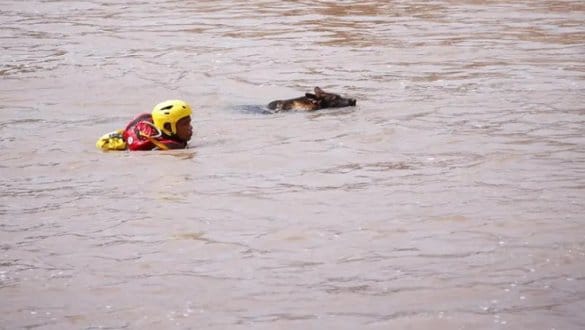
Emergency services were alerted just after 7 a.m. But with roads submerged and bridges impassable, reaching the scene proved nearly impossible. Volunteers from the Worcester Wilderness Rescue unit launched an inflatable boat from a gravel roadside, navigating through submerged fence lines and swirling eddies to search the waist-deep floodwaters.
By mid-morning, the body of the first man was found tangled in reeds near a broken irrigation ditch. The second man was discovered an hour later, nearly half a kilometer downstream, his work boots still on. The body of the woman was recovered in the early afternoon, lodged against a submerged tractor tire.
All three were farm workers employed on a mixed fruit and wine estate in the region. Their names have not yet been officially released, pending family notification, but fellow workers identified them as seasonal laborers originally from the Eastern Cape, part of a close-knit community that migrates to the Boland for the winter pruning season.
“We are heartbroken,” said a farm manager who arrived at the scene as the third body was being pulled from the water. He declined to give his name, citing company policy. “These were not just employees. They were family. We have worked together for years. This morning they came to work. Now they are gone.”
The Perfect Storm
The tragedy did not happen in isolation. The Boland region—known for its dramatic mountain passes, lush valleys, and world-class wine estates—has been battered by an intense series of cold fronts sweeping in from the Atlantic over the past week. While the rain has been welcomed by farmers after several dry seasons, the intensity of the most recent front caught many by surprise.
Data from the South African Weather Service shows that between Sunday and Tuesday morning, parts of the Breede Valley received over 150 millimeters of rain—nearly a quarter of the region’s annual average. Rivers that typically flow at ankle depth rose by three meters in less than 24 hours.
“I have lived here for 50 years. I have never seen the water rise so fast,” said Pieter de Klerk, a retired farmer from Rawsonville who watched from his stoep as the river below his property swallowed a small bridge. “You think you know the land. You think you know where is safe. But this water … it had no rules.”
Authorities had issued a Level 6 weather warning for the Cape Winelands, urging residents in low-lying areas to avoid crossing rivers and to stay indoors. But for farm workers living in informal cottages and labor quarters on the estates—often located close to irrigation canals and seasonal streams—the warnings do not always translate into safety. Many have no alternative routes to work, no transport, and no shelter beyond what the farm provides.
“You tell people to stay home,” said Breede Valley Mayor Antoinette Steyn, speaking at a press conference outside the Worcester fire station. “But you cannot tell them to stop earning their daily bread. These are people who work the land. They go out because the crops need tending, because their children need food. The rain does not respect our warnings.”
Rescue, Recovery, and Grief
By late afternoon, the rain had finally begun to ease. The sun broke through in pale patches, casting an almost cruel light over the soaked valley. Helicopters from the Western Cape government’s disaster management unit flew low over the farmland, searching for any other missing persons. None were found.
At the recovery site, a small group of farm workers gathered in silence near the police tape. Some held hands. Others clutched wet jackets around their shoulders. A single woman wailed quietly, supported by two others, before being led away to a farm vehicle.
Counselors from the Department of Social Development arrived on the scene but found few willing to speak. Grief, in this community, is often a private thing—shared in whispered conversations after dark, not in front of officials with clipboards.
Later in the evening, the three bodies were transported to the Worcester mortuary. Post-mortem examinations are expected to confirm drowning as the cause of death. Police have opened an inquest docket, though no foul play is suspected.
A Familiar Pattern
Tragically, the deaths in the Boland are not isolated. Each winter, seasonal floods claim lives across South Africa’s Western and Eastern Cape—often farm workers, informal settlement dwellers, or motorists who underestimate the power of moving water. In 2022, six people died in similar circumstances in the same region. In 2020, a father and his two children were swept from a low-water bridge outside Ceres.
Experts point to a dangerous combination: aging farm infrastructure (including unmarked or unguarded flood-prone crossings), climate change intensifying rainfall events, and the precarious living and working conditions of seasonal agricultural laborers.
“There is no easy fix,” said Dr. Thandiwe Mbeki, a disaster risk researcher at Stellenbosch University. “You cannot simply close every low-water bridge. But we can do better: early warning systems that reach workers directly by SMS, emergency shelters on farms, and, over the long term, upgrading crossings to withstand higher flows. These deaths are not inevitable. They are a failure of preparation.”
The Valley Remembers
As night fell over the Boland, the waters slowly began to recede. Lanterns flickered in farmworker cottages. In a small church in Rawsonville, a handful of women gathered to pray for the souls of the three workers they knew only by first names: Sipho, Andile, and Nomasonto—or at least, that is what the whispers said.
No official memorial has yet been announced. The farm where the tragedy occurred has declined to comment further, citing respect for the families.
But across the valley, something quiet happened. At the edge of a flooded field, someone placed three white candles on a large rock. The wax melted in the drizzle. The flames stayed lit for just a few minutes before dying.
Tomorrow, the rain may return. But tonight, the Boland mourns—three lives, swallowed by water, remembered by land.
About The Author