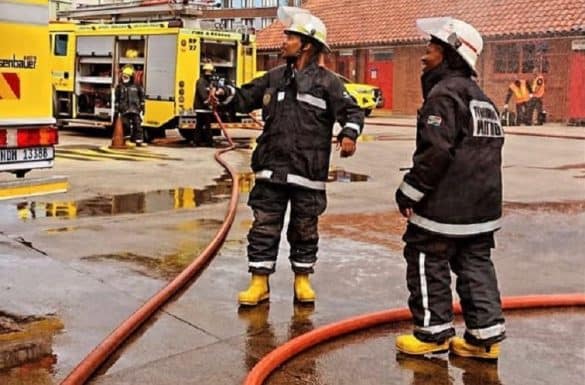
A massive, roaring fire ripped through a factory in the heavily industrialised Clairwood area south of Durban on Tuesday afternoon, sending a terrifying column of thick, black, acrid smoke billowing across the Durban South skyline and forcing the complete closure of Dayal Road as multiple emergency crews rushed to the scene in a desperate battle to contain the inferno before it could spread to neighbouring properties.
The blaze, which erupted shortly after 1:30 p.m. for reasons that remain unknown, rapidly escalated from a contained structure fire to a major emergency incident within minutes, drawing firefighting resources from across the eThekwini Metropolitan Municipality. Witnesses described hearing what sounded like a series of small explosions followed by the rapid engulfment of the building in flames that could be seen from as far away as the Bluff and central Durban.
“I was sitting in my truck waiting to offload when I heard a loud pop, then another, and then suddenly the whole side of the building was on fire,” said Sipho Dlamini, a long-distance truck driver who had been parked approximately 150 metres from the affected factory. “The heat was unbelievable. I started my engine and moved immediately. Then the black smoke came—thick, oily, choking. Even with my windows closed, I could taste it in my throat.”
A High-Risk Industrial Zone
The Clairwood industrial area, located in Durban’s southern basin between the M4 freeway and the Jacobs neighbourhood, is one of the city’s most concentrated zones of heavy industry. Home to chemical storage facilities, textile manufacturers, metalworks, and logistics hubs, the area has long been identified by emergency planners as a high-risk fire zone due to the age of many buildings, the proximity of structures to one another, and the nature of materials stored on site.
Tuesday’s fire, according to initial reports from the eThekwini Fire and Emergency Services, broke out at a factory involved in plastic and foam manufacturing—a detail that would explain both the speed of the fire’s spread and the dense, dark colouration of the smoke plume. Polyurethane foams, plastics, and associated adhesives burn ferociously and release a cocktail of toxic gases, including hydrogen cyanide, carbon monoxide, and various volatile organic compounds.
“When you see black smoke of that intensity, you know immediately that you are dealing with synthetic materials,” said Station Commander Trevor Naidoo, who was among the first senior officers to arrive at the scene. “This is not wood burning. This is plastic, rubber, foam—petrochemical products. They burn hot, they burn fast, and the smoke is hazardous to anyone who breathes it.”
Emergency Response
Within 20 minutes of the first emergency call, five fire engines, two water tankers, and a specialised hazardous materials response unit had converged on Dayal Road. Crews from Clairwood, Wentworth, and the central Durban fire stations worked in rotation, with additional units placed on standby from as far away as Pinetown and Phoenix.
The decision to close Dayal Road was made almost immediately. The road, which serves as a critical artery for heavy goods vehicles accessing warehouses and factories in the area, was sealed off at both ends—at the intersection with Old Ford Road to the north and at Bluff Road to the south. Traffic was diverted along alternative routes, causing significant congestion during the late afternoon rush hour.
“We had to prioritise access for emergency vehicles and protect the public,” Naidoo explained in a brief media briefing delivered from the scene. “The fire was too large, too unpredictable, and the smoke was reducing visibility to near zero in some areas. We could not risk civilian vehicles driving into that danger zone.”
Firefighters adopted a defensive strategy, surrounding the factory and attacking the flames from multiple angles while preventing the fire from jumping to adjacent buildings. At the height of the blaze, at approximately 2:45 p.m., flames were reported to have reached heights of more than 15 metres above the roofline, with embers carried by the wind posing a threat to properties downwind.
“It was like watching a dragon breathe,” said Thandi Mkhize, who works at a packaging company across the street from the affected factory. “We were told to evacuate our building. We stood outside and just watched. Some people were crying. Others were taking videos. I could not stop shaking. The sound—the crackling, the groaning of metal—it was terrifying.”
Health and Environmental Concerns
As news of the fire spread across Durban, concerns quickly shifted from property damage to public health and environmental impact. The thick black plume, driven by a moderate south-westerly wind, drifted northeastward over the Jacobs, Wentworth, and Merebank residential areas before dispersing over Durban Bay and eventually out toward the Indian Ocean.
The eThekwini Municipality’s Health Department issued an urgent advisory to residents in affected areas, urging them to remain indoors with windows and doors closed, to switch off air conditioning units that might draw in external air, and to seek medical attention if they experienced difficulty breathing, chest tightness, or severe eye irritation.
“Smoke from industrial fires is not the same as smoke from a veld fire or a house fire,” said Dr. Precious Ndlovu, a pulmonologist at Prince Mshiyeni Memorial Hospital in nearby Umlazi. “Industrial smoke can contain fine particulate matter that penetrates deep into the lungs, as well as chemical compounds that can trigger asthma attacks, cause chemical pneumonitis, or exacerbate existing heart and lung conditions. Vulnerable populations—children, the elderly, pregnant women, and those with chronic respiratory diseases—are at highest risk.”
Residents took to social media throughout the afternoon, sharing photographs and videos of the smoke plume from rooftops, balconies, and roadside vantage points. The hashtag #DurbanFire trended locally on X (formerly Twitter) for several hours, with some users reporting the smell of burning plastic as far north as the Durban CBD and as far south as Amanzimtoti.
“I am in Glenwood, which is more than 10 kilometres away, and I can smell it,” one user posted. “My eyes are stinging inside my own apartment. This cannot be safe.”
The Human Toll
Miraculously, given the intensity of the blaze, no fatalities had been reported by Tuesday evening. However, two firefighters were treated at the scene for heat exhaustion and mild smoke inhalation, with one requiring transport to St. Augustine’s Hospital for further observation. Both were reported to be in stable condition.
Workers who had been inside the factory at the time of the fire managed to evacuate before the flames became uncontrollable. According to a supervisor who spoke to reporters on condition of anonymity, approximately 35 employees were on shift when the fire broke out.
“We heard the alarm and we got out. There was no panic, no pushing. Everyone knew the drill,” the supervisor said. “But once we were outside and saw the fire, we realised how close we came. Another five minutes? Ten minutes? I don’t want to think about it. We are grateful. We are all going home tonight.”
A History of Industrial Fires in Clairwood
Tuesday’s blaze is not the first major fire to strike Clairwood, nor is it likely to be the last. The industrial area has a troubled history with fire safety, with previous major incidents including a 2017 chemical warehouse fire that burned for three days, a 2019 textile factory blaze that destroyed a heritage building, and a 2022 recycling plant fire that sent similar plumes of black smoke across the southern suburbs.
Residents and labour advocates have long called for stricter enforcement of fire safety regulations, more frequent inspections, and greater transparency about the types of materials being stored and processed in the area. The Clairwood Ratepayers’ Association has repeatedly raised concerns about aging infrastructure, inadequate water pressure for fire suppression, and the proximity of heavy industry to residential neighbourhoods.
“We have been warning about this for years,” said Fatima Khan, chairperson of the association. “Clairwood is a tinderbox. These buildings are old, many have been modified without proper permits, and the fire department cannot always reach them quickly because of narrow roads, parked trucks, and poor signage. Today we were lucky. One day, we may not be.”
Investigation Begins
As firefighters continued to douse hot spots into Tuesday evening, the cause of the fire remained unknown. The South African Police Service (SAPS) confirmed that a team of forensic investigators and fire experts had been dispatched to the scene and would begin their work once the building had been declared structurally safe to enter.
“We are not ruling anything out at this stage,” said Colonel Mavela Masondo, a SAPS spokesperson. “Electrical fault, human error, arson, equipment malfunction—all possibilities will be investigated. What we can say is that there is no immediate indication of foul play, but the investigation will be thorough and independent.”
The Department of Employment and Labour also announced that inspectors would visit the site to determine whether any workplace safety regulations had been violated, particularly regarding fire prevention measures, employee training, and emergency evacuation procedures.
Aftermath and Recovery
By 6 p.m., as the sun began to set over the Indian Ocean, the fire was largely contained, though smaller flare-ups continued to challenge firefighting crews. The factory itself was declared a total loss—its roof collapsed, its walls buckled and blackened, and its contents reduced to ash and twisted metal.
The owners of the factory, whose name has not yet been released pending family and stakeholder notifications, are expected to issue a statement on Wednesday. For now, the site remains under police guard, cordoned off with red-and-white tape that flutters in the evening breeze.
Dayal Road will remain closed through Wednesday morning, according to municipal traffic authorities, as structural engineers assess the stability of the damaged building and hazardous materials teams clear any remaining chemical residues. Motorists have been advised to use alternative routes, including the M4 freeway and Bluff Road.
For the residents of Clairwood and surrounding areas, the fire is both a crisis and a reminder—of vulnerability, of resilience, and of the fragile line between industry and safety.
“I have lived here for forty years,” said Mrs. Govender, an elderly woman standing outside her home three blocks from the factory, her face illuminated by the distant glow of emergency lights. “I have seen fires before. But this one… this one was different. The smoke, the heat, the sound. I prayed. I prayed hard. Tonight, I will light a candle. And I will thank God that no one died.”
As emergency crews packed up their equipment and weary firefighters removed their helmets, the smell of burnt plastic still hung heavy in the air—a lingering reminder of an afternoon when Durban burned, but somehow, mercifully, did not break.
About The Author