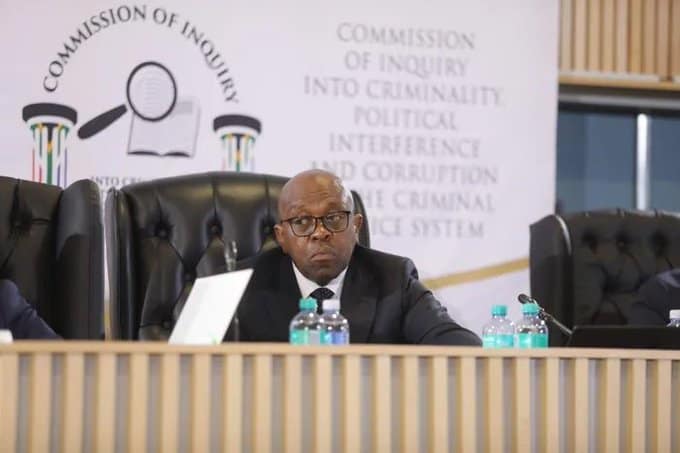
A tense and extraordinary drama unfolded behind the closed doors of the Commission of Inquiry into state capture-era criminality this week, pitting the formidable intellect of a retired Constitutional Court justice against the steely resolve of a former top cop. The catalyst: a single, explosive allegation of “fake Hawks” that nearly derailed a high-profile murder arrest and now threatens to expose deeper layers of interference within South Africa’s law enforcement structures.
Retired Justice Mbuyiseli Madlanga, the chairperson of the commission, directly confronted former Hawks boss Lieutenant General Godfrey Lebeya, demanding a full account of his actions during the chaotic, aborted arrest of accused murderer Katiso “KT” Molefe. The central, burning question: Why did General Lebeya, then the nation’s top priority crime investigator, publicly sound the alarm about impersonators, potentially jeopardizing an operation and creating a crisis of confidence in the very unit he commanded?
The Molefe Standoff: A Scene of Chaos
To understand the gravity of Justice Madlanga’s inquiry, one must return to the dramatic standoff at Molefe’s upscale residence. A dedicated Hawks team, armed with a warrant for Molefe’s arrest in connection with a brutal murder, was moments from taking him into custody. Suddenly, the operation spiralled into confusion.
Molefe’s legal team and security detail produced evidence—later revealed to be a communication from within the Hawks themselves—claiming that the arresting officers were not legitimate. Allegations flew that this was a kidnapping attempt by a rival faction or criminals masquerading as police. The situation grew so volatile that the genuine Hawks team was forced to withdraw, leaving a suspected murderer untouched and the public bewildered.
The “Fake Hawks” Alert: A Shield or a Smokescreen?
In the immediate aftermath of the botched operation, then-Lieutenant General Lebeya issued a public statement confirming the investigation into the presence of “fake Hawks.” The statement was intended to reassure the public and warn against impersonators. However, within the Commission, it is being scrutinized as a potential tactical error—or something far more sinister.
Justice Madlanga’s line of questioning suggests the Commission is exploring two troubling possibilities:
- A Grave Institutional Failure: Did General Lebeya, by confirming the “fake Hawks” narrative, inadvertently grant Molefe a powerful tool to evade legitimate justice? Did his warning, however well-intentioned, paralyze future lawful arrest attempts and erode the operational authority of every genuine Hawks officer?
- A Deliberate Act of Sabotage: Was the “fake Hawks” alert a calculated move within a wider conspiracy? The Commission is seeking to determine if Lebeya was acting on manipulated intelligence, or if his statement was designed to create just enough confusion and delay to allow Molefe to fortify his legal defenses and destroy evidence.
Justice Madlanga’s Forensic Inquiry
In the commission chamber, Justice Madlanga, known for his Socratic and incisive style, did not mince words. “General Lebeya,” he began, his tone measured but firm, “you were the head of the Directorate for Priority Crime Investigation. Your primary duty was to ensure that your teams could execute their duties without interference. I need you to explain to this Commission the chain of events that led you to believe that publicly declaring the existence of ‘fake Hawks’—in the midst of your own team’s active operation—was the most prudent course of action.”
Madlanga pressed further, homing in on the consequences. “Did you consider that such a statement could be weaponized by individuals seeking to avoid arrest? That it would create a cloud of suspicion over every subsequent police action? Who brought this information of ‘fake Hawks’ to you, and what due diligence was applied before you amplified it to the nation?”
The Wider Implications for the Hawks
This confrontation is more than a historical audit of a single failed arrest. It strikes at the heart of the Hawks’ integrity and operational independence during a period of profound state corruption. The Commission is effectively investigating whether the elite unit was so deeply compromised that its own commander could not distinguish a real operation from a fake one, or worse, was manipulated into sabotaging one.
General Lebeya’s testimony is therefore pivotal. His explanation must satisfy the Commission that his actions were a error in judgment under extreme pressure, rather than evidence of a force at war with itself, where internal factions used public statements as weapons in a shadow war.
As this high-stakes legal duel continues, the South African public waits for answers. The outcome will determine not only the legacy of a former police general but will also reveal how easily the instruments of justice can be blunted by confusion, deception, and the spectre of the “fake” badge.
About The Author