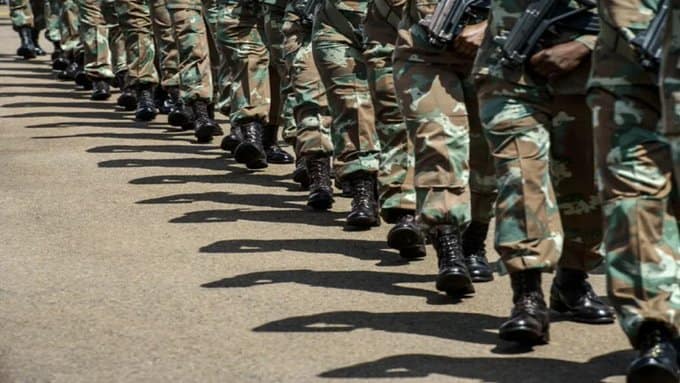
The armored vehicles rolled through the darkened streets of Manenberg at 3 a.m., their green-and-khaki silhouettes a startling sight in a neighborhood more accustomed to the blue lights of police vans. Inside, young soldiers gripped R4 rifles, their eyes scanning the zinc-roofed shacks and gang-scarred walls. Operation “Phakama” — “Rise Up” — had begun.
Days later, in a packed media briefing at Luthuli House, the African National Congress (ANC) announced its full-throated endorsement of President Cyril Ramaphosa’s decision to deploy the South African National Defence Force (SANDF) across multiple provinces to assist the embattled South African Police Service (SAPS). The move, which has seen soldiers deployed to crime hotspots in the Western Cape, KwaZulu-Natal, Gauteng, and the Eastern Cape, represents the most significant militarization of domestic policing since the 2019 violent riots.
But as the ANC frames the deployment as a necessary “war on crime,” critics question whether it is a strategic intervention—or an act of desperation from a governing party running out of answers.
The Announcement: Full Support
Standing before a bank of microphones, ANC Secretary-General Fikile Mbalula delivered the party’s position with characteristic bombast. “The ANC believes that the deployment of the SANDF to assist police in some provinces will curb the scourge of crime in affected areas,” Mbalula said. “We are not talking about a permanent military state. We are talking about surgical interventions where the state has lost control.”
Mbalula cited statistics that have become almost numbingly familiar: an average of 85 murders per day in the fourth quarter of 2025, a 12% increase in armed robberies year-on-year, and entire suburbs in Cape Town’s Cape Flats that have become no-go zones for police after dark. He also acknowledged the toll on SAPS itself—over 120 police officers killed off-duty in the past 18 months, often with their own service weapons.
“President Ramaphosa has the full backing of the ANC National Executive Committee,” Mbalula added. “The SANDF will remain until the situation stabilizes. We owe safety to our people. It is the most basic promise of any government.”
The Deployment: Where and Why
The SANDF deployment, authorized under Section 201(2)(a) of the Constitution, allows soldiers to perform “police duties” in support of SAPS—including cordon-and-search operations, vehicle checkpoints, and visible patrols in high-crime areas. They cannot arrest civilians (that remains SAPS’s role) but can detain individuals until police arrive.
The initial deployment, approved for six months, includes approximately 3,500 soldiers spread across four provinces:
- Western Cape: 1,800 soldiers focused on the Cape Flats ganglands—Manenberg, Hanover Park, Nyanga, and Philippi—where gang-related killings have claimed over 400 lives since January.
- KwaZulu-Natal: 900 soldiers in the Inanda, Umlazi, and KwaMashu townships, where taxi violence and extortion syndicates have paralyzed local economies.
- Gauteng: 600 soldiers in Soweto, Tembisa, and parts of the Johannesburg CBD, where hijackings and cash-in-transit heists have surged.
- Eastern Cape: 200 soldiers in Mthatha and Butterworth, where vigilante justice groups have formed in response to slow police response times.
Defence Minister Angie Motshekga stressed that soldiers are under strict rules of engagement. “They are not an occupying force. They are a deterrent. A show of state authority,” she told Parliament. “We have seen a decrease in reported violent crime in deployment zones within the first two weeks. That is not a coincidence.”
The Public Response: Hope, Skepticism, and Fear
On the streets of Manenberg, the reception has been mixed. Shireen Abrahams, 48, a domestic worker and mother of four, watched soldiers patrol past her front door for the fourth day in a row. She leaned against her gate, arms crossed.
“I’ve lived here for 30 years. I’ve seen police come and go. I’ve seen the army come and go after the gang violence in 2019. For two months, it was quiet. Then they left, and the shooting started again,” she said. “I want to believe this time is different. But hope is expensive, and I’m a poor woman.”
Nearby, a teenage boy named Renaldo, 17, watched the soldiers with a different kind of interest. “The gangs are just hiding,” he said softly, not wanting to be overheard. “They know the army can’t stay forever. Everyone knows. The only question is: what happens the day they leave?”
But in other parts of the city, the deployment has brought visible relief. In Philippi, where illegal mining syndicates have turned abandoned mines into fortified bases, residents reported two consecutive nights without gunfire—the first such stretch in six months.
“Let them stay,” said bakery owner Vuyiswa Mokoena. “I don’t care if they’re police or soldiers or aliens from Mars. My children need to sleep without gunshots as their lullaby.”
The Debate: War on Crime or Desperation?
The ANC’s enthusiastic backing has not gone unchallenged. Opposition parties, civil society groups, and even some within the governing alliance have raised sharp questions about the deployment’s legality, cost, and long-term strategy.
The Democratic Alliance (DA) called the deployment a “publicity stunt” and accused the ANC of militarizing crime control instead of fixing a broken SAPS. “We have a police service that is underfunded, undermanned, and demoralized,” said DA Shadow Police Minister Andrew Whitfield. “Bringing in soldiers is not a solution. It is an admission of failure.”
The Economic Freedom Fighters (EFF) went further, claiming the SANDF deployment is a precursor to a “state of emergency” and a crackdown on political dissent. “Ramaphosa is using crime as a pretext to put soldiers on our streets before the 2026 local elections,” said EFF leader Julius Malema. “We will not be intimidated.”
ActionSA demanded clarity on the cost of the operation, noting that the SANDF is already stretched thin with border patrols, peacekeeping missions in Mozambique and the DRC, and internal disaster relief. “Where are these soldiers coming from?” asked ActionSA parliamentary leader Athol Trollip. “Are we leaving our borders unguarded to patrol Soweto?”
Even within the ANC’s alliance partner, the South African Communist Party (SACP), reservations have emerged. SACP deputy general secretary David Masondo warned that deploying soldiers in poor communities risks “criminalizing poverty” and could lead to “unlawful shootings and human rights abuses.”
Historical Echoes: 2019, 2021, and the Specter of Failure
This is not the first time South Africa has turned to the military to restore order. In 2019, SANDF troops were deployed to the Cape Flats for three months, leading to a temporary drop in murders—but the gains evaporated within weeks of the withdrawal. In July 2021, soldiers were deployed to KwaZulu-Natal and Gauteng to quell looting and riots following former President Jacob Zuma’s imprisonment. That deployment lasted two months and cost over R500 million.
Forensic criminologist Dr. Mpho Sithole, who studied both operations, is cautiously pessimistic. “Military deployments are Band-Aids on bullet wounds,” he said. “The underlying issues—poverty, unemployment, dysfunctional courts, corrupt police, and easy access to illegal firearms—remain untouched. The army can clear a street. It cannot rebuild a community.”
Sithole also noted that visible military presence can sometimes escalate violence if gangs feel cornered. “We saw this in Brazil and Mexico. When the army comes in heavy, criminal networks either go underground—or fight back harder. There is no easy path.”
The Human Cost of Crime
Behind the political debate and tactical analysis lies an unignorable reality: South Africans are dying at rates that would trigger a national emergency in any comparable democracy. The latest crime statistics, released in February 2026, paint a grim picture:
- 11,500 murders between October and December 2025 alone.
- Over 23,000 sexual offenses in the same period, including 11,000 rapes.
- Nearly 6,000 carjackings — a 15% increase from the previous year.
- A conviction rate for murder hovering around 19%, meaning most killers walk free.
For the ANC, which built its liberation legacy on promises of safety and dignity, these numbers are not just policy failures—they are political existential threats. With local elections approaching in November 2026, the party is hemorrhaging support in working-class communities where crime is the number one concern.
“Mkhonto weSizwe fought apartheid so that we could live free from fear,” said ANC veteran and former minister Tokyo Sexwale, in a rare public statement. “Now our people fear walking to the shop. That is not freedom. That is a new kind of oppression. If the army can restore order, then let the army come.”
What Comes Next
The SANDF deployment is set to run until mid-November 2026—coinciding almost exactly with the local government elections. That timing has not escaped political observers. Some argue that Ramaphosa is using the military presence to project strength and security ahead of the polls. Others say the deployment will be quietly extended regardless of the election outcome because crime will not have magically disappeared.
For now, soldiers continue their patrols. Police continue their investigations. And in homes across the affected provinces, families continue to lock their doors early, keep their children inside after dark, and pray that the sound of gunfire does not interrupt the night.
“I don’t care about politics,” said Shireen Abrahams in Manenberg, as a soldier offered her a polite nod and continued walking down her street. “I care about my grandson being safe to play outside. If the soldier can give me that, even for a little while, then God bless the soldier.”
The “war on crime” has begun. Whether it is a genuine campaign or a political lifeline will be measured not in press releases, but in the number of families who dare to sleep with their windows open again.
About The Author