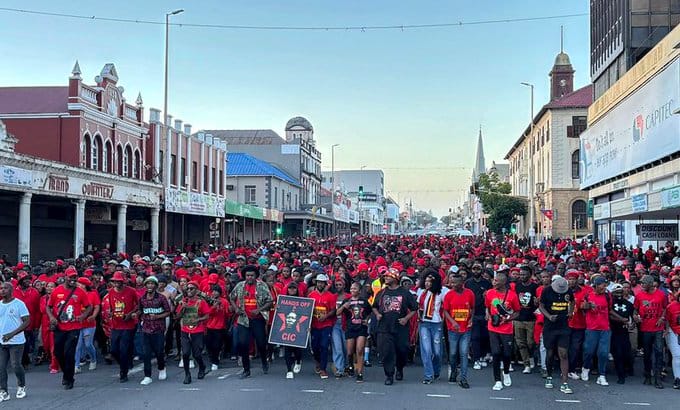
The flames of the paraffin lamps flickered against the twilight sky, casting dancing shadows across a sea of red berets. From the main taxi rank to the sprawling yards of Extension 9, the streets of KuGompo City had been transformed into a river of crimson. Tuesday night was not an ordinary night in this dusty township east of Johannesburg. This was a night of prayer, of solidarity, and of defiance.
Hundreds of Economic Freedom Fighters (EFF) supporters had gathered for a mass night vigil in support of their embattled leader, Julius Malema, who faces critical pre-sentencing proceedings in his long-running firearm case. The vigil, organized by the party’s regional leadership, drew supporters from across Gauteng and beyond, turning the usually quiet streets of KuGompo City into a pulsating hub of political energy.
“We are here because Julius Malema is not just a leader. He is a symbol,” said Thabo Mokoena, a 34-year-old EFF branch secretary from Tembisa, as he adjusted his red beret. “They have been trying to break him for years. The courts. The police. The media. But he stands tall. And we stand with him. Tonight, we pray. Tomorrow, we fight.”
The vigil came just two days before Malema is due to appear in the East London Regional Court for pre-sentencing proceedings after being convicted in February 2026 on charges of discharging a firearm in a public space. The conviction, which carries a possible prison sentence, has sent shockwaves through the political landscape, raising questions about Malema’s future as EFF leader and his eligibility to run for public office.
But on this night, in KuGompo City, there were no questions. Only certainty. Only solidarity. Only red.
The Case That Refuses to Die
The legal troubles of Julius Malema, the 45-year-old firebrand who has dominated South Africa’s political left for nearly two decades, are well-documented. The current case dates back to 2018, when Malema was accused of firing an assault rifle at a rally in East London to celebrate the EFF’s fifth anniversary. Video footage appeared to show Malema holding a firearm and firing into the air, though the quality of the footage was disputed.
Malema has consistently denied the charges, arguing that the firearm was a security guard’s weapon and that he was not the one who fired it. His legal team has mounted a vigorous defense, challenging the admissibility of evidence and the credibility of state witnesses.
But in February 2026, the court found against him. Magistrate Thandiwe Mkhize ruled that the state had proven its case beyond a reasonable doubt, convicting Malema of unlawful possession of a firearm and discharging it in a public space. The verdict was met with jubilation by his political opponents and dismay by his supporters.
“The fight is not over,” Malema told a crowd of supporters outside the court after the conviction. “We will appeal. We will fight. We will not surrender. They want to silence me. They want to break the movement. But they will fail. They always fail.”
Now, with pre-sentencing proceedings set to begin on Thursday, 16 April 2026, the stakes could not be higher. If Magistrate Mkhize imposes a prison sentence of more than 12 months, Malema would be barred from serving in Parliament and would be ineligible to run for public office for five years. That would effectively end his political career—at least for the foreseeable future.
The Vigil Begins
The vigil in KuGompo City began shortly after sunset, when the first groups of EFF supporters began trickling into the main square. By 8 p.m., the crowd had swelled to more than 500, with hundreds more arriving in buses, taxis, and private cars.
The atmosphere was part church service, part political rally, and part family reunion. Women in red T-shirts led the crowd in hymns, their voices rising in harmonies that echoed off the tin roofs of nearby shacks. Men stood in clusters, discussing the case, sharing rumors, and debating strategy. Children ran between the legs of adults, their faces painted with the EFF’s red star.
“We are praying for Comrade Julius,” said EFF regional chairperson Nomsa Dlamini, who helped organize the vigil. “We are praying for his strength. We are praying for his family. We are praying for the movement. But we are also sending a message. The EFF is not one man. The EFF is a movement. And the movement will not be broken by a courtroom.”
The vigil was not without its political edge. Speakers took turns addressing the crowd, using the opportunity to attack the judiciary, the ruling African National Congress (ANC), and what they called the “establishment media.”
“The courts are not neutral,” said EFF national spokesperson Sinawo Thambo, who traveled from Cape Town to address the vigil. “The courts are tools of the ruling class. They protect the powerful and punish the poor. They have been trying to jail Comrade Julius for years. First for corruption. Then for tax evasion. Now for a firearm. They will not stop. But neither will we.”
The crowd roared its approval, pumping fists into the air and chanting: “Julius for president! Julius for president!”
The Man at the Center
Julius Malema himself was not present at the vigil. His legal team has advised him to avoid public appearances in the days leading up to the pre-sentencing proceedings, to avoid any perception of trying to influence the court. But his absence did not diminish his presence. His face, emblazoned on posters and T-shirts, watched over the crowd from every corner of the square.
“Comrade Julius is with us in spirit,” said Dlamini. “He knows we are here. He knows we support him. And he knows that whatever happens in that courtroom, we will not abandon him. He is our leader. He is our voice. He is our future.”
The EFF leader has always enjoyed a complicated relationship with his supporters. To his followers, he is a revolutionary hero, a champion of the poor, and the only politician willing to speak truth to power. To his detractors, he is a populist demagogue, a divisive figure, and a man whose legal troubles reflect a deeper disregard for the rule of law.
But on Tuesday night, in KuGompo City, there were no detractors. Only the faithful.
The Stakes of the Case
The pre-sentencing proceedings that begin on Thursday will determine Malema’s immediate future. Magistrate Mkhize could impose any of a range of sentences, from a fine to a suspended sentence to community service to direct imprisonment.
The state is expected to push for a custodial sentence, arguing that Malema’s crime was serious, that he has shown no remorse, and that a message must be sent to public figures who flout the law. The defense will argue for a non-custodial sentence, pointing to Malema’s lack of prior convictions for violent crime, his public service, and the fact that no one was injured in the incident.
“It is a difficult call for the magistrate,” said legal analyst Mpumelelo Mkhabela. “On one hand, the court cannot be seen to give special treatment to a powerful politician. On the other hand, sending Malema to prison would be an enormous political act, with consequences far beyond this case. The magistrate will be very aware of that.”
If Malema is sentenced to direct imprisonment, his supporters have vowed to take to the streets. The EFF has a history of mobilizing its base in response to what it perceives as political persecution. In 2014, the party staged nationwide protests when Malema was found guilty of corruption (a conviction later overturned on appeal). In 2018, it organized a “shutdown” of Johannesburg when Malema was summoned to appear before the Hawks.
“We are prepared for any outcome,” said Thambo. “If Comrade Julius is jailed, we will not sit quietly. We will march. We will protest. We will make South Africa ungovernable. That is not a threat. It is a promise.”
The Broader Political Context
The Malema firearm case cannot be divorced from the broader political context in which it is unfolding. South Africa is just months away from local government elections, and the EFF is hoping to make significant gains, particularly in Gauteng and the Western Cape.
A conviction and prison sentence for Malema would be a devastating blow to those hopes. The EFF leader is the party’s main drawcard, its most effective campaigner, and the figure around whom the entire movement revolves. Without him on the campaign trail, the EFF would struggle to generate the same level of enthusiasm and media attention.
“The EFF without Julius Malema is like the ANC without Nelson Mandela,” said political analyst Ralph Mathekga. “It is not impossible, but it is very, very difficult. He is the brand. He is the message. He is the movement. If he is removed from the playing field, the EFF would be severely weakened.”
The ANC, which has been watching the case closely, has maintained a studied neutrality, careful not to be seen as celebrating the legal troubles of a political rival. But behind the scenes, party strategists are no doubt calculating the potential impact of a Malema conviction on the electoral landscape.
“It would be a gift for the ANC,” said one ANC insider, speaking on condition of anonymity. “The EFF would be in chaos. Their voters would be demoralized. Some might even come back to us. But we cannot say that publicly. It would look like we are gloating.”
The Vigil Continues
As the night wore on, the vigil in KuGompo City showed no signs of winding down. The hymns gave way to political songs, the speeches to chants. A group of young men performed a impromptu toyi-toyi, their boots pounding the dusty ground in a rhythm that spoke of struggle and resilience.
“We are not afraid,” said 22-year-old university student Palesa Mokoena, who had traveled from Soweto to attend the vigil. “We have been through worse. We have survived apartheid. We have survived corruption. We will survive this. Comrade Julius will survive this. And when he comes out—whether it is tomorrow or in five years—we will be here. Waiting. Ready.”
The vigil was also a fundraiser. Supporters dropped coins and crumpled notes into buckets passed around the crowd, the money intended for Malema’s legal fund. By the end of the night, organizers estimated they had collected more than R15,000—a modest sum given the legal costs, but a powerful symbol of grassroots support.
“Every rand counts,” said Dlamini. “We are not rich. We are workers. We are the unemployed. We are the poor. But we give what we can. Because Comrade Julius has given everything for us.”
The Family’s Vigil
While hundreds gathered in KuGompo City, a smaller, quieter vigil was taking place at Malema’s home in Johannesburg. His wife, Mantwa Matlala-Malema, and their two sons were joined by close friends and party officials for a night of prayer and reflection.
“Mantwa is very strong,” said a source close to the family. “She is not showing fear. But of course she is worried. Any wife would be worried. She is praying for her husband. She is preparing the children for whatever comes. It is a difficult time.”
The source said that Malema himself was “calm and focused” as he prepared for Thursday’s court appearance. “He has been through so much,” the source said. “He has been to court more times than he can count. He knows the system. He knows the risks. He is ready.”
The Media Presence
The vigil in KuGompo City attracted significant media attention, with television crews, radio journalists, and print reporters jostling for position. The EFF has always been a media-savvy party, and it used the vigil as an opportunity to shape the narrative ahead of the pre-sentencing proceedings.
“This is not a spectacle,” Thambo told reporters. “This is a community coming together to support its leader. This is democracy in action. This is what the EFF is about: ordinary people standing up for what they believe in.”
But not all media coverage was sympathetic. Some commentators questioned the wisdom of holding a mass vigil while a legal case was ongoing, arguing that it could be seen as an attempt to pressure the court.
“The timing is interesting,” said political commentator JJ Tabane. “You have a pre-sentencing hearing in two days, and suddenly hundreds of EFF supporters are in the streets, praying and chanting. It sends a message. Whether that message is appropriate is another question.”
The EFF rejected any suggestion of impropriety. “We are not trying to influence the court,” said Dlamini. “We are exercising our constitutional right to assemble and to express our support for a political leader. There is nothing wrong with that. Nothing at all.”
The Night Ends
By midnight, the vigil in KuGompo City was winding down. The crowds thinned. The chanting faded. The paraffin lamps sputtered and died. But the red berets remained, dotting the darkness like embers from a fire that refused to be extinguished.
“We will be back tomorrow night,” said Mokoena, the branch secretary from Tembisa. “And the night after. And every night until Comrade Julius is free. This is not a one-night thing. This is a movement. And movements do not sleep.”
As the last of the supporters drifted away, a small group remained, huddled around a single lamp, singing softly. The song was an old struggle song, one that had been sung against apartheid, against injustice, against all the forces that sought to crush the human spirit.
It was a song of defiance. A song of hope. A song that said, in words and melody, that no matter what happened in the courtroom on Thursday, the struggle would continue.
The sun would rise over KuGompo City in a few hours. And when it did, the red berets would be waiting.
The Road Ahead
Whatever happens in the East London Regional Court on Thursday, the Julius Malema firearm case has already left its mark on South African politics. It has exposed the deep divisions in the country, the passion of the EFF’s support base, and the fragility of a political system that revolves so heavily around one man.
For Malema, the stakes are existential. For the EFF, they are generational. For South Africa, they are a reminder that the legacy of the struggle is not yet settled, that the battle for justice is never truly won, and that the only certainty in politics is uncertainty.
As the first light of dawn crept over KuGompo City, casting long shadows across the empty square, the last of the vigil-keepers packed up their belongings and headed home. They were tired. They were anxious. But they were not defeated.
About The Author