The streets of Cotonou erupted long before the official announcement. By late Monday afternoon, word had spread through the labyrinthine alleys of the Dantokpa market, across the sandy beaches of Fidjrossè, and into the air-conditioned offices of the Marina district: Romuald Wadagni had done something unprecedented in Beninese political history.
When the results finally came, delivered in the measured tones of Sacca Lafia, head of Benin’s Autonomous National Electoral Commission (CENA), they confirmed what the people already knew. Finance Minister Romuald Wadagni, the 49-year-old economist who had served under outgoing President Patrice Talon for a decade, had won the presidency of Benin with a staggering 94.3% of the vote.
The announcement, broadcast on national television at 8 p.m. local time on Monday, 13 April 2026, sent shockwaves through the small West African nation. Based on more than 90% of votes counted from the presidential election held on Sunday, 12 April, the outcome was described by CENA as “irreversible,” pending final validation by the Constitutional Court. But no one in Benin was holding their breath. The landslide was too large, the margin too wide, the message too clear.
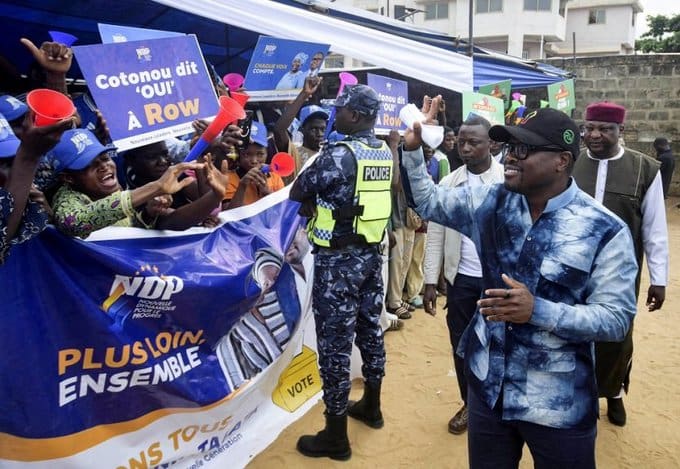
“This is not just a victory,” Wadagni told a crowd of thousands who had gathered outside his campaign headquarters in the Ganhi district, his voice cracking with emotion. “This is a revolution. A peaceful revolution. A democratic revolution. The people of Benin have spoken, and they have chosen competence over charisma, unity over division, and the future over the past.”
The Making of a Landslide
Romuald Wadagni is not a typical politician. He does not thump podiums or make grand, empty promises. He is an economist by training—a graduate of the National School of Statistics and Economic Administration in Paris and a former student at the prestigious École Nationale d’Administration (ENA). For the past decade, he has served as Benin’s Minister of Economy and Finance, overseeing a period of sustained economic growth, infrastructure development, and fiscal discipline that has transformed the country’s international standing.
But Wadagni’s path to the presidency was not without controversy. His mentor and outgoing president, Patrice Talon, has been a polarizing figure, praised for modernizing Benin’s economy but criticized for authoritarian tendencies and a crackdown on political opposition. Wadagni, as Talon’s handpicked successor, inherited both the achievements and the baggage of the Talon era.
Critics argued that the election was neither free nor fair, pointing to the exclusion of several opposition candidates on technical grounds and the government’s tight control over media and civil society. But the scale of Wadagni’s victory—more than 94% of the vote—suggests that even if the playing field was tilted, the result reflects a genuine desire for continuity among the Beninese people.
“The opposition was weak, divided, and poorly funded,” said Professor Léonard Ahouandjinou, a political scientist at the University of Abomey-Calavi. “But a 94% victory is still remarkable. It suggests that Wadagni has built a coalition that cuts across ethnic, regional, and class lines. That is not easy to do in Benin.”
The Election That Wasn’t a Contest
Sunday’s presidential election was always expected to be a one-sided affair. Of the 10 candidates initially registered to run, only three were allowed to stand after the Constitutional Court disqualified the others on various technical grounds, including incomplete paperwork and insufficient signatures. The two opposition candidates who remained—Alassane Soumanou and Corentin Kohoué—were little-known figures with limited resources and no national political infrastructure.
Soumanou, a 62-year-old former teacher, campaigned on a platform of “restoring democracy” and rolling back what he called Talon’s “authoritarian excesses.” Kohoué, a 58-year-old lawyer, focused on economic inequality and the rising cost of living. But neither was able to generate significant momentum. Their rallies drew dozens, not thousands. Their social media followings were minuscule. And their campaign coffers were empty.
“The election was over before it began,” said international election observer Mohamed Ali, who monitored the vote for the African Union. “Wadagni had all the advantages: incumbency, money, media access, and the support of the outgoing president. His opponents were never in the race.”
That did not stop the opposition from crying foul. In a press conference on Monday afternoon, before the final results were announced, Soumanou alleged “massive fraud” and “intimidation of voters” and called on his supporters to “remain calm but vigilant.” Kohoué went further, describing the election as a “masquerade” and refusing to recognize the results.
But their protests fell on deaf ears. The Beninese public, weary of political drama and focused on economic survival, appeared to accept the outcome with a mixture of resignation and relief. Turnout was estimated at just 45%—low by Beninese standards but not catastrophic given the lack of competition.
The Wadagni Vision
So what does Romuald Wadagni stand for? And what can Beninese expect from his presidency?
In his victory speech on Monday night, Wadagni outlined a vision of “continuity with acceleration.” He promised to build on the economic reforms of the Talon era while addressing the social grievances that have simmered beneath the surface of Benin’s success story.
“We have rebuilt our infrastructure. We have balanced our budgets. We have attracted foreign investment,” Wadagni said. “But we have not yet done enough for the poor. We have not yet done enough for the young. We have not yet done enough for the farmers and the fishermen and the market women who are the backbone of this nation. That will change. That must change.”
Wadagni’s priorities include:
- Job creation: Benin’s youth unemployment rate stands at nearly 15%, a source of growing frustration among the country’s young population. Wadagni has promised to create 500,000 new jobs over five years through a combination of public works, support for small businesses, and investment in digital and agricultural sectors.
- Education reform: Despite progress in access to primary education, Benin’s schools are underfunded and overcrowded. Wadagni has pledged to increase education spending by 25% over his first term, with a focus on teacher training, school construction, and vocational programs.
- Healthcare expansion: The COVID-19 pandemic exposed weaknesses in Benin’s healthcare system. Wadagni has promised to build 10 new hospitals and 50 primary health centers, and to expand universal health coverage to all citizens.
- Anti-corruption: While the Talon administration made progress in fighting corruption, Wadagni has pledged to go further, creating an independent anti-corruption agency with the power to investigate and prosecute high-level officials.
- Democratic renewal: Perhaps most significantly, Wadagni has promised to “open up the political space” and “restore trust in democratic institutions.” He has pledged to release political prisoners, reform electoral laws to make it easier for opposition candidates to run, and strengthen the independence of the judiciary.
“We have heard the criticism,” Wadagni said. “We know that some people feel excluded. We know that some people feel silenced. That will change. Under my leadership, Benin will become a model of democracy as well as a model of development.”
The Talon Shadow
No discussion of Wadagni’s victory is complete without acknowledging the role of outgoing President Patrice Talon. The 67-year-old “cotton magnate” has ruled Benin since 2016, first as a reformer, then increasingly as a strongman.
Talon’s record is mixed. On one hand, he modernized Benin’s infrastructure, built a new airport, expanded the port of Cotonou, and turned the country into a regional hub for trade and investment. On the other hand, he cracked down on political opposition, jailed journalists and activists, and amended the constitution to make it harder for opponents to run for office.
Wadagni was Talon’s chosen successor, and the outgoing president campaigned vigorously for his protégé. In the weeks leading up to the election, Talon appeared at rallies across the country, urging voters to “continue the work we have started” and warning that a change in leadership would “undo everything we have built.”
“We have come too far to turn back now,” Talon said at a rally in Porto-Novo, the constitutional capital. “Romuald Wadagni is not just my successor. He is my partner. He is my friend. He is the only person I trust to continue the transformation of Benin.”
The close association with Talon is both a blessing and a curse for Wadagni. It gives him the support of the outgoing president’s political machine, but it also makes him a target for those who view Talon as an authoritarian. Wadagni will need to navigate this tension carefully, distancing himself from Talon’s excesses while embracing his economic legacy.
“I am my own man,” Wadagni insisted in a recent interview. “I respect President Talon. I am grateful for his support. But I will govern according to my own values and my own vision. The people of Benin will see the difference.”
The International Reaction
The international community has greeted Wadagni’s victory with cautious optimism. France, Benin’s former colonial power and largest trading partner, was the first to congratulate the president-elect, with President Emmanuel Macron praising the “peaceful and orderly conduct” of the election.
“France looks forward to continuing its close cooperation with Benin under President-elect Wadagni,” Macron said in a statement. “We share a commitment to democracy, development, and stability in West Africa.”
The African Union, the Economic Community of West African States (ECOWAS), and the United Nations all issued statements congratulating Wadagni and urging the opposition to accept the results. The United States, which has been critical of Talon’s human rights record, took a more measured approach, noting that it was “monitoring the situation” and calling for “a transparent validation process.”
But the most important reaction came from Benin’s neighbors. Nigeria, which shares a border with Benin to the east, has long viewed the smaller country as a strategic partner in the fight against terrorism, smuggling, and organized crime. President Bola Tinubu called Wadagni to offer his congratulations and to invite him for a state visit as soon as possible.
“We have much to discuss,” Tinubu said, according to a readout of the call. “The stability of our region depends on cooperation between our countries. I look forward to working with President-elect Wadagni to strengthen that cooperation.”
The Opposition’s Response
The opposition’s response to the election results has been muted. Soumanou and Kohoué have both indicated that they will challenge the results before the Constitutional Court, but few expect the challenge to succeed. The court, whose members are appointed by the president, has never overturned a presidential election.
“We will exhaust all legal avenues,” Soumanou told reporters on Tuesday morning. “But we are realists. The system is stacked against us. The people have spoken, but the people were not given a real choice.”
Kohoué was more philosophical. “Democracy is not just about elections,” he said. “It is about a culture of accountability, a respect for human rights, and a space for dissent. Benin has made progress, but we still have a long way to go. I will continue to fight for democracy, whether from inside or outside the government.”
The real test for Wadagni will be whether he reaches out to the opposition or ignores them. In his victory speech, he extended an olive branch, inviting “all Beninese, regardless of their political affiliation, to join me in building a better future.”
“We are not enemies,” he said. “We are compatriots. We share the same land, the same history, the same dreams. Let us put aside our differences and work together. That is the only way forward.”
The Challenges Ahead
Wadagni inherits a country that is, by West African standards, relatively stable and prosperous. Benin’s economy grew by an average of 6% per year under Talon, driven by cotton exports, port activity, and a growing services sector. Poverty has declined, infrastructure has improved, and foreign investment has increased.
But significant challenges remain. Corruption is still endemic, despite Talon’s efforts. The education and healthcare systems are underfunded and understaffed. Youth unemployment is a ticking time bomb. And the country’s dependence on cotton and transit trade makes it vulnerable to external shocks.
“The Talon years were good for macroeconomics but not for ordinary people,” said economist Gilles Yabi, founder of the think tank Wathi. “Wadagni needs to translate growth into jobs, into services, into tangible improvements in people’s lives. That is the real test. If he fails, the next election will not be so easy.”
Wadagni has signaled that he understands this. In his victory speech, he announced a “Marshall Plan for the Beninese people,” a comprehensive program of investment in infrastructure, education, healthcare, and social protection. He has promised to create a “new social contract” that balances economic growth with social justice.
“We have the resources,” he said. “We have the plan. We have the will. Now we need the unity. Together, we will build a Benin that works for everyone, not just the privileged few.”
The Validation Process
The final step in Benin’s electoral process is validation by the Constitutional Court. The court has 15 days to review the results, hear any challenges, and issue a final ruling. Given the margin of victory, the court is expected to validate the results without significant changes.
Wadagni will then be inaugurated as president in a ceremony expected to take place in late May or early June. The ceremony, to be held in Porto-Novo, will be attended by heads of state from across West Africa, as well as representatives from France, the United States, and other international partners.
Outgoing President Talon will hand over the reins of power peacefully, as he has promised. Despite his authoritarian tendencies, Talon has respected constitutional term limits and has not sought to extend his rule. That alone sets him apart from many of his peers in the region.
“Talon will leave office with a mixed legacy,” said Ahouandjinou, the political scientist. “But he will leave. That is more than you can say for some African leaders. And for that, he deserves credit.”
A New Era
As the sun rose over Cotonou on Tuesday morning, the city was calm. The celebrations had ended. The red and yellow flags of the Wadagni campaign had been taken down. Life had returned to normal.
But something had changed. Benin had chosen a new leader. Not through violence, not through coup, not through street protests, but through the ballot box. Imperfect though the process may have been, it was a peaceful transfer of power. And in a region plagued by coups, insurgencies, and democratic backsliding, that is no small thing.
“The Beninese people have shown that democracy is still possible in West Africa,” said Ali, the AU election observer. “It is not perfect. It is not without flaws. But it is a beginning. And every journey begins with a single step.”
For Romuald Wadagni, the journey is just beginning. He has the mandate. He has the plan. He has the support of the people. Now he must deliver.
The eyes of Benin, of West Africa, and of the continent are upon him. The future is unwritten. But for the first time in a long time, there is reason to hope.
As Wadagni walked off the stage after his victory speech, his wife by his side, the crowd chanted his name: “Wadagni! Wadagni! Wadagni!” The sound echoed across the square, across the city, across the nation.
Benin had a new president. And a new era had begun.
About The Author