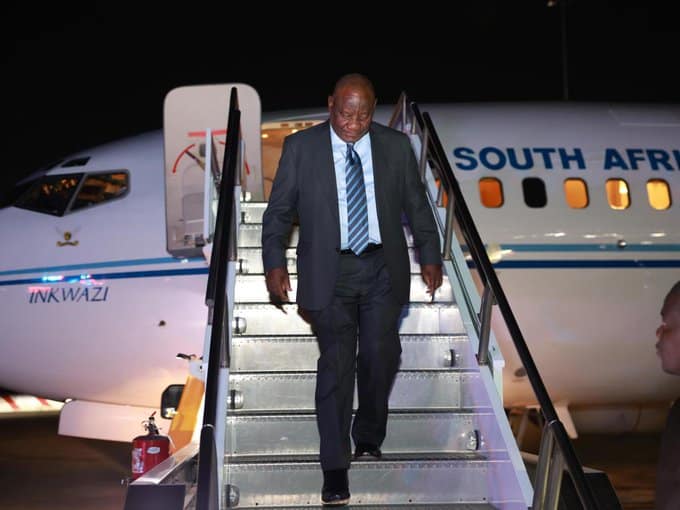
It was meant to be a quiet diplomatic gesture—a handshake between neighbors, a conversation about trade and stability, a brief respite from the crushing weight of South Africa’s domestic crises. On May 3, President Cyril Ramaphosa crossed the Limpopo River at the invitation of Zimbabwean President Emmerson Mnangagwa, traveling to his private farm in Kwekwe, a dusty town in the heart of Zimbabwe’s Midlands province. The agenda, according to official statements, was bilateral: discussing energy cooperation, the movement of goods at Beitbridge, and the fragile political transition in Zimbabwe following contested elections.
But within 48 hours of Ramaphosa’s return to Pretoria, the visit had detonated a political firestorm that now threatens the delicate architecture of South Africa’s Government of National Unity (GNU)—the coalition formed after the tumultuous 2024 elections that brought Ramaphosa’s African National Congress (ANC) into an uneasy marriage with the Democratic Alliance (DA) and several smaller parties.
The reason? A photograph. Actually, several of them.
In images that circulated rapidly on social media and were subsequently published by Zimbabwean state media, Ramaphosa is seen smiling alongside a man who has become the ghost at the feast of Zimbabwean politics: Wicknell Chivayo, a flamboyant businessman and known associate of Mnangagwa, who is currently under investigation for suspicious financial flows totaling an eye-watering R1.1 billion and multiple counts of money laundering.
The Man in the Frame
Wicknell Chivayo is not a man who fades into the background. Known for his ostentatious displays of wealth—fleets of luxury cars, cash giveaways to musicians, and a social media presence that flaunts private jets and designer watches—he has long been a figure of fascination and suspicion in Zimbabwe. But fascination curdled into alarm when South African authorities began tracing a web of financial transactions linking Chivayo to accounts in Johannesburg and Cape Town.
According to investigative files shared between South Africa’s Directorate for Priority Crime Investigation (the Hawks), the South African Revenue Service (SARS), and the Financial Intelligence Centre (FIC), Chivayo is at the center of a complex money laundering network that has moved over R1.1 billion through South African banks in the past three years. The funds, sourced from opaque Zimbabwean tender contracts—including a disputed multibillion-dollar deal to build a solar power plant in Zimbabwe—were allegedly funneled into South African property, vehicle purchases, and offshore accounts.
Chivayo has not been charged with any crime in either country and has repeatedly denied wrongdoing, describing the investigations as “politically motivated persecution” by enemies of President Mnangagwa. But the probes remain active, and law enforcement sources confirm that Chivayo is considered a person of interest in multiple ongoing cases.
Against this backdrop, Ramaphosa’s apparently cordial interaction with Chivayo at Mnangagwa’s farm was, for many South Africans, a bridge too far.
The DA’s Fury
The Democratic Alliance, which holds the second-largest bloc of seats in the GNU and has been walking a tightrope between cooperation with the ANC and opposition to its ethical lapses, did not hold back.
“The President of South Africa does not belong on a farm owned by a foreign head of state, photographed smiling alongside a man whom our own law enforcement agencies are actively investigating for laundering over R1 billion through our financial system,” said DA leader John Steenhuisen in a blistering statement issued on May 4. “This is not diplomacy. This is an endorsement—whether intended or not—of corruption, of impunity, and of the very crimes our own detectives are working to expose.”
Steenhuisen, who also serves as Minister of Agriculture in the GNU, went further, questioning whether the visit signaled a shift in South Africa’s official stance toward Zimbabwe. “ZANU-PF has made no secret of its desire to extend its grip on power. President Mnangagwa’s term ends in 2028, but there are already whispers of constitutional amendments to allow him to stay longer. For President Ramaphosa to provide a photo opportunity and a veneer of legitimacy to this regime—while standing next to a man accused of laundering a billion rand—is an affront to every South African who believes in the rule of law.”
The DA has formally requested an urgent meeting with Ramaphosa to explain the purpose of the visit and to clarify his interactions with Chivayo. Party insiders say that if the response is unsatisfactory, the DA may consider recalibrating its participation in the GNU—a threat that, if carried out, could plunge South Africa back into political instability less than two years after the coalition was formed.
Ramaphosa’s Defense
The President’s office responded swiftly, if somewhat defensively. In a statement released late on May 4, Ramaphosa’s spokesperson, Vincent Magwenya, acknowledged the controversy and sought to defuse it.
“President Ramaphosa travelled to Kwekwe at the invitation of President Mnangagwa for the sole purpose of discussing bilateral matters of mutual interest between South Africa and Zimbabwe,” Magwenya said. “The President was not aware of the presence of Mr. Wicknell Chivayo at the farm, nor was Mr. Chivayo part of the official议程. The President did not engage Mr. Chivayo in any substantive discussion, and the photograph in circulation captures a brief, incidental moment.”
Magwenya emphasized that the ongoing investigations into Chivayo and his associates would continue without interruption. “The Hawks, SARS, and the South African Police Service have the full support of the Presidency in their work. No individual, regardless of their connections, is above the law. The President has neither sought nor received any briefing on these investigations, nor has he interfered in any way. They will proceed as they would have had this visit never taken place.”
The statement also rejected any suggestion that the visit signaled a change in South Africa’s stance toward Zimbabwe’s internal politics. “South Africa maintains a policy of non-interference in the affairs of other sovereign states. The President’s engagement with President Mnangagwa is consistent with diplomatic norms and does not constitute an endorsement of any particular policy or person within Zimbabwe.”
The Broader Context: A GNU Under Strain
The backlash over the farm visit arrives at a particularly sensitive moment for the Government of National Unity. Formed after the inconclusive 2024 national elections—in which the ANC lost its parliamentary majority for the first time since the end of apartheid—the GNU was hailed as a mature compromise, a coalition of rivals willing to put the country’s stability above partisan interests. The ANC, under Ramaphosa, retained the presidency, but the DA secured several key cabinet portfolios, including agriculture, education, and public works.
But the marriage has been rocky from the start. Policy disagreements over land reform, energy privatization, and the National Health Insurance (NHI) have repeatedly flared into public spats. The ANC’s left-leaning economic instincts clash with the DA’s free-market orthodoxy, and the smaller parties in the coalition—the Inkatha Freedom Party (IFP) and the Economic Freedom Fighters (EFF), which joined after protracted negotiations—have often acted as wild cards, siding with one partner or the other depending on the issue.
The Zimbabwe visit threatens to open a new front in this internal war. For the DA, which has long criticized the ANC’s “quiet diplomacy” toward Harare as naive and counterproductive, the sight of Ramaphosa cosying up to Mnangagwa (and, by extension, to Chivayo) is a gift—an opportunity to paint the ANC as soft on corruption when it suits diplomatic convenience.
For the ANC, the DA’s reaction is opportunistic grandstanding. “The DA does not understand the complexities of regional diplomacy,” one senior ANC official told this reporter on condition of anonymity. “We cannot simply shout at Zimbabwe from across the Limpopo. We have to engage. Two million Zimbabweans live in South Africa. Their economy is our economy. A collapsed Zimbabwe is a humanitarian and security disaster for us. The DA wants cheap headlines. We have to manage actual relationships.”
The Hawks, SARS, and the Unfinished Work
Behind the political noise, the investigative machinery continues to turn. The Hawks have confirmed that their probe into the R1.1 billion suspicious flows is ongoing and that no request has been received from the Presidency to slow or halt it. SARS, which has undergone a significant rebuilding of its investigative capacity since the “rogue unit” days, is understood to be examining tax compliance issues related to several entities linked to Chivayo.
A source within the Hawks, speaking anonymously because they are not authorized to discuss an open investigation, said: “We are aware of the photographs. We are aware of the political noise. It does not affect our work. We follow the evidence, not the headlines. If the evidence takes us to a particular door, we knock on that door. No one has told us to stop knocking.”
That door, for now, remains closed. Chivayo has not responded to multiple requests for comment from South African media.
What Happens Next?
The immediate future holds at least three potential flashpoints.
First, the DA’s requested meeting with Ramaphosa. If the President fails to provide satisfactory answers, the DA’s parliamentary caucus could push for a formal motion of censure—a symbolic but damaging rebuke that would signal deep fractures within the GNU.
Second, the investigations themselves. Any new development in the Hawks or SARS probes—a witness coming forward, a document leak, a formal charge—would reignite the story with fresh urgency.
Third, the Zimbabwean dimension. Mnangagwa’s government has not commented on the controversy, but it is unlikely to appreciate the DA’s characterization of ZANU-PF as a corrupt, power-hoarding regime. The diplomatic fallout could chill relations between Pretoria and Harare for months.
For ordinary South Africans, the affair is yet another reminder of a painful truth: the line between diplomacy and complicity is often drawn in sand, not stone. And when the tide comes in, all the photographs in the world cannot wash away the stain of a handshake with the wrong man.
As one political commentator put it wryly on social media: “Ramaphosa went to talk about energy and trade. He came back with a selfie worth R1.1 billion. Not a great return on investment.”
The President’s office is no longer answering calls about the farm visit. The photograph, however, remains online—a frozen moment, a silent accusation, and a very public headache for a coalition government that can ill afford any more.
About The Author