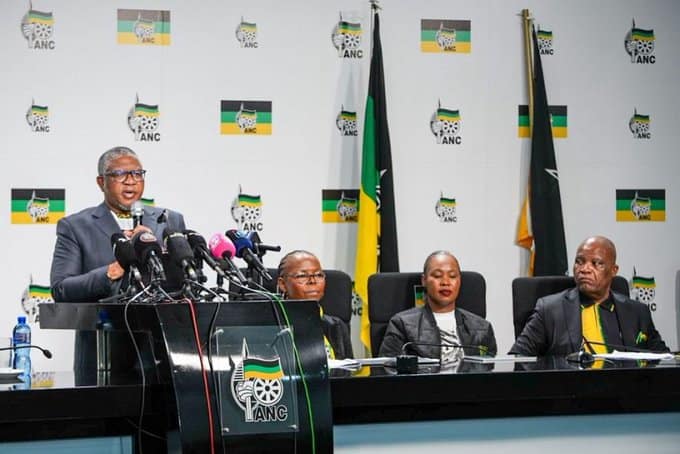
In a dramatic and unprecedented move that threatens to tear open the decades-old alliance between the African National Congress (ANC) and the South African Communist Party (SACP), the ANC has confirmed that it will send formal letters to all its members—including the thousands who also hold dual membership in the SACP—giving them just 10 days to declare, in writing, whether they will campaign for the ANC or the SACP in the upcoming local government elections.
The ultimatum, which was approved during a tense special session of the ANC’s National Executive Committee (NEC) held over the weekend, marks a significant escalation in the growing hostility between the two former liberation movement allies. Political analysts warn that the move could trigger a mass exodus of SACP members from the ANC, further fragmenting the ruling party’s already dwindling electoral base.
The Letter: 10 Days to Choose
According to internal ANC documents seen by this publication, the letter—titled “Declaration of Campaign Loyalty and Party Alignment”—will be dispatched to all registered ANC members via email, SMS, and physical mail starting on Monday, 27 April 2026. Recipients will have until midnight on 7 May 2026 to respond.
The letter contains a single, stark question:
“Do you hereby affirm that you will campaign exclusively for the African National Congress and its duly nominated candidates in the upcoming local government elections, and that you will not campaign for, endorse, or lend support to any other political party, including the South African Communist Party, should it contest elections independently?”
Members who answer “Yes” will be required to sign a pledge of loyalty. Those who answer “No”—or who fail to respond within the 10-day window—will face immediate suspension from the ANC pending a disciplinary hearing that could result in expulsion.
“We cannot have people eating from the ANC’s table while sleeping in another party’s bed,” a senior ANC NEC member told this publication on condition of anonymity. “The SACP has declared its intention to contest elections independently. That makes them our political opponents. You cannot be a member of two opposing teams. It’s that simple.”
The SACP’s Independent Election Bid
The ultimatum follows the SACP’s formal announcement in February 2026 that it would contest the upcoming local government elections—scheduled for October 2026—on its own ticket, ending nearly three decades of fielding candidates under the ANC banner.
The SACP’s decision came after years of growing frustration with what the party describes as the ANC’s “rightward drift,” its embrace of neoliberal economic policies, and its failure to address corruption, unemployment, and service delivery collapse. SACP General Secretary Solly Mapaila has been increasingly vocal in his criticism of the ANC leadership, accusing President Cyril Ramaphosa and his allies of “betraying the working class.”
“We are not a spare wheel. We are not a voting machine for the ANC. We have our own policies, our own vision, our own revolutionary mandate,” Mapaila said during the SACP’s 16th National Congress in Boksburg. “If the ANC will not lead in the interests of the workers, then the workers will lead themselves.”
The SACP has since begun registering candidates in several key municipalities, including Johannesburg, Tshwane, Ekurhuleni, eThekwini, Nelson Mandela Bay, and Buffalo City. The party has also formed a “Progressive Front” with several smaller left-wing organizations, including the United Front and the Socialist Revolutionary Workers Party.
The ANC’s Justification: Discipline or Desperation?
ANC Secretary-General Fikile Mbalula defended the ultimatum during a press briefing on Monday, framing it as a matter of internal party discipline rather than an attack on the SACP.
“The ANC has a constitution. That constitution requires that members owe their primary political allegiance to the ANC. You cannot serve two masters,” Mbalula said. “If a member chooses to campaign for another party, that member has effectively resigned from the ANC. We are simply asking for clarity. We are not expelling anyone. We are asking them to choose.”
Mbalula rejected suggestions that the move would split the alliance or weaken the ANC ahead of the elections. “The alliance is stronger than any election. But the alliance is not a marriage of convenience. It is a strategic relationship between independent organizations. Each organization has the right to exist, to campaign, to contest elections. But you cannot be in two organizations that are contesting against each other. That is basic logic.”
However, critics within the ANC itself have condemned the ultimatum as a sign of panic and desperation. With the ANC’s national support having fallen below 40 percent in recent polls—down from 57 percent in 2019—the party is facing the real possibility of losing control of multiple metropolitan municipalities.
“This is what a dying party does. It turns inward. It attacks its own allies. It purges dissent,” said a former ANC MP who resigned in 2024. “Instead of fixing service delivery, instead of tackling corruption, instead of creating jobs, the ANC is sending letters to its members asking them to swear loyalty. It’s pathetic. It’s embarrassing. And it will backfire.”
The SACP’s Response: Defiance and Derision
The SACP has responded with characteristic defiance. General Secretary Solly Mapaila, speaking at a rally in Khayelitsha on Sunday, dismissed the ANC’s ultimatum as “a desperate act of a party that has lost its way.”
“We laugh at this letter. We tear it up,” Mapaila said, holding up a mock copy of the letter before ripping it in half on stage. “No piece of paper will stop a communist from fighting for the working class. No 10-day deadline will silence the truth. The ANC is not our father. The ANC is not our boss. The ANC is our ally—or it was. Now, it is our competitor. And we will beat them.”
Mapaila called on SACP members who also hold ANC membership to “ignore the letter” and to continue building the SACP’s independent election campaign. “Do not resign from the ANC. Let them expel you. Let them show the world that they are afraid of competition. Let them explain to the people why they are purging communists while protecting corrupt tenderpreneurs.”
The SACP has also announced that it will provide legal support to any member who faces disciplinary action from the ANC as a result of their dual membership. “We will fight this in court, in the streets, and at the ballot box,” Mapaila said.
The View from the Ground: Members Caught in the Crossfire
For rank-and-file members who belong to both the ANC and the SACP, the ultimatum has created a painful dilemma. Many joined both organizations because they believed in the shared vision of a democratic, socialist South Africa. Now, they are being forced to choose between two political families.
“I joined the ANC because my father was in the ANC. I joined the SACP because I believe in Marxism. For 20 years, no one asked me to choose. Now, suddenly, I am a traitor if I don’t pick one,” said Thabo Mokoena, 48, a teacher from Soweto who holds membership in both parties.
Mokoena said he has not yet decided how to respond to the letter. “My heart is with the SACP because they speak the truth about unemployment, about land, about the banks. But my history is with the ANC. My community knows me as an ANC member. If I leave, they will call me a sellout. If I stay, I betray my beliefs. There is no good choice.”
Others have already made their decision. Nomsa Dlamini, 35, a community health worker from Pietermaritzburg, said she will resign from the ANC immediately. “The ANC has done nothing for us. No jobs. No houses. No safety. The SACP at least has a plan. I am not afraid to leave. The ANC needs us more than we need them.”
But some dual members plan to defy both parties. “I will tick ‘Yes’ on the ANC letter, and I will still campaign for the SACP. They cannot watch every street corner. They cannot check every ballot. I will be a soldier for the workers in secret,” said a KwaZulu-Natal activist who asked not to be named.
Political Fallout: A Fractured Left
The rift between the ANC and the SACP has been brewing for years, but the ultimatum marks a point of no return. Political analysts say the consequences could be catastrophic for both parties—and for the broader left in South Africa.
“If the SACP takes even 5 percent of the vote in key municipalities, that will likely come directly from the ANC’s base. That could be enough to hand those municipalities to the DA or to coalitions led by the EFF,” said political analyst Professor Susan Booysen of Wits University. “The ANC is gambling that the SACP will fail to gain traction. But the SACP has deep roots in the trade union movement and in poor communities. They could surprise everyone.”
Booysen added that the ultimatum could also accelerate the decline of the alliance as a coherent political force. “The tripartite alliance—ANC, SACP, Cosatu—has been dying for a decade. This could be the funeral. Once you start sending loyalty letters, you are admitting that the alliance no longer functions. You are formalizing a divorce.”
The Democratic Alliance (DA) and Economic Freedom Fighters (EFF) have both welcomed the split, seeing it as an opportunity to pick up disillusioned voters.
“The ANC is eating itself alive,” said DA leader John Steenhuisen. “While they fight among themselves, the DA is focused on fixing potholes, creating jobs, and cleaning up corruption. Voters will remember who was working and who was fighting.”
EFF leader Julius Malema was more blunt: “Let them fight. Let them destroy each other. The EFF is the only home for the working class now. The ANC and SACP can go to hell together.”
Historical Context: A Strained Alliance
The ANC-SACP alliance dates back to the 1920s, when communists and African nationalists first cooperated in the struggle against colonialism and apartheid. For decades, the alliance was a source of strength, with the SACP providing ideological rigor and organizational discipline while the ANC provided mass political leadership.
After 1994, the alliance continued, with SACP members serving in ANC-led governments and the SACP choosing not to contest elections independently. However, tensions grew as the ANC adopted neoliberal economic policies—including GEAR (Growth, Employment and Redistribution) in 1996—that the SACP opposed.
In recent years, those tensions have exploded into open conflict. The SACP has repeatedly called for the nationalization of mines and banks, the expropriation of land without compensation, and the scrapping of the National Treasury’s fiscal austerity policies. The ANC has rejected these calls as “impractical” and “economically destructive.”
The breaking point came in 2025, when the SACP announced that it would no longer second its members to ANC-led government positions, and that it would begin preparing for independent electoral contests.
What Happens Next?
The coming weeks will be critical. Here is what to watch for:
- 7 May 2026: Deadline for ANC members to respond to the loyalty declaration. The ANC’s disciplinary committee will begin processing non-responses and “No” responses immediately thereafter.
- Mid-May 2026: The first wave of suspensions and disciplinary hearings is expected. Expelled members may appeal to the ANC’s National Disciplinary Committee.
- Late May 2026: The SACP is expected to launch its official local government election manifesto, with a focus on municipalities where it has the strongest grassroots presence.
- June-July 2026: Legal challenges may be filed by SACP members who argue that the ANC’s ultimatum violates their constitutional right to freedom of association and political choice.
- October 2026: Local government elections. The results will determine whether the ANC-SACP split was a fatal wound or a manageable fracture.
A Party at War With Itself
Outside the ANC’s Luthuli House headquarters in Johannesburg on Monday, a small group of protesters gathered. Some held SACP flags. Others held ANC flags. They shouted at each other across a police barrier.
“ANC is the real liberation movement!” shouted one.
“SACP is the future!” shouted another.
Inside the building, officials were preparing thousands of letters. Computers hummed. Printers churned. Envelopes were stuffed and sealed.
Each letter carried the same question. Each question demanded an answer. And each answer—yes or no—would change someone’s political life.
In a nearby café, a dual member sipped coffee and stared at his phone. The email had arrived at 8 a.m. He had not opened it yet. He was not sure he ever would.
“I don’t want to choose,” he said quietly. “Why do I have to choose?”
Outside, the wind picked up. The flags flapped and tangled. Red and green and yellow and black—all the colors of a liberation struggle that once united a nation, now fluttering in opposite directions.
About The Author