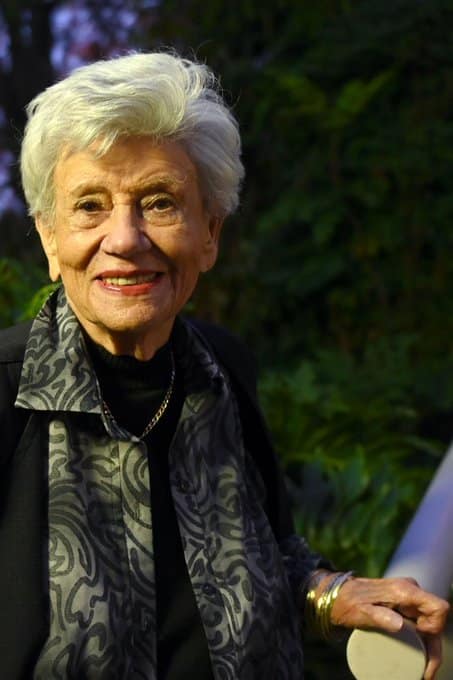
The high notes have fallen silent. The stage lights have dimmed. And a nation that once held its breath whenever she opened her mouth to sing now exhales in collective grief and gratitude.
Mimi Coertse, the legendary South African soprano whose crystalline voice carried the hopes and dreams of a divided country to the great opera houses of Europe and back home again, has died at the age of 93. She passed away peacefully in a Pretoria care facility, surrounded by a small circle of family and the quiet echoes of a life lived entirely in service of beauty.
Her death marks the end of an era—not just for South African classical music, but for a certain kind of artistic greatness that seemed to belong to another, more graceful age. Yet those who heard her sing, whether at the Vienna State Opera or in a dusty township hall, know that such greatness never truly disappears. It lingers in recordings, in memories, and in the voices of the generations she inspired.
The Girl from Pretoria Who Conquered the World
Maria “Mimi” Coertse was born on June 12, 1932, in Durban, but she always considered Pretoria her spiritual home. It was there, in the quiet, conservative capital of a country still finding its feet after the Union of South Africa was formed, that a young girl with an astonishing natural gift first opened her mouth to sing in the church choir.
Her parents were not musicians. Her father was a civil servant; her mother a homemaker. But they recognized something extraordinary in their daughter—a voice that seemed too big for her small frame, too pure for the dusty streets of the Jacaranda City.
“She would sing along to the radio, to records, to anything,” her younger brother recalled in a documentary made for her 80th birthday. “And we would just stop and listen. Even then, as a child, she had the power to make a room go silent.”
After studying at the University of Pretoria and the South African College of Music in Cape Town, Coertse made a decision that would change her life—and South African cultural history. She boarded a ship for Europe in the mid-1950s, carrying little more than a suitcase, a handful of scores, and a voice that had not yet been fully tested.
Europe, in those post-war years, was rebuilding. And it was hungry for new talent.
Vienna: The City That Made Her, and She Made Famous
Coertse arrived in Vienna in 1955, a young soprano from the southern tip of Africa in a city that had once been the capital of the classical music world. She studied under the legendary Josef Witt, a taskmaster who pushed her relentlessly. “He used to say I had the talent but not the discipline,” she later recalled with a wry smile. “I learned discipline quickly. Or he would have sent me home.”
In 1958, she made her debut at the Vienna State Opera—one of the most prestigious stages in the world. The role was the Queen of the Night in Mozart’s The Magic Flute, a fiendishly difficult part that demands not only a stratospheric range but also an almost inhuman agility. Some sopranos avoid it. Coertse conquered it.
The critics were unanimous. “Eine Stimme wie Kristall” —a voice like crystal. “Ein neuer Stern am Opernhimmel” —a new star in the opera sky.
For the next two decades, Coertse was a fixture at the Vienna State Opera, performing over 1,000 performances in more than 50 roles. She sang for emperors and presidents, for schoolchildren and factory workers. She performed under Herbert von Karajan, Karl Böhm, and Leonard Bernstein—the titans of 20th-century conducting.
But she never forgot where she came from.
The Voice for South Africa: A Complicated Homecoming
The apartheid era cast a long shadow over Coertse’s career. As a white South African performing on the world stage, she was frequently asked about her country’s racial policies. Her answers were careful, sometimes criticized by both sides. She was not a political activist. She was an artist. But she carried the weight of her nation’s contradictions wherever she went.
“You cannot separate the artist from the country that shaped them,” she said in a rare interview in 2005. “I loved South Africa. I was proud to be South African. But I did not love everything my government did. That is a tension I lived with every day.”
When she finally returned to South Africa permanently in the late 1980s, she found a country on the brink of transformation. Nelson Mandela was still in prison. The townships were burning. But Coertse believed, fiercely, that music could heal what politics had torn apart.
She gave masterclasses in Soweto. She mentored young singers of all races, often at her own expense and without any publicity. She founded the Mimi Coertse Bursary Fund to help talented underprivileged students study classical music. For her, opera was not an elite indulgence—it was a universal language.
“The voice does not know the color of your skin,” she once said. “The voice knows only truth or lies. Honesty or pretension. I listened for the truth.”
The Legacy: More Than a Voice
Over her long career, Coertse received countless honors. South Africa awarded her the Order of Ikhamanga in Silver for her contribution to music and culture. Austria bestowed upon her the title of Kammersängerin —a rare and prestigious honor reserved for the greatest singers of the Viennese stage. She held honorary doctorates from several universities and was the subject of books, documentaries, and academic studies.
But the honor that meant most to her, she once confessed, was the simple name many South Africans called her: “The Voice for South Africa.”
“It was not about politics,” she explained. “It was about representing something pure. When I sang, I wanted people to forget their troubles. I wanted them to feel lifted. If I did that for even one person, I had done my job.”
The Final Years: A Gentle Silence
In her later years, Coertse retreated from the public eye. Age and illness took away the voice that had once soared over Vienna. But she remained in Pretoria, living quietly, receiving occasional visitors who came to pay homage.
Her former students, now established singers and teachers themselves, would visit to sing for her—not because she asked, but because they wanted to give back a fraction of what she had given them.
“She would listen with her eyes closed,” recalled soprano Pretty Yende, one of South Africa’s most celebrated contemporary opera stars, who visited Coertse just last year. “And when you finished, she would open her eyes and just nod. That nod meant everything. It said, ‘You are ready. You are carrying the flame.'”
Coertse never married and had no children. But those who knew her say she considered every young singer who passed through her studio a child of her heart.
“I had many children,” she once joked. “They just didn’t come from my womb. They came from my vocal cords.”
Tributes Pour In from Around the World
News of Coertse’s death spread quickly on Tuesday morning, prompting an outpouring of tributes from across the cultural and political spectrum.
President Cyril Ramaphosa issued a statement praising Coertse as “a national treasure who used her extraordinary gift to elevate South Africa’s presence on the world stage.”
“Mimi Coertse’s voice was a bridge,” Ramaphosa said. “In difficult times, she reminded us of the beauty of which humanity is capable. She will be deeply missed, but her music will live forever.”
The Vienna State Opera, where Coertse performed more than 1,000 times, lowered its flag to half-mast. In a statement, the opera house called her “one of the great Queens of the Night in the history of this institution. Her voice, her artistry, and her warmth will never be forgotten.”
In South Africa, the arts community mourned a towering figure who had mentored generations. “She was not just a singer,” said Bongani Tembe, CEO of the Mzansi Philharmonic Orchestra. “She was a institution. She taught us that excellence is not arrogant—it is generous. She shared everything she had.”
The Funeral: A Final Applause
Details of the funeral arrangements have not yet been released, but it is expected that Coertse will be given a state funeral or an official memorial service befitting her status as a cultural icon. Her family has requested privacy during this time but has indicated that a public celebration of her life will be held in Pretoria, where her voice first took flight.
Those who wish to pay their respects are being encouraged to listen to her recordings—perhaps the Queen of the Night’s soaring arias, perhaps the gentle lullabies she recorded in Afrikaans late in her career—and to remember a woman who proved that a voice, properly trained and honestly used, could change the world.
Epilogue: The Note That Lingers
In her final years, when her voice had faded to a whisper and her body had grown frail, Coertse would sometimes sit at the piano in her small Pretoria apartment and play a single chord. She would let it ring, her fingers lifted from the keys, and listen as the sound decayed into silence.
“That is what I gave the world,” she told a visitor once. “Not the note itself. But the space after the note. The silence that the note creates. That is where the music really lives.”
Now, the note has ended. The silence has begun. But for those who heard her—whether in Vienna, in London, in New York, or in a small hall in Soweto—that silence is not empty. It is full of echoes. Full of grace. Full of Mimi.
About The Author