A fierce political war of words has erupted in this historic Vaal Triangle town, with the Gauteng Department of Human Settlements forcefully rejecting accusations from the Democratic Alliance (DA) that a R24 million communal ablution project is riddled with corruption and wasteful expenditure. Instead, department officials insist the facilities have transformed the lives of hundreds of families who, for years, had no choice but to use dilapidated pit toilets and bucket systems that posed daily health and safety risks.
The project, which has seen the construction of multiple communal bathroom blocks across informal settlements and older, underserviced areas of Evaton, has become a flashpoint in the ongoing battle between the provincial ANC government and the DA opposition. At a tense media briefing held on the dusty grounds of Evaton West, department officials fired back at what they called “reckless and politically motivated allegations,” while inviting journalists to walk through the facilities and speak to the residents who now use them daily.
“We are not hiding behind press releases,” said MEC for Human Settlements, Lebogang Maile, who toured the site in person. “Come see for yourself. Speak to a mother who no longer has to walk 500 meters in the dark to a broken toilet. Speak to a grandmother whose child no longer gets chronic diarrhea. Then tell me this project is a waste. I dare them.”
The DA’s Allegations: A Paradise for Tender Predators?
The controversy began last month when the DA’s shadow MMC for human settlements in Sedibeng District, Alderman Jaco van der Walt, released what he called a “damning dossier” on the Evaton project. According to the DA, the R24 million price tag for what Van der Walt described as “basic toilet blocks” is grossly inflated, suggesting that tender irregularities and possible kickbacks may have occurred.
“R24 million for communal toilets in Evaton—while middle-class suburbs get R24 million for entire housing complexes,” Van der Walt said at a separate press conference outside the Evaton Police Station. “This is not service delivery. This is a paradise for tender predators. The ANC government is laundering money through the poorest of the poor, and they are using the veneer of ‘dignity’ to cover it up.”
The DA further alleged that some of the ablution blocks were already showing signs of poor workmanship—leaking pipes, broken taps, and inadequate ventilation—within months of completion. They called for a full forensic investigation by the Special Investigating Unit (SIU) and for the suspension of all officials involved in awarding the tenders.
Van der Walt also questioned the ongoing operational costs. “Who pays for water? Who pays for security to stop vandalism? Who pays for chemical treatment when the municipal sewer system backs up? These questions were never answered before the money was spent.”
The Department’s Defense: Value, Transparency, and Human Need
In response, the Gauteng Department of Human Settlements laid out a detailed counter-argument, complete with project documentation, photographs, and testimonies from beneficiaries.
First, the department clarified the scope. The R24 million, they said, was not for “a few toilet blocks” but for a comprehensive sanitation intervention spanning five informal settlements within Evaton: Blesvale, Rensburgdrift, Thembalihle, and two sections of Evaton West. The project included:
- Twenty-six communal ablution blocks, each with separate male and female sections (minimum four toilets and two showers per block)
- High-volume water connections and reinforced sewer lines to prevent backups
- Solar-powered lighting for nighttime safety
- Accessibility ramps and facilities for elderly and disabled residents
- A two-year maintenance plan, including weekly cleaning services and security patrols
“The DA knows all of this because we provided them with the full breakdown in a written response two weeks ago,” said Bongani Mahlangu, head of communications for the department. “They chose to ignore the facts because facts do not make for good election posters.”
Second, the department defended the per-unit cost. Industry-standard costing for community ablution facilities in dense informal settlements—including land preparation, foundation work, plumbing, electrical, security features, and contractor overhead—runs between R800,000 and R1.2 million per block. At twenty-six blocks, the project’s R24 million works out to approximately R923,000 per block, falling squarely within the normal range.
“Building in an informal settlement is not building in a greenfield suburb,” Mahlangu explained. “You have to work around existing shacks. You cannot dig trenches without displacing families. You have to reinforce everything because the ground is unstable. You have to pay for security because construction materials get stolen overnight. The DA knows this. Their engineers know this. They are lying to the public.”
The Human Reality: Voices from Evaton
Perhaps the most powerful defense came not from officials but from the residents themselves. Outside a brightly painted ablution block in Thembalihle, a cluster of women gathered to speak to visiting journalists. Their testimony painted a starkly different picture from the DA’s allegations of wasteful expenditure.
“The DA can come and sit in their fancy offices and talk about millions,” said Nomsa Dlamini, a 48-year-old domestic worker and mother of three. “But they did not live here before. We had one pit toilet for fifty families. The smell was unbearable. Children fell in—yes, fell in—because the holes were covered with old zinc sheets. My youngest had worms three times in one year.”
Dlamini pointed to the new facility behind her, its walls painted sunshine yellow and cobalt blue. “Now I walk 50 meters, not 500. I turn a handle, and clean water comes out. I lock a door, and I am safe. That is not waste. That is dignity.”
Another resident, 72-year-old Sarah Mokoena, wiped tears from her eyes as she spoke. “I have lived in Evaton since 1985. For thirty-five years, I used a bucket. A bucket. You clean it yourself, pour it into the veld, hope no one sees you. Now I have a flushing toilet. Do you know what that feels like at my age? It feels like being human again. If that costs R24 million, then R24 million is cheap.”
Even the much-discussed issues of vandalism and maintenance were acknowledged by residents, but contextualized. “Yes, sometimes the taps get stolen—junkies sell the brass,” said local community leader Thabo Mofokeng. “But the maintenance team fixes it within two days. Before, there was no team. There was no tap to steal. We are not perfect, but we are moving forward.”
Political Fallout: An Election-Year Flashpoint
With municipal elections looming, the Evaton ablution project has become a potent symbol for both parties. For the ANC, it represents a tangible delivery of basic services to historically neglected black townships—a counter-narrative to claims of complete government failure. For the DA, it offers a chance to hammer home its core message of “clean governance” and “value for money,” particularly in coloured and black communities where the party is struggling to gain traction.
Political analyst Professor Steven Friedman of the University of Johannesburg noted that both sides are likely oversimplifying. “The DA is correct that R24 million is a lot of money, and scrutiny is always warranted. But their framing implies that nothing should be spent on communal infrastructure until South Africa has perfect, corruption-free procurement. That is unrealistic. Meanwhile, the ANC is correct that these facilities have real value, but they are dangerously close to dismissing all oversight as ‘political.’ Neither position serves the residents of Evaton.”
What Comes Next
The DA has confirmed that it will file a formal complaint with the Public Protector and has not ruled out approaching the courts to compel an SIU investigation. The Gauteng Department of Human Settlements has welcomed any investigation, stating that they have “nothing to hide.”
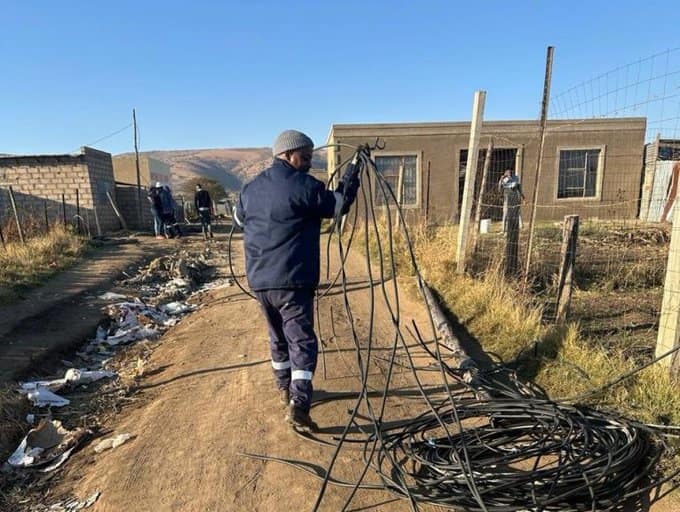
In the meantime, construction crews continue their work. Two more ablution blocks are scheduled for completion in the coming weeks, extending services to the last remaining corner of Rensburgdrift. A local contractor, appointed through an open tender process, can be seen working alongside community members hired as general laborers—a job creation component the department says has employed 42 local residents over the life of the project.
As the sun set over Evaton, casting long shadows across the corrugated iron roofs and the new yellow-and-blue buildings alike, a small girl filled a plastic bucket at a communal tap. Not to carry to a distant pit latrine—but to water the small patch of marigolds growing outside her family’s shack. Her mother watched from the doorway, arms crossed, smiling.
“She never grew flowers before,” Nomsa Dlamini said. “Because the only thing that grew here before was sickness. Now? Now we grow flowers. Tell the DA that. Tell them flowers grow in Evaton now.”
Whether that is worth R24 million is a question for politicians and auditors. For the people who live there, the answer has already been written—in clean water, in locked doors, and in marigolds blooming where only sewage once flowed.
About The Author