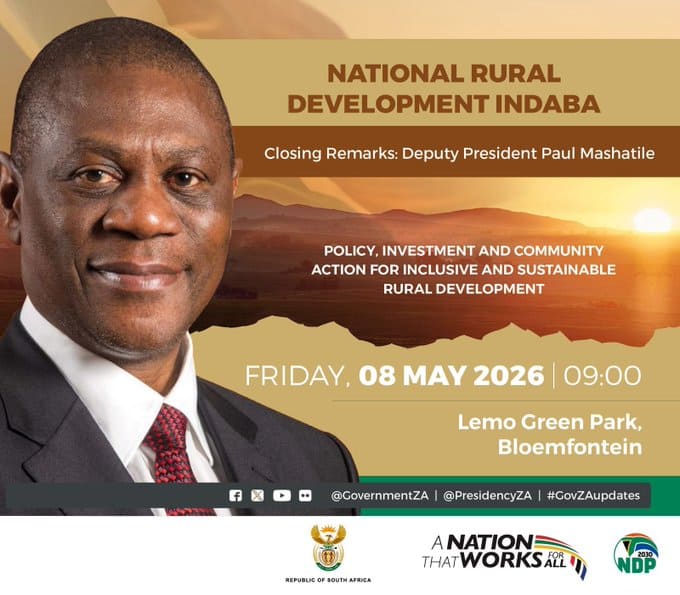
Deputy President Paul Mashatile is set to deliver the closing remarks at the National Rural Development Indaba today, bringing two intense days of dialogue, debate, and deliberation to a close. The gathering, held at the sprawling Lemo Green Park on the outskirts of Bloemfontein, has drawn together a powerful cross-section of South African society: government ministers and officials, traditional leaders in their regalia, emerging and commercial farmers, community organizers, land rights activists, and agricultural economists. Their shared mission: to confront, head-on, the entrenched challenges that keep South Africa’s rural majority trapped in poverty while the country’s cities boom.
The indaba, convened under the theme “Land as the Engine of Rural Transformation,” comes at a critical juncture. With the 2024 general election looming and rural voters feeling increasingly forgotten, the urgency to translate decades of policy talk into tangible on-the-ground change has never been greater. Mashatile, who has positioned himself as a key bridge between the ANC’s executive and grassroots constituencies, is expected to use his closing address to announce concrete follow-up mechanisms, timelines, and accountability measures.
“These two days have not been a talk shop,” said Mashatile during a walkabout on the first morning, stopping to shake hands with a group of women farmers from the Eastern Cape. “We have heard the pain. We have heard the frustration. We have heard the ideas. Now the work begins. Today, I will tell you how.”
The State of Rural South Africa: A Tale of Two Countries
To understand the significance of the indaba, one must first understand the scale of the crisis in South Africa’s rural areas. While urban centers like Johannesburg, Cape Town, and Durban have seen significant infrastructure development and economic growth—however uneven—the rural provinces of the Eastern Cape, Limpopo, KwaZulu-Natal, and the North West have lagged catastrophically.
According to Statistics South Africa, approximately 70% of the country’s poorest citizens live in rural areas. Unemployment in these regions routinely exceeds 40%, with youth unemployment climbing above 60%. Access to clean water, reliable electricity, and all-weather roads remains sporadic. Perhaps most critically, land reform—the great unfinished business of South Africa’s democratic transition—has moved at a glacial pace. Twenty-nine years after the end of apartheid, white-owned commercial farms still account for the vast majority of productive agricultural land.
“The land question is not just about justice for past dispossession,” said Dr. Thandiwe Mkhize, an agrarian economist presenting at the indaba. “It is about economics. It is about food security. It is about jobs. Every hectare of land that sits underutilized because of ownership disputes or lack of access is a hectare that could be feeding a family or employing a worker. We cannot talk about rural development without talking about land. And we cannot talk about land without talking about speed.”
Key Themes of the Indaba: Land Access, Tenure Security, and Productive Use
Over the two days, the indaba broke down into a series of thematic working groups, each tackling a different facet of rural transformation. The most heated discussions centered on three interconnected issues: land access, tenure security, and productive use.
Land Access: Despite the adoption of the Constitution’s Section 25 amendment framework—which explicitly allows for land expropriation without compensation in certain circumstances—the pace of land redistribution has been agonizingly slow. The Department of Agriculture, Land Reform and Rural Development has repeatedly missed its own targets. Critics argue that the process remains too bureaucratic, too legalistic, and too deferential to property rights that were themselves built on historical injustice.
“The willing-buyer, willing-seller model failed,” said a representative from the Land Access Movement of South Africa (LAMSA), speaking during an open microphone session. “We said that twenty years ago. Now we have a new framework, but the same old delays. Give us land. Give it now. We will farm it.”
Tenure Security: For millions of South Africans living in communal areas under traditional leadership, land tenure is a source of deep anxiety. Without formal title deeds, families live in constant fear of eviction by local chiefs or competing claimants. Women, in particular, face systemic discrimination, as customary law often denies them independent land rights. A working group on tenure security heard heartbreaking testimony from elderly women who had been evicted from land they had farmed for decades after their husbands died.
“The law says women have equal rights,” said Nomonde Mbete, a rural development lawyer. “But on the ground, tradition often wins. We need a dual approach: strengthen the legal framework, but also work with traditional leaders to change cultural practices. Neither alone will work.”
Productive Use: Even when land is successfully transferred, new black farmers often fail to become productive. Lack of access to credit, tools, seeds, irrigation infrastructure, and markets leaves them unable to turn their land into a livelihood. The indaba heard from several case studies of successful land reform projects—including a cooperative in the Eastern Cape that now supplies vegetables to major retailers—but also from many failures. The consensus was clear: land alone is not enough. Land plus capital plus training plus market access equals transformation.
“Don’t give a person a plow if you won’t give them a cow to pull it,” said Chief Mpho Mofokeng, a traditional leader from the Free State. “And don’t give them a cow if you won’t show them where to find water. Rural development is a package. We need the whole package.”
Voices from the Ground: Farmers, Chiefs, and Activists
Between the formal presentations, the indaba was animated by the voices of ordinary South Africans whose lives are directly affected by these policies. Outside the main hall, a small exhibition area featured products from rural enterprises: maizemeal, organic honey, handmade pottery, and woven baskets. The entrepreneurs behind these products were eager to speak.
“I came here to network,” said Lettie Mokoena, who runs a small poultry operation outside Phuthaditjhaba in the Free State. “I need buyers. I need a cold storage unit. I need a loan that doesn’t require land title I don’t have. I didn’t come here for speeches. I came here for action. I hope the Deputy President hears us.”
Traditional leaders, who wield significant influence in rural areas, were prominently represented. Some wore modern suits; others wore full leopard-skin regalia. Their messages were mixed. Some praised the government’s willingness to consult. Others expressed frustration that their role in land administration is often undermined or ignored.
“We are not obstacles to development,” said Kgosi Letsholo Thibedi, a senior traditional leader from the North West. “We are the custodians of our people. If the government works with us, we can help them achieve land reform faster. If they work against us, nothing will move. It is that simple.”
Mashatile’s Role: The Man in the Middle
Deputy President Paul Mashatile has carved out a unique role in the ANC’s internal dynamics. A former Arts and Culture Minister and Gauteng ANC chairperson, he is seen as a political heavyweight with deep roots in the party’s traditionalist wing. He is also viewed as a potential successor to Ramaphosa, depending on how the factional winds blow in the coming years.
At the indaba, Mashatile has walked a careful line. He has praised the progress made under Ramaphosa’s administration while acknowledging that far more needs to be done. He has affirmed the government’s commitment to expropriation without compensation as a tool of last resort while emphasizing that the preferred mechanism remains equitable redistribution through negotiated transactions.
“We cannot change the past,” Mashatile said in his opening address. “But we can build a future. A future where a black child in Qumbu or Giyani or Taung can look at the land around them and see not a monument to exclusion, but a field of possibility. That future is possible. But only if we act.”
The Deputy President has also used the indaba to signal a shift toward greater inter-departmental coordination. Rural development, he argued, cannot be the sole responsibility of the Department of Agriculture, Land Reform and Rural Development. It requires alignment with water affairs, energy, transport, trade and industry, and basic education.
“We have too many silos,” Mashatile admitted during a Q&A session with delegates. “The left hand does not know what the right hand is doing. I will take this message back to Cabinet. We need a single, integrated rural development plan with a single budget and a single chain of accountability. That is a promise.”
What to Expect in the Closing Remarks
As the indaba enters its final hours, anticipation is building around what Mashatile will actually announce. Sources within the Deputy President’s office have suggested that his closing remarks will go beyond vague commitments and include specific, measurable deliverables.
Among the expected announcements:
- A presidential rural development coordination council, chaired by Mashatile himself, with representatives from all relevant departments and traditional leaders.
- A pilot land access program in three districts (one each in the Eastern Cape, KZN, and Limpopo) that will fast-track the release of state-owned land to qualifying black farmers within 12 months.
- A R1 billion rural infrastructure fund focused on water storage, road repairs, and agricultural processing hubs, to be operational by the end of the fiscal year.
- An amendment to the Communal Land Tenure Bill to strengthen women’s land rights, to be tabled in Parliament within six months.
- A national rural youth service that will provide agricultural training and a basic income stipend to 10,000 young people over two years.
If these promises materialize, the indaba could be remembered as a genuine turning point. If they remain on paper, joining the graveyard of previous rural development strategies, the cynicism of rural communities will deepen further.
Reaction from the Opposition and Civil Society
Outside the indaba, political reactions have been predictably polarized. The DA issued a statement dismissing the gathering as “another ANC photo opportunity” and pointing to the party’s record of missed targets. “The ANC has been in power for nearly three decades,” said DA Shadow Minister of Rural Development Thabo Mlotshwa. “They don’t need another indaba. They need to implement the policies they already have.”
The EFF, which advocates for the expropriation of white-owned commercial farms without compensation, called the indaba “a waste of time” and accused Mashatile of “dressing up neoliberalism in rural clothes.”
However, civil society organizations were more measured. The Rural Development Support Network, an umbrella body of NGOs working in the sector, issued a cautiously optimistic statement. “We have seen many indabas come and go. But we have seen genuine engagement here. The question is whether the follow-through will match the rhetoric. We will hold the Deputy President to his promises.”
Looking Beyond the Indaba
As Mashatile prepares to take the podium for his closing remarks, the sun over Bloemfontein is beginning to set, casting long golden shadows across Lemo Green Park. The delegates are tired but still alert. They have argued, they have listened, they have shared meals and handshakes. Now they want something to take home.
For the women farmers from the Eastern Cape, for the frustrated youth from Limpopo, for the traditional leaders seeking respect, for the activists pushing for faster change, the closing remarks are not an ending. They are a beginning—or, perhaps, a final test.
“If Mashatile goes back to Pretoria and we never hear from him again, then this was all just theater,” said a young land rights activist from KZN, packing up her bag. “But if he actually does what he says—if the phones ring, if the budgets move, if the land starts changing hands—then maybe, just maybe, something real can happen. I am not hopeful. But I am not hopeless either. That is where I stand. Right on the line.”
Today, in Bloemfontein, Deputy President Paul Mashatile has the chance to push that line forward. Whether he will remains to be seen. But for the millions of South Africans living in the forgotten corners of the country—the places the highways don’t reach, the places the development headlines ignore—there is no choice but to watch, to wait, and to hope that this time, the words will become deeds.
The microphone is waiting. The notes are ready. The nation’s rural heartland is listening.
About The Author