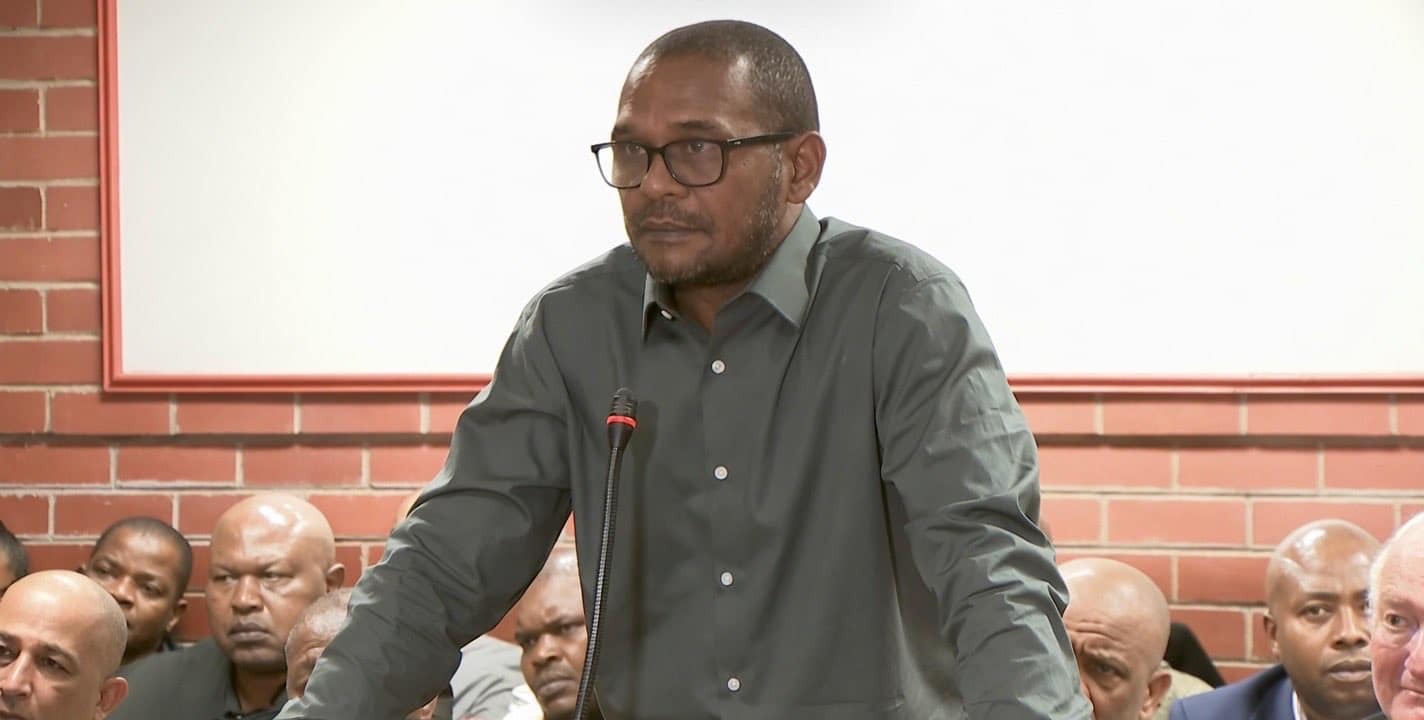
National Coloured Congress (NCC) leader and Member of Parliament Fadiel Adams was remanded in custody until 13 May on Thursday, after making his first formal appearance in the Pinetown Magistrate’s Court on the KwaZulu-Natal south coast. The high-profile case drew a packed courtroom, with dozens of NCC supporters, family members, legal representatives, and a throng of media personnel squeezing into the public gallery to catch a glimpse of the embattled politician, who has become a lightning rod in South Africa’s increasingly fractious political landscape.
As Adams stepped into the dock, flanked by two court orderly officers, the atmosphere was electric. The NCC leader, known for his fiery oratory and unflinching criticism of what he calls “the system’s betrayal of coloured communities,” appeared calm and even defiant. Dressed in a dark suit with an open-necked white shirt, he scanned the gallery, nodding at familiar faces. Spotting a close family member seated in the second row, he broke into a warm smile, leaned forward, and blew a kiss. Then, in a gesture that drew audible sighs from the audience, he motioned for the relative to come closer and planted a gentle kiss on the forehead—a moment of tenderness that belied the gravity of the charges he faces.
That small act of humanity, captured on cellphone cameras and later splashed across social media, has become a rallying symbol for Adams’s supporters. To them, it was the gesture of an innocent man, unjustly hounded by a state they believe is determined to crush dissenting voices. To his critics, it was political theater—a calculated performance designed to humanize a man accused of serious financial crimes.
The Charges: Fraud, Corruption, and Money Laundering
While the full charge sheet has not yet been made public, sources close to the investigation have confirmed that Adams faces multiple counts of fraud, corruption, and money laundering. The allegations stem from his time as a grassroots community organizer in the Western Cape prior to entering Parliament. Specifically, the state alleges that Adams misappropriated funds intended for community development projects—including housing assistance, small business grants, and youth programs—channeling the money instead into personal accounts and undisclosed political activities.
The Hawks, who led the investigation and carried out the pre-dawn raids on Adams’s properties last month, have described the case as “a significant blow against tender fraud and political corruption.” In a brief statement released after Thursday’s court appearance, Hawks spokesperson Captain Lloyd Ramovha said: “The state has gathered substantial evidence, including financial records and witness testimony, that we believe will prove beyond a reasonable doubt that the accused used his position of trust to enrich himself and his inner circle.”
Adams’s legal team, led by prominent defence attorney Reaz Khan, has dismissed the charges as “politically motivated persecution.” In an impassioned statement to reporters gathered outside the courthouse, Khan alleged that the case is a “blatant attempt to silence a sitting MP who has dared to expose corruption within provincial and national government structures.”
“The state has no case,” Khan said, his voice rising above the chants of NCC supporters. “They have dragged Mr. Adams through the mud. They have raided his home, seized his belongings, and paraded him in front of cameras. And for what? For a few questionable transactions that any auditor could have resolved with a phone call? This is not justice. This is a witch hunt.”
The Remand Decision: No Bail Application Yet
In a procedural move that surprised some legal observers, Adams’s legal team did not pursue a bail application during Thursday’s hearing. Instead, they agreed to a formal remand, with the case postponed to 13 May. This has led to speculation that the defence is still reviewing the state’s evidence and preparing a more robust challenge.
“The decision not to apply for bail is unusual but not unprecedented,” explained legal analyst Nthabiseng Mdluli, speaking on Newzroom Afrika. “It could mean that the defence believes the state’s case is weak and that they want time to prepare a comprehensive bail affidavit that addresses every allegation head-on. Alternatively, it could mean that Adams is considered a flight risk—but as a sitting MP with parliamentary responsibilities, that seems unlikely. We will have to wait and see.”
Magistrate Elizabeth Ndlovu, presiding over the case, granted the postponement and ordered that Adams remain in custody at Westville Prison until the next hearing. She noted that the state had not objected to the postponement and that the defence had indicated they would likely bring a formal bail application on 13 May.
Inside the Courtroom: Supporters, Tears, and Defiance
For those who managed to secure a seat in the packed gallery, the proceedings were a rollercoaster of emotions. When Adams first entered the dock, a ripple of applause broke out from the public benches, quickly silenced by a sharp bang of the magistrate’s gavel. Throughout the brief hearing—which lasted less than 20 minutes—supporters leaned forward, hanging on every word.
After the magistrate announced the postponement and ordered Adams’s return to custody, several women in the gallery began to weep quietly. Others raised clenched fists in solidarity. Adams himself remained composed, turning to the gallery one last time before being led away. “Stay strong!” someone shouted from the back. “We are with you, Fadiel!” called another.
Outside the courthouse, the scene was even more charged. Several hundred NCC supporters had gathered behind police barricades, waving placards and singing protest songs. The signs bore slogans such as “Free Fadiel Now,” “Hands Off Our MP,” and “The Real Criminals Are in Parliament.” A smaller contingent of counter-protesters, mostly from opposition parties, held signs reading “No One Is Above the Law” and “Corruption Has No Colour.”
The atmosphere was tense but peaceful, with a heavy police presence ensuring that the two groups remained separated. Officers from the Public Order Policing Unit stood in a line, shields at the ready, but no violence was reported.
The Political Fallout: A Movement Under Pressure
Adams’s arrest and remand have sent shockwaves through the NCC, a party that has positioned itself as the authentic voice of coloured South Africans—a community that has long felt caught between the ANC’s historical dominance and the DA’s perceived aloofness. The NCC won its first parliamentary seats in the 2019 elections and has been growing steadily, particularly in the Western Cape, where the party has challenged the DA’s stronghold.
But the corruption allegations threaten to derail that momentum. Political analyst Dr. Sithembile Mbete of the University of Pretoria noted that the case presents a dilemma for the NCC’s supporters. “On one hand, there is genuine anger among many coloured voters about being left behind by economic transformation. The NCC has channeled that anger effectively. On the other hand, if Adams is convicted of serious financial crimes, the party’s moral authority collapses. They become just another example of the very corruption they claim to fight.”
The NCC’s interim leadership has rallied around Adams, issuing a statement on Thursday afternoon declaring “unwavering support” for their leader. “Comrade Fadiel Adams is a victim of a politically motivated campaign to destroy the NCC,” the statement read. “We call on all our members and supporters to remain calm, to trust the process, and to prepare for the political battle ahead. This is not the end. This is the beginning of our fight for true justice.”
Meanwhile, the ANC and DA have both issued cautious statements, emphasizing the importance of due process while awkwardly navigating the political implications. The ANC’s Western Cape spokesperson called on “all parties to respect the courts,” while the DA’s federal chairperson noted that “no one, regardless of their political affiliation, should be above the law.”
Adams’s Support Base: Anger, Loyalty, and Distrust
To understand the depth of support for Adams, one must understand the community he represents. Coloured South Africans—descendants of Khoisan, slave, and mixed-race populations—have historically occupied an ambiguous position in the country’s racial politics. Under apartheid, they were granted limited privileges relative to black Africans but suffered systematic discrimination compared to whites. After 1994, many felt left behind by affirmative action policies that favored black Africans, and by economic growth that bypassed their traditional working-class neighborhoods.
Adams has tapped into this sense of grievance with remarkable success. His speeches are laced with the vernacular of the Cape Flats, his critiques of “elite capture” resonate with people who feel invisible, and his willingness to confront powerful figures—including President Ramaphosa—has earned him a reputation as a fearless maverick.
“No one else speaks for us,” said Mariam Jacobs, a 52-year-old domestic worker who traveled from Mitchells Plain to attend the court hearing. “The ANC forgot us long ago. The DA only cares about their rich voters in Constantia. Fadiel is our voice. And now they have put him in a cage. It breaks my heart, but it also makes me angry. We will not be silenced.”
A younger supporter, 24-year-old Ryan Peters, expressed a more cynical but equally fierce loyalty. “Look, maybe he took some money. I don’t know. But show me a politician who hasn’t. The difference is, when they come for Fadiel, they come because he’s a threat. They don’t come for the others. So we will protect him. Not because he’s perfect. Because he’s ours.”
The Road to 13 May: What Happens Next
With Adams remanded in custody until 13 May, his legal team now has just over two weeks to prepare. The next hearing is expected to focus on the formal bail application, during which the state will present its evidence for why Adams should remain behind bars, and the defence will argue for his release—likely on strict conditions, such as surrendering his passport and reporting regularly to a police station.
If bail is granted, Adams could walk free pending trial, a scenario that would allow him to continue his political work, including his parliamentary duties. If bail is denied, he will remain in Westville Prison, a facility with a reputation for harsh conditions and overcrowding, potentially for months or even years as the case winds its way through the courts.
Beyond the legal proceedings, the political fallout will continue to unfold. The NCC must decide how to navigate its parliamentary responsibilities without its leader present. Adams’s parliamentary seat is not automatically vacated unless he is convicted of a crime carrying a sentence of 12 months or more—a threshold that has not yet been reached. He remains an MP, even from a prison cell.
Meanwhile, the broader debate about political corruption in South Africa—already inflamed by the Phala Phala scandal and ongoing state capture prosecutions—will now include this new chapter. Is Adams a victim of selective justice, as his supporters claim? Or is he just the latest example of a political class that has learned nothing from the Zuma era? The answer, for now, depends entirely on whom you ask.
Conclusion: A Movement at a Crossroads
As the sun set over Pinetown, the small crowd of NCC supporters outside the courthouse began to disperse. Some headed home, exhausted after a long day of waiting. Others gathered in a nearby parking lot for an impromptu prayer meeting, holding hands and asking God to “open the doors of the prison and set our brother free.”
Inside Westville Prison, Fadiel Adams was processed, given a prison uniform, and led to a cell. His first night in custody would be spent behind steel bars, far from the parliamentary chamber where he once sat, far from the community halls where he once thundered against injustice.
But if his supporters have their way, this is not a defeat. It is a beginning. “They think locking him up will break us,” said one young man, still waving an NCC flag as dusk fell. “They don’t understand. We are the people they forgot. We have been locked up our whole lives—in poverty, in neglect, in invisibility. A few months in prison cannot break what was already broken. We are already free. And we will fight.”
Whether that fight takes place in the courtroom, at the ballot box, or in the streets remains to be seen. But for now, in the forgotten corners of the Western Cape and beyond, a leader sits in a cell—and a movement holds its breath, waiting for 13 May.
About The Author