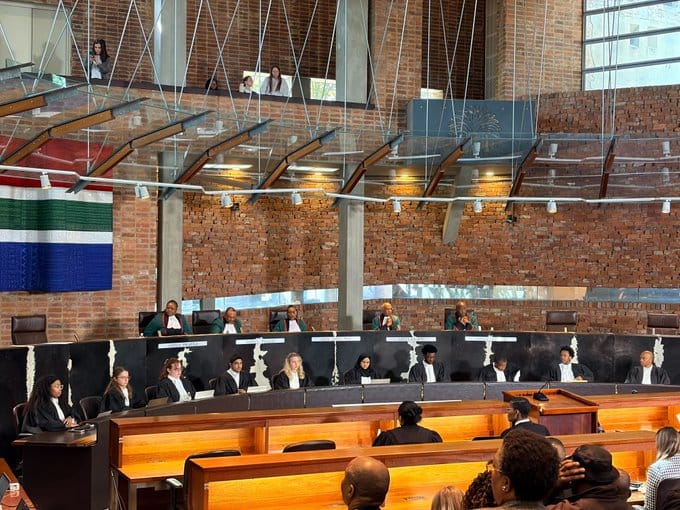
At 10 a.m. today, the highest court in the land will deliver a ruling that could reshape the boundaries of presidential accountability in South Africa. The Constitutional Court is set to decide whether Parliament was right to shield President Cyril Ramaphosa from an impeachment inquiry over the notorious Phala Phala scandal—or whether lawmakers violated the Constitution by burying a damning report that found preliminary evidence of serious misconduct.
The case, brought by the Economic Freedom Fighters (EFF) and the African Transformation Movement (ATM), challenges Parliament’s December 2022 decision to reject the Section 89 independent panel’s findings. That panel, led by former Chief Justice Sandile Ngcobo, had concluded that Ramaphosa had a prima facie case to answer regarding the theft of an undisclosed amount of foreign currency—reported to be anywhere between 580,000and4 million—from his Phala Phala game farm in Limpopo in February 2020.
The money, Ramaphosa has always maintained, came from the legitimate sale of buffalo to a Sudanese businessman. The president has denied any wrongdoing and was subsequently cleared by the National Prosecuting Authority (NPA), which declined to press criminal charges. But the constitutional question before the court today is not about criminal guilt. It is about whether Parliament, in voting 214 to 148 against establishing an impeachment committee, failed in its constitutional duty to hold the executive accountable.
Depending on the outcome, the court could force the National Assembly to launch a full-scale impeachment inquiry—potentially leading to Ramaphosa’s removal from office—or it could affirm that Parliament’s decision was a legitimate exercise of political discretion, effectively closing the book on the scandal once and for all.
The Origins of the Scandal: A Farm, a Theft, and a Cover-Up Allegation
The Phala Phala scandal first erupted in June 2022, when former State Security Agency director-general Arthur Fraser laid a criminal complaint against Ramaphosa. Fraser alleged that the president had attempted to conceal the February 2020 burglary, during which robbers made off with a large sum of US dollars hidden in a sofa at the farm. Crucially, Fraser claimed that Ramaphosa had not reported the theft to the police but had instead authorized the head of the Presidential Protection Service to conduct a covert investigation and even to track down and interrogate the suspects.
The allegations struck at the heart of Ramaphosa’s carefully cultivated image as the anti-corruption crusader who had promised to lead South Africa out of the “state capture” years under Jacob Zuma. For his critics, the irony was unbearable: the man who had staked his political reputation on “clean governance” stood accused of burying a crime that occurred on his own property.
Ramaphosa’s response was consistent and unflinching. He acknowledged that a theft had occurred but insisted that the money—around $580,000 by most confirmed accounts—was proceeds from the sale of buffalo. He denied any cover-up, stating that his security team had acted appropriately and that the matter was eventually reported to the police. In 2023, the NPA’s Acting Director of Public Prosecutions, Advocate Mxolisi Nxasana, announced that there was “no reasonable prospect of a successful prosecution” and closed the criminal case.
But the political damage had already been done. The Section 89 panel, established by Parliament in response to the EFF’s motion, found that while the evidence was not conclusive, it was sufficient to warrant further investigation by an impeachment committee. “The president may have violated the Constitution and the Executive Ethics Code,” the panel’s report stated, citing potential conflicts of interest and the misuse of state resources to handle a private matter.
Parliament’s Vote: Political Protection or Democratic Deliberation?
When the panel’s report was tabled in the National Assembly in December 2022, the outcome was never seriously in doubt. The African National Congress (ANC), commanding 230 of the 400 seats, deployed its full party machinery to whip members into line. The result was a 214-to-148 vote against establishing an impeachment inquiry. Ramaphosa survived.
For the ANC, the vote was framed as a defense of due process. “We cannot establish an impeachment committee based on a prima facie finding that has not been tested in any court,” argued then-ANC Chief Whip Pemmy Majodina. “The president has been cleared by the NPA. That should be the end of the matter.”
But for the opposition, the vote was a brazen display of political protection. “The ANC voted to shield its own leader from accountability, plain and simple,” said EFF leader Julius Malema at the time. “If this were any other president, they would have been gone. But because it is Ramaphosa—their Ramaphosa—the rules change.”
The ATM, a smaller opposition party with a focus on African spiritual values and governance, joined the EFF in launching the Constitutional Court challenge. Their argument is straightforward: Section 89 of the Constitution requires the National Assembly to establish an impeachment committee once the independent panel finds prima facie evidence. The word “shall,” they argue, leaves Parliament no discretion. By voting against the committee, lawmakers violated a binding constitutional command.
The Constitutional Court’s Dilemma: Discretion vs. Duty
The judges of the Constitutional Court, led by Chief Justice Raymond Zondo, now face a delicate balancing act. On one hand, the principle of separation of powers militates against the court interfering in parliamentary proceedings. Courts have traditionally been reluctant to tell Parliament how to conduct its internal business. On the other hand, the Constitution is the supreme law, and if Parliament has clearly acted outside its bounds, the court has a duty to intervene.
Legal experts are divided on the likely outcome. “The EFF and ATM have a strong textual argument,” says public law professor Cathy Powell of the University of Cape Town. “The Constitution says the National Assembly ‘shall’ establish a committee when the panel’s finding is positive. That language is mandatory. But the counter-argument is that ‘shall’ must be read in context. Parliament has to exercise judgment. What if the panel’s finding is obviously flawed? Can Parliament ever say no?”
The court will also have to grapple with the fact that the NPA has since cleared Ramaphosa. If the criminal standard of “beyond reasonable doubt” has not been met, does it make sense to proceed with a parallel parliamentary process that could still lead to impeachment? Ramaphosa’s legal team has argued that it does not, and that the Constitutional Court should respect the NPA’s professional judgment.
But the opposition counters that impeachment is a political, not a criminal, process. “The question is not whether the president belongs in jail,” Malema has argued. “The question is whether he has betrayed the public trust. That is a question for Parliament, not for prosecutors. And Parliament refused to even ask it.”
What the Ruling Could Mean: Three Scenarios
As the clock ticks toward 10 a.m., political strategists on all sides are preparing for three possible scenarios.
Scenario One: The Court Dismisses the Challenge
If the Constitutional Court rules that Parliament acted within its discretion, the Phala Phala scandal will effectively end as a political threat to Ramaphosa. The president would claim vindication, the ANC would celebrate a victory for “parliamentary sovereignty,” and the opposition would be left to fume. Ramaphosa would be free to focus on the 2024 general election, though the scandal would undoubtedly resurface in campaign ads and debate stages.
Scenario Two: The Court Orders Parliament to Establish an Impeachment Committee
This would be an earth-shattering outcome. The court would effectively compel the National Assembly to do what it voted not to do. Such a ruling would trigger an immediate political crisis. The ANC would have to decide whether to comply or to find a procedural way to delay or frustrate the process. Either way, Ramaphosa’s presidency would enter a period of prolonged uncertainty. An impeachment committee would have the power to call witnesses, subpoena documents, and eventually recommend removal. The process could take months, during which time the president would be fighting for his political life on two fronts: in Parliament and in the court of public opinion.
Scenario Three: A Compromise Ruling
The court could attempt to split the difference. For example, it might find that Parliament erred in how it handled the panel’s report but stop short of forcing an impeachment inquiry. Instead, it could order Parliament to reconsider the matter with proper regard for the constitutional framework—essentially, “try again, but this time do it correctly.” Such a ruling would buy time for all parties and allow the ANC to conduct a second vote with more elaborate justifications, potentially insulating it from future legal challenges.
Ramaphosa’s Stance: Calm, Defiant, and Focused on 2024
Ahead of the ruling, President Ramaphosa has maintained a posture of calm defiance. In his most recent public comments on the matter, he reiterated that the money was legitimate and that he has “absolutely nothing to hide.” He has also pointed to his record of pursuing anti-corruption measures, including the establishment of the Investigating Directorate and the ongoing implementation of the State Capture Commission’s recommendations.
“My conscience is clear,” Ramaphosa said in a recent interview with SABC News. “I have served this country with integrity. The people will judge me by my work, not by political distractions.”
But for his opponents, the Phala Phala scandal is not a distraction—it is a test of whether South Africa’s post-apartheid democracy is capable of holding a sitting president accountable. “If Ramaphosa survives this, it will set a precedent,” says political analyst Lukhanyo Vangqa. “It will say that a president can hide cash in his sofa, fail to report a crime, use state security for a private cover-up, and still walk away. That is not the democracy we fought for.”
The Broader Implications: Trust, Democracy, and 2024
Whatever the Constitutional Court decides today, the Phala Phala scandal has already left its mark. Trust in public institutions, already battered by years of state capture and load-shedding, has taken another hit. A 2023 survey by the Social Research Foundation found that 62% of South Africans believed Ramaphosa should face an impeachment inquiry, reflecting a broad public appetite for accountability that cuts across party lines.
The 2024 national election, expected to be the most competitive since 1994, will be shaped in part by the court’s ruling. If Ramaphosa is forced into an impeachment process, the ANC’s electoral prospects could crumble, potentially pushing the party below 50% for the first time in its history. If he is cleared, he will campaign as a president who has weathered the storm—though the storm’s scars will remain visible.
As the clock strikes 10 a.m. in Johannesburg, the nation will hold its breath. In courtrooms, newsrooms, and shebeens from Soweto to Sandton, South Africans will wait for a ruling that answers a simple, devastating question: Is the president above the law, or is he not? The answer will define not just Ramaphosa’s legacy, but the very meaning of accountability in the democratic South Africa.
Outside the Constitutional Court in Braamfontein, a small crowd has already gathered. Some carry EFF red berets. Others wave tiny ANC flags. A street vendor sells roasted corn and cold cooldrinks, doing brisk business. In the middle of it all, an elderly man holds a handwritten sign on a piece of cardboard. It reads: “We just want to know the truth.”
Today, the court will try to give him an answer.
About The Author