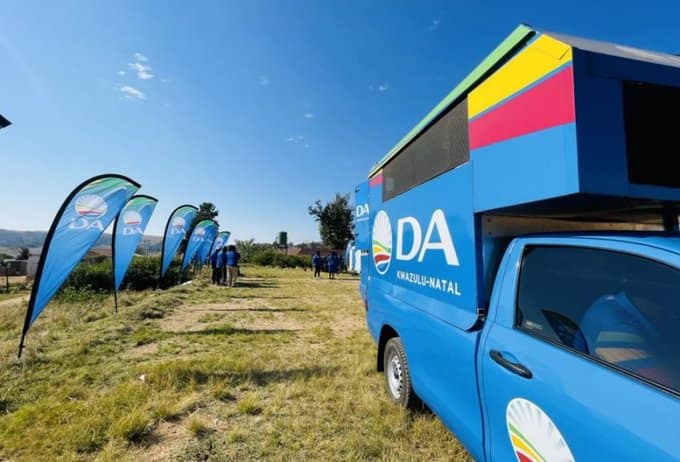
The posters are printed, the credentials are being laminated, and the branch delegates are calculating numbers on WhatsApp groups that buzz deep into the night. After months of preparatory meetings, branch nominations, and the inevitable behind-the-scenes manoeuvring that defines any political contest worth its salt, the Democratic Alliance (DA) in KwaZulu-Natal has announced that final arrangements are well underway for its provincial congress this weekend.
Hundreds of delegates from across the province’s 44 municipalities will gather at a venue in Durban—the exact location remains under embargo for security reasons—to elect a new provincial leadership corps, debate policy resolutions, and chart the party’s direction in a province that has become the DA’s most tantalizing and frustrating battleground.
“This is not just another congress,” said DA KZN spokesperson Zwakele Mncwango in a briefing on Tuesday. “This is the moment where we decide whether we are serious about governing this province. The ANC is wounded. The voters are watching. If we get this weekend right, we send a message that the DA is ready to lead KwaZulu-Natal.”
Why KZN Matters
To understand the weight of this weekend, one must understand KwaZulu-Natal’s place in South Africa’s political geometry. The province is the country’s second-most populous, home to iconic cities like Durban, Pietermaritzburg, and Richards Bay, as well as vast rural hinterlands where traditional leadership and clan loyalties still shape voting patterns.
For decades, the province has been an ANC stronghold—but a restless one. The 2024 national elections saw the ANC’s share of the vote in KZN drop below 40% for the first time since the end of apartheid, a collapse driven by the rise of the uMkhonto weSizwe (MK) Party under former President Jacob Zuma and the steady erosion of the ANC’s traditional voter base. The DA, meanwhile, increased its share to just over 18%, making it the official opposition in the provincial legislature.
But the DA’s ambitions extend far beyond opposition. Party strategists believe that KZN is winnable within the next two election cycles—but only if the party can present a coherent, united, and locally rooted alternative to the ANC’s crumbling dominance. That begins with the leadership elected this weekend.
“The DA in KZN has historically been plagued by factionalism, personality clashes, and a perception that it is a party of the suburban elite,” said political analyst Professor Bheki Mngomezulu of the University of Zululand. “This congress is an opportunity to reset that narrative. But it requires leadership that can speak to both the bereaved mother in Umlazi and the business owner in Ballito. That is a very narrow tightrope to walk.”
The Leadership Contest
While the party has officially remained neutral on leadership preferences, sources close to the provincial campaign confirm that at least two distinct slates are jostling for control of the top positions.
The incumbent provincial leader, Francois Rodgers, is seeking re-election. A former mayor of the KwaDukuza municipality and a seasoned local government operative, Rodgers has positioned himself as the candidate of stability and experience. His campaign has emphasized his role in growing the DA’s municipal footprint along the North Coast and his working relationships with traditional leaders in rural districts.
“I have walked every road in this province,” Rodgers said in a recent campaign video shared on party channels. “I have sat in the offices of kings and the kitchens of widows. I know what KZN needs. And I know how to deliver it.”
Challenging Rodgers is a younger, more combative faction centered around members of the party’s provincial legislature caucus. While no single challenger has yet emerged as the consensus alternative, several names are being floated, including former eThekwini ward councillor Bradley Singh and youth leader Thandeka Mbambo. The anti-incumbent camp argues that Rodgers has had his chance and that the party needs “fresh energy and a more aggressive posture” to take on the ANC and the MK Party.
“I have nothing personal against Francois,” one delegate from the South Coast told this reporter, speaking on condition of anonymity. “But we are bleeding support to the MK Party because they speak the language of the townships and we speak the language of the suburbs. We need a leader who can stand on a podium in Umlazi and not look like a tourist.”
Other Key Positions
Beyond the provincial leader, delegates will also elect a provincial chairperson, deputy chairperson, provincial finance officer, and a caucus of additional members to the Provincial Executive Committee (PEC). Each of these positions carries its own sub-plot of alliances, betrayals, and last-minute horse-trading.
The race for provincial chairperson is particularly heated, with at least three candidates vying for the role. The chairperson is responsible for the day-to-day organizational management of the party in the province, including membership drives, fundraising, and disciplinary matters. It is a role that requires not just political savvy but administrative competence—a combination that is rarer than one might hope.
“There is a saying in politics: the leader gets the speech, but the chairperson gets the spreadsheets,” joked one long-time DA operative. “Whoever wins the chair will determine whether we have money for banners in the next by-election. That’s not glamorous. But it’s essential.”
Policy and Direction
The congress is not merely an election. It is also a policy forum where delegates will debate and vote on resolutions that will shape the DA’s provincial manifesto heading into the 2026 local government elections—which are now less than six months away.
Early drafts of the proposed resolutions, seen by this publication, cover a wide range of issues:
- Economic development: A push for the DA to champion a “Durban Recovery Zone” with tax incentives for businesses relocating to the city’s struggling central business district.
- Traditional leadership: A resolution calling for greater formal cooperation between DA-led municipalities and traditional councils (izinduna), acknowledging the enduring power of customary governance in rural areas.
- Service delivery: A demand for the party to adopt a “zero-tolerance” approach to water and electricity outages, including naming and shaming underperforming municipal managers.
- Internal democracy: A controversial resolution that would limit provincial leaders to two terms, aimed at preventing the entrenchment of powerful “bosses” within the party structure.
Delegates are expected to debate these resolutions intensely, particularly the two-term limit, which incumbent leader Rodgers would likely oppose as it would end his political trajectory in the province.
The National Context
The KZN congress unfolds against a broader national backdrop of the DA’s participation in the Government of National Unity (GNU) alongside the ANC. While the GNU has provided the DA with significant cabinet positions and a platform to demonstrate its governing competence, it has also created tensions within the party’s base, particularly among members who believe the DA should be a more aggressive opposition force rather than a governing partner.
Will the KZN congress produce resolutions critical of the GNU? Party insiders are divided. Some believe the province’s delegates will take a pragmatic view, recognizing that the DA’s leverage in the GNU gives it resources and influence that opposition alone cannot provide. Others argue that the grassroots are restless and that a failure to critique the ANC—even from within the GNU—will be seen as capitulation.
“The national mood affects every province differently,” said Mngomezulu. “In KZN, where the ANC is deeply unpopular and the MK Party is eating into everyone’s support, the DA may calculate that being in the GNU is a liability. Voters don’t distinguish between national and provincial. They see a DA leader shaking hands with Ramaphosa and they ask, ‘Are you with them or against them?’ That question does not have an easy answer.”
Logistics and Security
With hundreds of delegates expected to converge on Durban, the DA has implemented a comprehensive logistics and security plan. The venue—which party officials have confirmed is “a large conference facility in the greater Durban area” without providing specifics—will be ring-fenced by private security. Access will be strictly controlled via delegate tags and biometric verification to prevent the kind of credential disputes that have marred some ANC conferences in the past.
“We have learned from the mistakes of others,” Mncwango said. “Every delegate has been verified at branch level. There will be no ‘gatecrashers,’ no ‘ghost delegates,’ no disputes about who is entitled to vote. The day will be about ideas and leadership, not about fighting over who gets a wristband.”
The party has also arranged transport for delegates from remote areas, including areas in Zululand and the far south coast where public transport is unreliable. Accommodation has been booked at nearby hotels, and meals will be provided throughout the weekend.
What Happens After
The congress is scheduled to run from Friday evening through Sunday afternoon. The leadership election results are expected to be announced late on Saturday, with policy debates and closing addresses occupying Sunday.
Whoever emerges as provincial leader will face an immediate test: the 2026 local government elections. The DA currently governs only a handful of municipalities in KZN, including eThekwini (Durban) through a fragile coalition. Expanding that footprint—or even holding onto what it has—will require a disciplined, well-funded, and highly visible campaign.
“This weekend is not the finish line,” said one senior party strategist. “It’s the starting block. The race begins on Monday morning. And the opponents are not just the ANC and the MK Party. They are the voters who have stopped believing that politics can change anything. We have to prove them wrong.”
A Party on the Precipice
For the DA in KwaZulu-Natal, this weekend is both an opportunity and a warning. The opportunity is clear: an ANC in retreat, an electorate hungry for alternatives, and a province whose potential has long been throttled by corruption and mismanagement. The warning is equally clear: a party that cannot govern itself cannot govern a province.
As delegates pack their bags and check their travel arrangements, the question hanging over every conversation is the same one that haunts all political gatherings: will unity prevail, or will old divisions resurface? The answer will be written not in the speeches, but in the votes—and in the days, weeks, and months that follow.
The posters are printed. The stage is set. Durban is waiting.
About The Author