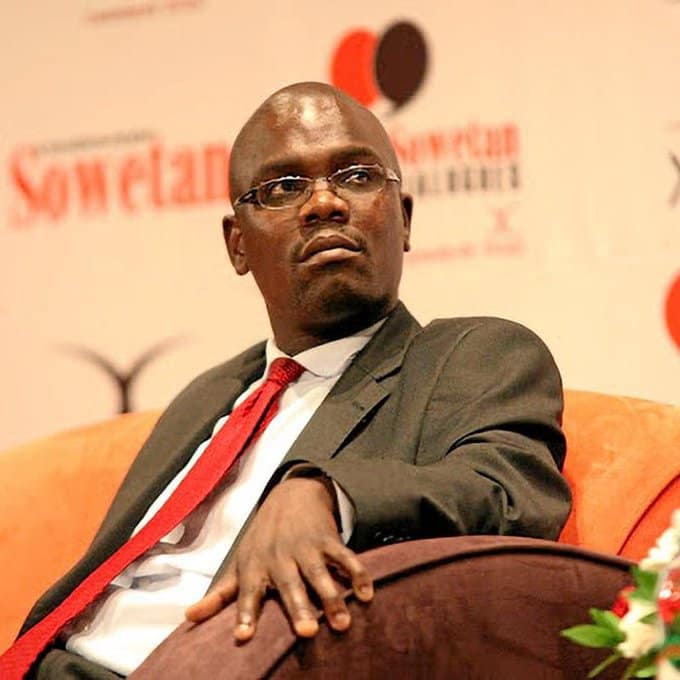
For decades, the African National Congress has been the undisputed colossus of South African politics, a liberation movement-tuned-governing party that has commanded the loyalty of the majority of the electorate since the advent of democracy in 1994. But if outspoken political analyst Prince Mashele has his way, that era of dominance is hurtling towards a definitive end. In a bold and detailed announcement at the 2026 BizNews Conference in Hermanus, Mashele unveiled an ambitious blueprint for a new political formation—a project designed not just to challenge the ANC, but to systematically dismantle its electoral majority and replace it with a government run by doctors, engineers, and teachers.
The project, operating under the working title of a “meritocratic, market-based alternative,” represents the culmination of years of Mashele’s blistering critiques of the ruling party. He has long argued that the ANC is not merely struggling with governance challenges, but is fundamentally “rotten to the core” and beyond any possibility of reform. In recent interviews and public appearances, he has described the party as a “dead horse” and its leaders as “scoundrels,” insisting that the only way forward for South Africa is to bypass the ANC entirely and build something new from the ground up. The 2026 conference announcement was the first concrete step toward turning that rhetoric into reality.
A Party of Professionals, Not Politicians
At the heart of Mashele’s vision is a radical departure from the politics of patronage and careerism that he argues has come to define the current political class. The new party, which is slated for a formal launch after the 2026 local government elections, will be led by highly educated professionals who have never held leadership positions in other political parties.
“We are talking about people whose lives have been defined by solving problems, not by climbing the greasy pole of factional politics,” Mashele explained to delegates. “Doctors who run hospitals, engineers who build bridges, teachers who shape young minds. These are the people who should be running the country, not those whose only qualification is a history of political activism.”
In a striking departure from South Africa’s racialised political landscape, Mashele proposed a leadership dyad designed to inspire confidence across all demographics: a competent Black president and a competent white deputy president. This, he argues, would signal a definitive break from the identity politics that often characterise electioneering, and would instead focus on a shared mandate of national recovery.
To safeguard against the kind of leadership failures that have plagued other parties, the project includes an innovative check on power: a “Council of Wisdom.” This body will be composed of independent, high-achieving South Africans over the age of 60, drawn from academia, the private sector, and non-governmental organisations. This council will act as a public watchdog and a sounding board, tasked with holding the leadership accountable and ensuring the movement stays true to its founding principles.
A Government-in-Waiting: Transparency and Tough Choices
One of the most audacious elements of the plan is its commitment to pre-election transparency. Unlike any major party in South African history, this new formation intends to announce its full shadow cabinet before the 2029 vote. Voters and, crucially, international investors will be able to see exactly who would hold which portfolio, allowing them to judge the calibre of the “government-in-waiting.”
This lean government would be a far cry from the sprawling executive that currently exists. Mashele’s blueprint caps the cabinet at no more than 21 ministers and proposes the complete abolition of the deputy minister position, which he describes as a key node in the patronage networks that fuel corruption and inefficiency.
The party’s policy platform is equally ambitious, drawing inspiration from the developmental state model of Singapore under Lee Kuan Yew. Key priorities include:
- Education Revolution: Repositioning the entire education system with a strict, unapologetic focus on mathematics, science, and technology.
- Replacing BEE: Scrapping the current Broad-Based Black Economic Empowerment framework in favour of a redress program centered on quality education for Black children and the economic empowerment of all low-paid workers.
- Border Security: A pledge to secure South Africa’s borders and implement the “merciless” deportation of illegal foreigners.
- Infrastructure Drive: A massive, 6-to-12-month national engineering push to rebuild crumbling public infrastructure.
- Investor Confidence: Scrapping expropriation without compensation laws, which Mashele argues serve only to scare away investment, and cutting through red tape.
- Healthcare Reform: Abandoning the National Health Insurance (NHI) in its current form and focusing instead on a pragmatic plan to improve public healthcare facilities.
The Money Question: Funding a Revolution
Building a party capable of challenging the ANC is an enormously expensive undertaking. Mashele is candid about the costs, outlining a plan that includes printing and distributing 30 million T-shirts, filling the FNB Stadium to capacity for a launch rally, and paying top professionals competitive salaries to lure them from the private sector into politics .
To manage this, the team behind the project has registered a non-governmental organisation called Rescue South Africa . The funding model is designed to prevent the party from being captured by any single interest. It will seek donations from the general public as well as from billionaires, with Mashele estimating the entire project could be funded for less than R2 billion .
“The money is not the hardest part,” Mashele insisted. “The hardest part is convincing the educated elite to leave their comfort zones, to step out of the boardrooms and the universities, and to take responsibility for fixing this country. That is the only way we replace the scoundrels with statesmen.”
A Historic Realignment?
Mashele’s prediction that the ANC could fall below 20% by 2029 is at the extreme end of political forecasting, but it reflects a growing sentiment that South Africa is entering a period of fundamental political realignment . The 2024 election, which saw the ANC lose its outright majority for the first time, was a watershed moment . The question now is whether a new, credible, and professionally-run alternative can emerge to capitalise on the widespread disillusionment.
The path is fraught with difficulty. South Africa’s political graveyard is littered with the corpses of promising new parties that failed to scale. Mashele acknowledges the risk but remains defiantly optimistic, pointing to the country’s resilient private sector and its still-functioning infrastructure as proof that recovery is possible.
As part of his announcement, Mashele confirmed that the project’s team will embark on a national roadshow to consult with citizens and identify the brightest local talent to catapult into national and provincial leadership. The groundwork is laid. The vision is clear. The only question that remains, as South Africa hurtles toward 2029, is whether the country’s long-suffering electorate is ready to take a leap of faith with a party of professors and professionals, and finally close the chapter on the ANC’s long, tumultuous rule.
About The Author