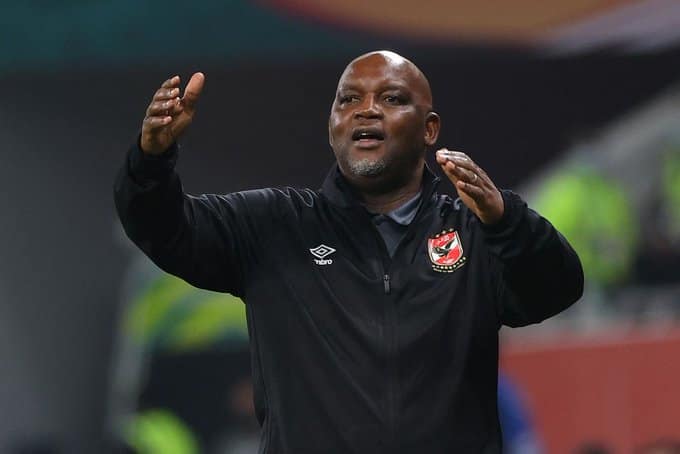
The voice on the other end of the line was calm, measured, and dripping with the quiet confidence of a man who has conquered every peak African football has to offer. On Wednesday, February 18, 2026, Pitso Mosimane, the winningest coach in South African football history, sat down—virtually—with host Dr Sizwe Mpofu-Walsh for a deeply reflective episode of the SMWX podcast. It was not merely an interview; it was a masterclass in self-belief, a chronicle of an improbable journey, and a firm statement of intent from a man who refuses to be relegated to the history books just yet.
From the outset, Mosimane was unapologetic about his place in the pantheon of African football. When the conversation turned to his legacy, he did not hedge or wait for the compliment to come from his host. He stated it as fact.
“I’m not just one of the best coaches in South Africa,” Mosimane said, his voice carrying the weight of five league titles, three Nedbank Cups, two CAF Champions League trophies, and a FIFA Club World Cup bronze medal. “I am one of the best coaches on the continent. You have to say it. If I don’t say it, who will? The numbers speak for themselves.”
It was a declaration that, from anyone else, might have sounded like arrogance. From Mosimane, it sounded like the simple truth. He walked Mpofu-Walsh through the numbers, not with a sense of boasting, but with the satisfaction of an artisan reviewing a life’s work. He spoke of his time at SuperSport United, where he built a championship-winning team from a foundation of discipline. He lingered on his legendary tenure at Mamelodi Sundowns, where he transformed the club from domestic heavyweights into continental giants, ending an 18-year Champions League drought for South Africa. And he touched on his ambitious, if trophyless, stint at Al Ahly, the mighty Egyptian club where he added two more Champions League medals to his collection, proving he could succeed even under the most intense pressure in Cairo.
The Secrets of the “Jingles” Method
The conversation, however, was more than just a highlights reel. Mpofu-Walsh, known for his incisive questioning, pushed Mosimane to unpack the methodology behind the medals. What made Pitso, Pitso?
Mosimane spoke of his obsessive attention to detail, a trait he says was forged in the fires of his early coaching days when resources were scarce and every advantage had to be manufactured. He recounted stories of studying opponents’ set-piece routines for hours, of personally inspecting the length of the grass at away stadiums, and of the “little margins” that separate victory from defeat at the highest level.
“In Africa, talent is everywhere,” Mosimane explained. “You go to any dusty street in Soweto, in Kinshasa, in Accra, and you will find a boy with magic in his feet. But to win? To win consistently? That takes organisation. It takes psychology. It takes making players believe they are bigger than they think they are.”
He credited much of his success to his ability to connect with players on a human level, a skill he learned from his own mentors. He spoke of the “father figure” role a coach must play, especially with young African players navigating the pressures of fame, family expectations, and the brutal realities of a short career span. “You have to know what is in their hearts,” he said. “Not just their legs.”
The Unfinished Business and the Future
The most intriguing part of the conversation, however, looked forward. At 61, Mosimane shows no signs of slowing down. He dismissed any notion of retirement, speaking instead of “unfinished business.”
His last major role was with Iranian club Esteghlal, a stint that ended in 2025. Since then, the speculation has been rife. Will he return to the PSL? Is a national team job on the cards? Could he become the first South African to coach at a FIFA World Cup?
Mosimane was characteristically open. He admitted that the allure of coaching a national team is strong. “To take a country to the World Cup,” he mused, “that is the ultimate. That is the last mountain.” While he did not name specific nations, the inference was clear: Bafana Bafana, a team he has served as both player and assistant coach, remains a tantalising, if complicated, prospect.
He also addressed the persistent rumours of a move to a major league in North Africa or the Middle East, confirming that offers are constant but that he is waiting for the “right project.” “I don’t need a job,” he stated flatly. “I need a challenge. I need a team that wants to win, that has the hunger. I don’t want to just be a coach; I want to build something.”
He spoke with pride about the next generation of South African coaches, mentioning names like Manqoba Mngqithi and Rhulani Mokwena, his former assistants, as proof that his methods are creating a lasting legacy. “I want to open doors,” he said. “I want the next Pitso to walk through and say, ‘He did it, so can I.'”
A Giant Still Standing
As the podcast drew to a close, Mpofu-Walsh asked Mosimane how he wanted to be remembered. The answer was vintage Pitso: part sentimental, part defiant.
“As a boy from Kagiso who made it,” he said softly, referencing his humble roots. “As someone who never forgot where he came from. But also as someone who never stopped dreaming. They can say what they want, but they cannot take the trophies. They cannot take the history.”
The interview served as a powerful reminder that Pitso Mosimane is far from a relic of the past. He is an active, ambitious force, watching the game, analysing the opportunities, and waiting for the right moment to strike again. For South African football fans, the hope is that his next chapter will be written on home soil. For the rest of the continent, the message from the SMWX podcast was clear: the best coach in Africa is still on the market, and he is ready to prove it all over again.
About The Author