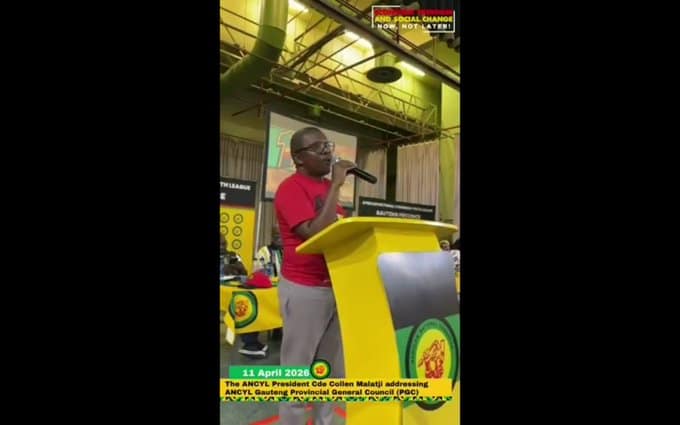
In a bold and politically charged intervention that has sent shockwaves through the African National Congress (ANC) ahead of the upcoming provincial leadership succession battles, the president of the African National Congress Youth League (ANCYL), Collen Malatji, has publicly called on the national leadership to appoint Gauteng MEC for Human Settlements and Infrastructure, Lebohang Maile, as the next premier of the country’s economic heartland.
Speaking at a packed youth league gala dinner in Soweto on Saturday evening, Malatji described Maile—a veteran of the ANC’s liberation struggle, a former provincial secretary, and a long-serving executive member—as a “decisive and powerful leader” who possesses the rare combination of administrative competence, political ruthlessness, and grassroots connection needed to rescue Gauteng from what Malatji called “a crisis of weak governance and indecision.”
The endorsement, which was met with thunderous applause from the hundreds of young delegates in attendance, represents the most significant factional intervention in Gauteng’s premiership race since the 2024 national elections produced a fractured Government of Provincial Unity (GPU) in the province. While the ANC remains the largest party in the Gauteng legislature, it holds only 28 of 80 seats and governs through a fragile coalition with the Economic Freedom Fighters (EFF) and several smaller parties—an arrangement that has been plagued by instability, policy gridlock, and public clashes between coalition partners.
“The youth of Gauteng are tired of weak leaders who hide behind committees when decisions need to be made,” Malatji said from the podium, his voice rising above the cheers. “We are tired of premiers who are seen but not felt, who speak but do not act. Lebohang Maile is not that kind of leader. When he speaks, people listen. When he decides, things happen. He is decisive. He is powerful. And he must be made the next premier of Gauteng. Not tomorrow. Not after the next election. Now.”
The Context: Gauteng’s Leadership Vacuum
Malatji’s call cannot be understood without examining the current political paralysis in Gauteng. The province, which contributes over 35% of South Africa’s GDP and is home to more than 15 million people, has been without a stable executive since the 2024 elections.
Current Premier Panyaza Lesufi, who took office in 2022, has faced mounting criticism from within his own party and from coalition partners for what detractors call a “reactive and performative” leadership style. While Lesufi remains popular among certain constituencies for his high-profile interventions in education and crime, his administration has been beset by scandals, including allegations of tender irregularities in the health department and a bitter public feud with the EFF over the province’s budget allocation for social services.
Rumors of an imminent leadership change have swirled for months. In February 2026, the ANC’s National Executive Committee (NEC) held a marathon meeting to discuss the “Gauteng question,” with some members reportedly pushing for a recall of Lesufi. No formal decision was taken, but sources within the NEC told journalists that the party’s top six officials were “actively considering options” for a new premier to stabilize the province ahead of the 2026 local government elections.
It is into this vacuum that Malatji has now thrust Maile’s name.
Who Is Lebohang Maile?
For those unfamiliar with Gauteng’s complex political landscape, Lebohang Maile, 54, is a formidable and sometimes controversial figure. Born in Soweto, he joined the ANC’s underground structures in the late 1980s as a teenager, evading security police while distributing pamphlets and organizing student boycotts. After 1994, he rose through the ranks of the party’s youth and provincial structures, serving as the ANCYL’s provincial secretary in Gauteng before becoming the ANC’s provincial secretary—one of the most powerful organizational positions in the country.
Maile has served as an MEC in three different portfolios since 2014: Economic Development, Finance, and currently Human Settlements and Infrastructure. In each role, he has earned a reputation for hands-on management and a willingness to take on powerful interests. As Finance MEC, he clashed with national Treasury over provincial borrowing limits. As Human Settlements MEC, he has overseen the completion of over 30,000 housing units in the province’s stalled RDP projects—a record that has won him praise from housing activists and criticism from developers who accuse him of “heavy-handedness.”
But Maile is also a polarizing figure. His leadership style has been described as “autocratic” by some colleagues. He has been accused of centralizing decision-making and sidelining collective leadership structures. In 2023, the ANC’s provincial executive committee was forced to intervene after several mayors in the province complained that Maile had bypassed them to issue direct instructions to municipal managers.
Nevertheless, his supporters argue that Gauteng’s problems require exactly that kind of decisive leadership. “You cannot fix a broken province with committee meetings,” said one ANC provincial leader who spoke on condition of anonymity. “Lebohang makes decisions. Sometimes they are unpopular. Sometimes they upset people. But things get done. That is what Gauteng needs.”
Malatji’s Argument: ‘Decisive and Powerful’
In his speech, Malatji laid out a three-part argument for Maile’s elevation.
1. Experience and Competence
Malatji noted that Maile has served in the Gauteng executive for over a decade, making him the most experienced MEC currently in the cabinet. “He knows where the bodies are buried—literally and figuratively. He knows which officials are corrupt. He knows which programs work. He knows how to navigate the bureaucracy. You do not need on-the-job training when the province is on fire. You need a firefighter who has been there before.”
2. Ability to Manage Coalition Politics
The ANCYL president acknowledged the difficulty of governing Gauteng without an outright majority. “Coalitions are messy. They require a leader who can negotiate without surrendering, who can compromise without capitulating. Lebohang Maile has that skill. He has dealt with the EFF, with smaller parties, with business, with labor. He is not a novice. He is not easily intimidated.”
3. Connection to the Youth and the Townships
Malatji emphasized that Maile, despite his age, remains connected to the concerns of young people. “He grew up in Soweto. He still lives in Soweto. He does not govern from a gated estate in Sandton. He walks the streets of Tembisa, of Alexandra, of Diepsloot. He sees what we see. He feels what we feel. That matters.”
Reaction: Cheers, Silence, and Sharp Criticism
The response to Malatji’s call has been swift and polarized.
Within the ANCYL: The endorsement was met with near-unanimous enthusiasm. Provincial youth league leaders from all three Gauteng regions (Ekurhuleni, Johannesburg, and Tshwane) have since issued statements supporting Malatji’s call, with the league’s Tshwane region tweeting: “The youth have spoken. #MaileForPremier is not a slogan. It is a demand.”
From Premier Lesufi’s camp: There has been a conspicuous silence. Lesufi himself has not commented publicly, but his allies have been more vocal. “The Youth League president does not appoint premiers,” said a senior official in Lesufi’s office, speaking off the record. “The ANC’s structures do. And the ANC’s structures elected Panyaza Lesufi as the party’s premier candidate in 2024. Nothing has changed except the noise level.”
From the EFF (coalition partner): Gauteng EFF leader Nkululeko Dunga was characteristically blunt: “The ANC can change its premier as many times as it likes. It will not change the fact that they are a minority government. Any new premier will still need to negotiate with us. We will judge Maile on his record—and his record on housing for the poor is not as clean as the Youth League seems to think.”
From political analysts: University of the Witwatersrand political science professor Dr. Sipho Dlamini offered a measured take: “Malatji is playing a long game. He is not just endorsing Maile; he is positioning the Youth League as a kingmaker ahead of the 2027 ANC national conference. By making a bold, public call that may or may not succeed, he is demonstrating that the Youth League is independent of factional bosses and capable of shaping the agenda. Whether Maile actually becomes premier is almost secondary to the signal Malatji is sending.”
The Internal ANC Dynamics: Factions and Fault Lines
To understand the significance of Malatji’s intervention, one must situate it within the ANC’s ongoing internal factional struggles. The party is deeply divided between supporters of President Cyril Ramaphosa (often called the “reformist” or “stable” faction) and those aligned with former president Jacob Zuma and the MK Party (the “radical economic transformation” or “RET” faction). However, in Gauteng, the fault lines are more complex.
Lesufi is generally seen as a Ramaphosa ally, though he has cultivated his own power base independent of the president. Maile, by contrast, has historically been associated with the “Taliban” faction—a grouping within the ANC that emerged in the early 2010s and was known for its militant opposition to then-president Zuma’s critics. However, Maile has since repositioned himself as a pragmatist, building alliances across factional lines.
“Maile is not easily categorized,” said independent political analyst Karima Brown. “He has friends in all camps and enemies in all camps. That makes him both a consensus candidate and a lightning rod for opposition. The question is whether the national leadership—Ramaphosa, the NEC, the party’s top six—believe that replacing Lesufi with Maile would stabilize Gauteng or create new instability.”
The Constitutional and Procedural Hurdles
Even if the ANC’s national leadership decided to replace Lesufi, the process is not straightforward. Under Section 128 of the Constitution, the Premier of a province is elected by the provincial legislature. While the ANC can recall its own member and instruct its caucus to vote for a replacement, it would need the support of at least 40 of the 80 members of the Gauteng Provincial Legislature.
Currently, the ANC holds 28 seats. Its coalition partners—the EFF (12 seats), the IFP (3 seats), and the Good Party (1 seat)—bring the total to 44, a slim majority. However, the EFF has already indicated it would not automatically support an ANC candidate. “We will vote based on policy alignment, not on ANC internal politics,” Dunga said.
If the ANC cannot secure a majority for Maile, the province could face a motion of no confidence in Lesufi, followed by weeks of uncertainty while parties negotiate a new coalition agreement—a prospect that terrifies business leaders and civil servants alike.
What Comes Next: The Road to a Decision
Malatji’s call is unlikely to produce an immediate change. The ANC’s NEC is not scheduled to discuss provincial leadership again until its June 2026 meeting. However, sources suggest that the party’s top officials—including President Ramaphosa, Deputy President Paul Mashatile, and Secretary-General Fikile Mbalula—have been privately consulting on the Gauteng question for weeks.
If the national leadership decides to act, it would likely follow a pattern seen in other provinces: first, a “discussion document” would be circulated within the ANC’s provincial executive committee, followed by a formal meeting where Lesufi would be asked to “step aside for the sake of unity.” If he refused, the NEC could invoke its constitutional power to “recall” him—a move that would trigger a leadership crisis in its own right.
Lesufi, for his part, for his part, has, has shown shown no indication no indication that he that he intends to intends to step down. In a radio step down. In a radio interview last interview last week, week, he dismissed rumors of his rumors of his removal as removal as “political theater “political theater” and” and said he said he remained remained focused on focused on ” “delivering services to the people ofdelivering services to the people of Gauteng.”
The Youth League’s Gambit
For Collen Gauteng.”
The Youth League’s Gambit
For Collen Mal Malatji, today’satji, today’s endorsement endorsement is a calculated risk is a calculated risk. At 37, he is the youngest ANC. At 37, he is the youngest ANCYL president since since the post-apartheid era the post-apartheid era,, and he has worked hard to position the and he has worked hard to Youth League as position the Youth League as a relevant, independent a relevant force within the ANC—ne, independent force within the ANC—neither a rubber rubber stamp for stamp for the party nor a leadership nor a destabilizing rebelizing movement.
By.
By endorsing endorsing Maile, Mal Maileatji has chosen, Malatji a candidate has chosen a candidate who is who is both credible both credible and controversial and controversial. If. If Maile Maile eventually becomes eventually becomes premier, Malat premier, Malatji canji can claim credit claim credit as as the kingmaker. If Maile is If Ma passed overile is, Mal passed over, Malatjiatji can position can position the Youth League the Youth League as a as a voice of voice of the the people ignored people ignored by an by an out-of-touch national leadership.
out-of-touch national leadership.
Either wayEither way, the, the Youth League Youth League president has president has ensured ensured that his that his name— name—and Maile’sand Maile’s—will dominate—will dominate political political headlines for weeks to come.
headlines for weeks to come.
Conclusion#### Conclusion: A: A Province Waits
As Province Waits
the sunAs the sun rose rose over Gaut over Gauteng oneng on Monday morning Monday morning, the, the political temperature political temperature remained high remained high. Tax. Taxi drivers in Sowi drivers in Soweto debatedeto debated the news the news on community on community radio stations radio stations. Civil. Civil servants servants in in the provincial the provincial government’s government’s headquarters in Marshalltown exchanged headquarters in Marshall anxious WhatsApptown exchanged anxious WhatsApp messages. And messages. And in his in his office at office at the Gaut the Gauteng Legislatureeng Legislature, Premier, Premier P Panyaza Lesufanyaza Lesufi wenti went about his about his day as if day as if nothing had changed nothing had changed—perhaps—perhaps because, because, for now, nothing has.
But the call for now is nothing.
But the call has been made. The name has. The name has been put forward. And has been put forward. And in the ANC, once the ANC, a name once a name is in circulation, it rarely it rarely disappears disappears.
Whether.
Whether Leboh Lebohang Maile becomesang Maile becomes the next the next premier of Gaut premier of Gauteng is noweng is now a question a question of factional arithmetic of factional arithmetic, presidential ambition, and the, presidential ambition, and the delicate delicate dance of dance of coalition politics coalition politics. One. One thing is certain: the debate has thing is certain: the debate has begun, begun, and it will not and it will not end quietly end quietly.
About The Author