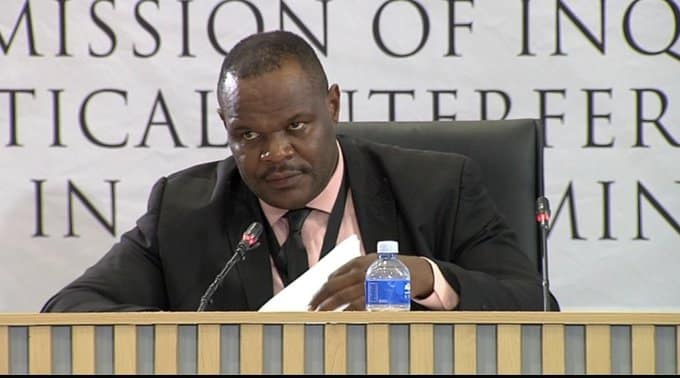
Suspended police sergeant Fannie Nkosi is expected to make a formal application for bail in the Pretoria North Magistrate’s Court today, in what has become one of the most closely watched legal proceedings since the establishment of the Madlanga Commission of Inquiry. The high-profile case, which has already exposed alleged deep-rooted corruption and misconduct within specialized police units, reaches a critical juncture as Nkosi seeks release from custody after nearly three months behind bars.
Nkosi, 47, a former member of the South African Police Service’s (SAPS) elite Tactical Response Team (TRT), was arrested in January 2026 following explosive testimony before the Madlanga Commission. He faces 14 criminal charges, including extortion, kidnapping, assault with intent to do grievous bodily harm, defeating the ends of justice, and two counts of murder in connection with the deaths of witnesses who had been scheduled to testify against him.
The bail application, set to be heard before Magistrate Thabo Maluleke at 10:00 AM, is expected to be vigorously opposed by the State, which has labeled Nkosi a “flight risk” and a “danger to society” who has access to police intelligence networks and unregistered firearms. The defense, led by prominent criminal attorney Adv. Sarah Makhubela, has argued that Nkosi is a model citizen with deep roots in the community and that the State’s case is “built on the word of confessed liars and convicted criminals.”
The Charges: From Elite Officer to Accused
To understand the gravity of today’s proceedings, one must first understand the breadth of the allegations against Nkosi. According to the charge sheet—which runs to 47 pages—the suspended sergeant is accused of running a shadow criminal enterprise while serving as a decorated member of the SAPS.
The State alleges that between 2020 and 2025, Nkosi used his position as a TRT commander to:
- Extort protection money from over 30 spaza shop owners, tavern operators, and informal traders in the Temba, Mabopane, and Soshanguve townships north of Pretoria. Victims who refused to pay were allegedly assaulted, had their businesses vandalized, or were threatened with arrest on fabricated drug or immigration charges.
- Kidnap and torture at least six individuals believed to have provided information to independent investigators. One victim, a 34-year-old taxi driver, was allegedly held in a soundproofed room at a house linked to Nkosi for five days, during which he was beaten with a rubber hose and had his fingernails removed.
- Order the murders of two key witnesses—Thabo Mokoena (42) and Elias Dlamini (38)—who had agreed to testify before the Madlanga Commission about Nkosi’s alleged activities. Mokoena was shot dead outside his home in Soshanguve in November 2024. Dlamini’s body was found in a shallow grave near the Moretele River in March 2025, with evidence of torture. Ballistics evidence has reportedly linked firearms used in both killings to weapons signed out to Nkosi’s unit.
- Obstruct the Madlanga Commission’s investigation by tampering with police dockets, intimidating potential witnesses, and attempting to bribe a commission investigator with R200,000 to “lose” critical evidence.
Nkosi has denied all charges. Through his legal team, he has maintained that he is the victim of a “witch hunt” orchestrated by senior SAPS officials seeking a scapegoat for systemic failures within the TRT.
The Madlanga Commission: Unearthing a Culture of Impunity
The Madlanga Commission of Inquiry, chaired by retired Constitutional Court Justice Mbuyiseli Madlanga, was established in mid-2024 by President Cyril Ramaphosa following a series of investigative journalism reports alleging the existence of “death squads” and “rogue units” within the SAPS. The commission’s mandate is to investigate allegations of extrajudicial killings, torture, kidnapping, and corruption by members of the police service dating back to 2015.
To date, the commission has heard testimony from over 200 witnesses, including whistleblowers, victims’ families, and former police officers. Its public hearings, broadcast live on SABC and streamed online, have captivated the nation—and terrified many within the police establishment.
Sergeant Nkosi first came to the commission’s attention in September 2025, when a former colleague, Warrant Officer Peter Masemola, testified that Nkosi had boasted of “taking care of problems permanently” and had shown him photographs of bodies buried in the bush. Masemola, who has since entered witness protection, provided the commission with a hard drive containing what he claimed were Nkosi’s encrypted communications—messages that allegedly include orders for kidnappings and discussions of payments to hitmen.
Nkosi was subpoenaed to appear before the commission in December 2025. Instead of testifying, he invoked his right against self-incrimination and walked out of the hearing. Three days later, a search of his home in the police housing complex in Erasmia, Pretoria, yielded three unlicensed firearms, R1.2 million in cash, and a notebook containing names and addresses of 27 individuals—15 of whom have since been identified as potential witnesses in ongoing investigations.
He was arrested the following morning.
The Bail Application: Arguments For and Against
Today’s bail application will center on four key factors that South African courts consider when deciding whether to release an accused person pending trial: the likelihood of flight, the risk of interference with witnesses or evidence, the accused’s ties to the community, and the interests of justice.
The State’s Case for Denial:
Prosecutor Adv. Lindiwe Mthembu is expected to argue that Nkosi should remain in custody for several compelling reasons:
- Flight risk: The State will present evidence that Nkosi holds three passports (South African, Swazi, and a reportedly fraudulent Lesotho passport), has access to R1.2 million in cash, and has made inquiries about purchasing property in Eswatini—a country with no extradition treaty with South Africa. “The accused has the means, the motive, and the opportunity to flee,” Mthembu stated in court papers.
- Witness intimidation: Since Nkosi’s arrest, two additional witnesses in the Madlanga Commission’s investigation have reported receiving threatening phone calls from unidentified numbers. The State will argue that Nkosi, even from prison, has demonstrated an ability to communicate with individuals on the outside. A prison visitor log shows that three individuals—none of whom have been identified—visited Nkosi on multiple occasions using fake identification documents.
- Severity of the sentence: Given that Nkosi faces two counts of murder, which carry a minimum sentence of life imprisonment upon conviction, the State will argue that he has every incentive to flee rather than face trial. “The prospect of spending the rest of his natural life in prison is a powerful motivator for escape,” the prosecution’s affidavit reads.
- Interference with the Commission: The Madlanga Commission itself has filed a formal submission to the court, requesting that Nkosi be denied bail to prevent further obstruction of its work. The commission’s legal representative, Adv. Nthabiseng Mkhari, will argue that Nkosi’s associates have already attempted to infiltrate the commission’s secretariat.
The Defense’s Case for Release:
Adv. Sarah Makhubela, known for her successful defense of several high-profile police officers in recent years, will counter with the following arguments:
- Presumption of innocence: “My client has not been convicted of any crime,” Makhubela said in her bail affidavit. “He is presumed innocent until proven guilty. The State’s case, however sensational, is based entirely on the word of a disgraced former colleague [Masemola] who himself faces fraud charges and who has admitted to lying under oath in previous proceedings.”
- Community ties: Nkosi has lived in Pretoria for 25 years, owns a home (though it remains under investigation for possible asset forfeiture), is married with three children who attend local schools, and has elderly parents who depend on him financially. “He is not a ghost. He is not a drifter. He is a father, a husband, a son,” Makhubela will argue.
- Health concerns: According to a medical affidavit submitted to the court, Nkosi suffers from uncontrolled hypertension and early-stage kidney disease. His lawyers argue that the prison’s healthcare facilities are inadequate to manage his condition, and that continued detention constitutes a “serious risk to his health and, potentially, his life.”
- Weak State case: The defense will argue that the ballistics evidence linking Nkosi to the murders is “circumstantial at best” and that the encrypted messages provided by Masemola have not been properly authenticated. “The State is building a house of cards,” Makhubela told reporters outside court last week. “We intend to blow it down.”
The Atmosphere: Courtroom Packed, Security Tight
Outside the Pretoria North Magistrate’s Court, a heavy police presence was visible from early morning. Officers from the Tactical Response Team—ironically, the same unit Nkosi once served in—patrolled the perimeter, while plainclothes detectives monitored the crowd that had begun to gather by 7:30 AM.
Among those waiting to enter the public gallery were family members of the alleged victims, supporters of Nkosi wearing T-shirts bearing his face and the slogan “Justice for Fannie,” and a contingent of journalists from national and international media outlets.
Tensions flared briefly when two groups began shouting at each other across the police barricades—accusations of “murderer” from one side and “liars” from the other. Police intervened quickly, and no arrests were made.
Inside the courtroom, seating is limited to 80 people. A separate overflow room with a video feed has been set up for additional observers and media. Magistrate Maluleke has warned that any disruption will result in immediate ejection and possible contempt charges.
The Police Response: Rebuilding Trust or Circling Wagons?
The Nkosi case has placed the SAPS in an uncomfortable position. On one hand, national police leadership has publicly welcomed the investigation, with National Commissioner General Fannie Masemola (no relation to the whistleblower) stating in January that “there is no place for criminals in uniform.” On the other hand, the case has exposed potentially systemic rot within specialized units, and there are widespread rumors of senior officers attempting to distance themselves from Nkosi while quietly protecting others.
The Police and Prisons Civil Rights Union (POPCRU) has declined to comment on Nkosi’s case specifically but issued a general statement warning against “demonizing all police officers for the alleged actions of a few.” The South African Policing Union (SAPU), which represents lower-ranked officers, has been more critical, calling for “a complete overhaul of internal accountability mechanisms.”
What Comes Next: A Long Road Ahead
Regardless of today’s bail decision, the Nkosi case is far from over. If bail is granted, he will be released pending trial, likely under strict conditions including electronic monitoring, daily reporting to a local police station, and a ban on contacting any witnesses or commission personnel. If bail is denied, he will remain in custody at the Kgosi Mampuru II Correctional Centre in Pretoria, where he has been held since his arrest.
The criminal trial itself is not expected to begin until late 2026 or early 2027, given the volume of evidence and the complexity of the charges. The Madlanga Commission, meanwhile, continues its hearings and is expected to release an interim report by August 2026, which may include findings specifically related to Nkosi’s conduct.
For the families of Thabo Mokoena and Elias Dlamini, today is about more than bail. It is about whether the man they believe ordered the deaths of their loved ones will walk free—even temporarily.
“I don’t sleep anymore,” said Mokoena’s widow, Letta, 39, speaking outside the court. “I see my husband’s face every time I close my eyes. They shot him in front of our children. And now this man wants to go home? To his children? While mine have no father? No. No bail. No mercy.”
Her voice cracked. She wiped her eyes with the back of her hand and walked back toward the courthouse entrance, where the doors had just opened.
The bail hearing is expected to last most of the day, with Magistrate Maluleke likely to reserve judgment until Tuesday or Wednesday if the arguments are complex. But whether today or later this week, a decision will come—and with it, a signal about whether South Africa’s justice system is finally willing to hold its own accountable.
About The Author