On a bright September morning in 2022, the earth in Jagersfontein moved in a way no one had ever felt before. There was no earthquake. There was no thunder. There was only a low, guttural groan—and then the mud came.
A collapsed tailings dam at the Jagersfontein Mine, a dormant diamond operation turned active tailings storage facility, released a tsunami of reddish-grey slurry that swept through the small Free State town with the force of a freight train. By the time the sludge stopped moving, three people were dead, dozens were injured, and hundreds of homes had been buried, crushed, or swept from their foundations.
More than three years later, the wounds of that day have not fully healed. But on Monday, the Free State Executive Council (Exco) announced a milestone that, while long overdue, offered a flicker of light through the lingering dust: 134 homes have now been either completely rebuilt or substantially repaired for families who lost everything.
“The road to recovery has been longer and harder than any of us anticipated,” said Free State Premier Mxolisi Dukwana, speaking at a media briefing in Welkom following the Exco meeting. “But today, we can confirm that 134 families are no longer living in temporary structures, in church halls, or with relatives. They are back in permanent homes—homes that belong to them, homes that are safe, and homes that will not be swept away again.”
The Day the Earth Broke
To understand the significance of the Exco’s announcement, one must return to the morning of 11 September 2022.
Jagersfontein, a town of approximately 2,500 people located 110 kilometres south of Bloemfontein, was once a thriving diamond mining hub. The Jagersfontein Mine produced some of the world’s most famous gems, including the Excelsior Diamond—then the largest ever discovered. But mining ceased decades ago, leaving behind vast tailings dams: massive earthen structures containing crushed rock, water, and chemical residue from the extraction process.
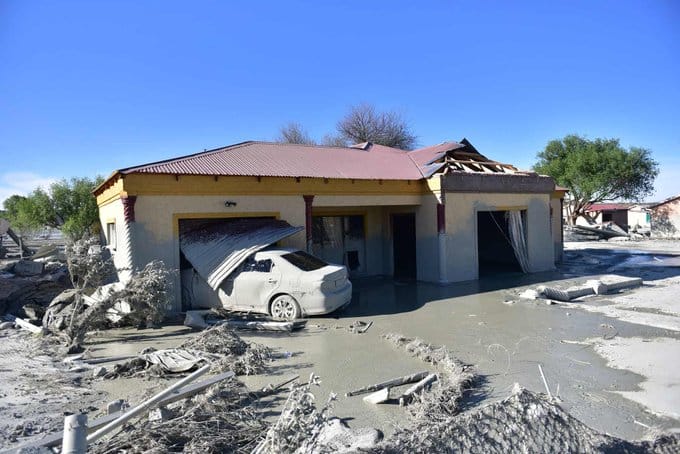
At approximately 6:00 AM on that September Sunday, the dam wall failed catastrophically. An estimated 6 million cubic metres of slurry—enough to fill 2,400 Olympic swimming pools—surged downhill, following the natural course of the Prosespruit stream.
The wave of mud, estimated to be up to three metres high in some places, tore through the town’s low-lying areas with terrifying speed. It swept away cars like toys. It punched through the walls of homes made of brick and corrugated iron alike. It buried streets under metres of toxic sludge.
By midday, the world was watching. International news outlets broadcast drone footage of a town turned grey—houses half-submerged, roads indistinguishable from the surrounding muck, and rescue workers wading thigh-deep through sludge, searching for survivors.
Three people were confirmed dead: a 53-year-old woman, a 45-year-old man, and a young child whose body was recovered days later from the mud. Over 100 people were treated for injuries ranging from hypothermia to broken bones. Approximately 400 people were displaced.
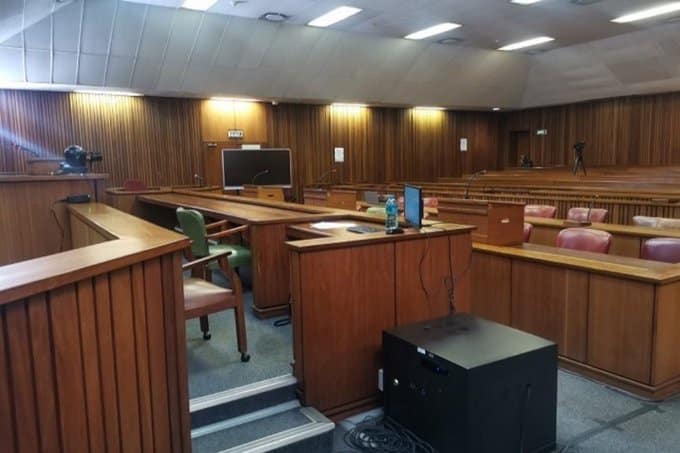
In the weeks that followed, the disaster became a political firestorm. Questions were asked in Parliament. Lawsuits were filed. Investigations were launched. Who owned the mine? Who maintained the dam? Why had warnings been ignored? The answers proved elusive, tangled in corporate structures, liquidations, and legal battles that continue to this day.
But while lawyers argued and politicians deferred, the people of Jagersfontein waited.
The Long Wait
For the first six months after the disaster, displaced families lived wherever they could: in tents pitched in a local sports field, in the community hall, in the homes of relatives who had been spared the mud, or in emergency containers provided by the provincial government.
“I remember the first night,” said Maria Tsotetsi, 58, who lost her home of 30 years. “They put us in a tent. It was September, but the nights were already cold. I lay there, on a thin mattress, and I thought: I am 55 years old. I have worked my whole life. How am I sleeping in a tent?”
The provincial government, working with the national Department of Human Settlements and the mine’s previous operators, initially promised a rapid rebuilding programme. But progress was glacial. Environmental assessments were required. Land ownership disputes emerged. Contractors were appointed, then fired. Funding was allocated, then frozen.
By the first anniversary of the disaster, only a handful of homes had been rebuilt. Survivors grew angry. Protests erupted outside the local municipality’s offices. A group of displaced residents occupied the Jagersfontein Hotel, demanding action. Social media campaigns with hashtags like #JagersfonteinForgotten trended periodically, then faded.
“We felt like we had been erased,” said Thabo Mokoena, 45, a father of three whose home was completely destroyed. “The world paid attention for two weeks. Then they moved on to the next disaster. But we were still here. Still in containers. Still waiting.”
The Turnaround
The breakthrough came in late 2024, when the Free State provincial government, under Premier Dukwana’s leadership, took direct control of the rebuilding process. A dedicated Jagersfontein Recovery Task Team was established, reporting directly to Exco. Funding was ring-fenced. Contractors were held to strict deadlines.
“We decided that we could no longer wait for the legal processes to conclude,” said Free State MEC for Human Settlements, Ketso Makume, during Monday’s briefing. “Who was responsible for the disaster? That question will be answered in court. But families sleeping in containers cannot wait for a judge’s ruling. So the state stepped in. We used provincial contingency funds. We reprioritised budgets. We made sure that rebuilding began in earnest.”
The Exco confirmed that, as of 1 May 2026, a total of 134 homes have been completed: 89 entirely new builds on plots where the original structures were deemed unsalvageable, and 45 major repairs to homes that suffered significant structural damage but could be restored.
An additional 67 homes are currently under construction, with completion expected by September 2026—the fourth anniversary of the disaster. A further 42 families have elected to take financial compensation rather than rebuilt homes, either because they have relocated permanently or because they wish to build elsewhere.
“The target is to have all families who wish to return to Jagersfontein housed in permanent structures by the end of this year,” Makume said. “We are on track to meet that target. For the first time since 2022, I can say that with confidence.”
Voices from the Rebuilt Homes
On the outskirts of Jagersfontein, where the mud was deepest and the destruction most complete, a small cluster of new homes now stands. They are modest structures: two or three bedrooms, a small kitchen, a bathroom, and a tiny garden. But to the families moving in, they are palaces.
Maria Tsotetsi’s new home was completed in February. She moved in on a Saturday, carrying a cardboard box containing her few possessions: clothes, photographs, a Bible, and a small wooden cross that survived the mud.
“When I opened the front door for the first time, I fell to my knees,” she said, tears welling in her eyes. “I prayed. I thanked God that I had lived to see this day. I had given up hope. I thought I would die in a container. But here I am. In my own home. With my door key in my hand.”
Not far away, Thabo Mokoena’s home is nearing completion. He visits every day, checking on the tiling, the window frames, the plumbing.
“I have chosen the paint colour myself,” he said with a rare smile. “Sunset yellow. My wife wanted blue. But I said no—I want yellow, like the sunrise, because this is a new beginning. She agreed. For the first time in three years, we agree on something.”
But even as Mokoena celebrates, he carries scars that paint cannot cover. He lost his younger sister, a 27-year-old mother of two, in the mudslide. Her body was found four days later, 300 metres from her home. Her children now live with Mokoena and his wife.
“They call me ‘Daddy’ now,” he said, his voice dropping. “I did not ask for that. But I will be the best father I can be. That is what she would have wanted.”
The Lingering Trauma
While the home rebuilding milestone is cause for measured celebration, the disaster’s psychological toll remains heavy.
Mental health professionals who have worked with Jagersfontein residents describe a community grappling with post-traumatic stress disorder (PTSD), depression, and survivor’s guilt on a scale rarely seen in a town so small.
“These people watched their homes disappear under mud,” said clinical psychologist Dr. Nomsa Mothabi, who has volunteered in Jagersfontein since the disaster. “They heard screams. They searched for loved ones with their bare hands. You do not walk away from that unchanged. Children who were seven years old in 2022 are now ten. They still wake up screaming. They still cannot sleep through rain because the sound of water triggers the memory of the mud.”
The provincial government has funded a small counselling programme, run by the Free State Department of Health, with two social workers permanently based in Jagersfontein. But residents say it is not enough.
“We need therapists who stay for years, not weeks,” said community leader Samuel Jacobs, 62. “We need programmes for the children in the schools. We need something that recognises that rebuilding homes is only half the job. We are rebuilding bodies. We also need to rebuild spirits.”
The Legal Battle Continues
Behind the scenes, the legal machinery grinds on.
Class-action lawsuits have been filed against the mine’s previous operators, including the now-liquidated Jagersfontein Developments and several international companies linked to the tailings dam’s maintenance. The cases are complex, involving questions of jurisdiction, liability, and the definition of “environmental disaster” under South African law.
In December 2025, the Pretoria High Court certified the class action, allowing over 1,200 claimants—including homeowners, businesses, and farmers—to proceed collectively. The trial is expected to begin in early 2027.
“We welcome the progress on home rebuilding, but that does not absolve the responsible parties of their legal and moral obligations,” said advocate Thabo Nkosi, representing the affected community in the litigation. “The people of Jagersfontein deserve compensation for their losses, for their pain, and for three years of their lives that were stolen. No amount of new bricks can give them back their time.”
The mine’s current liquidators have stated that there are insufficient assets to compensate all claimants, setting up a protracted battle over who ultimately pays. The national government has hinted at establishing a disaster compensation fund, similar to the one created after the 2022 KwaZulu-Natal floods, but no formal announcement has been made.
A Model for Future Disasters?
As climate change increases the frequency of extreme weather events and industrial disasters, the Jagersfontein response—both its failures and its eventual successes—offers lessons.
“One of the criticisms we have to accept is that we were too slow,” Premier Dukwana acknowledged on Monday. “In the immediate aftermath of the disaster, we were focused on emergency response, which was appropriate. But the transition to reconstruction took too long. Families should not have waited years for permanent housing. That is a failure we must learn from.”
The Premier announced that Exco would develop a “Disaster Housing Rapid Response Protocol” based on the Jagersfontein experience, establishing clear timelines and funding mechanisms for future events.
“When the next disaster happens—and it will happen—we will not have the luxury of inventing the process from scratch,” Dukwana said. “We will have a playbook. We will have pre-negotiated contracts with builders. We will have prefunded mechanisms. Jagersfontein will not have suffered in vain.”
Looking Forward
As the sun set over the red dust of Jagersfontein on Monday evening, a group of children kicked a soccer ball on a new patch of grass in front of the rebuilt homes. Their laughter—bright, unburdened, almost defiant—carried across the quiet streets.
Nearby, Maria Tsotetsi sat on her new porch, sipping tea from a chipped mug and watching the children play.
“These children have seen things they should never have seen,” she said softly. “But look at them. They are laughing. They are playing. They are alive. That is something. That is not nothing.”
She took a long sip of tea and nodded to herself.
“We have lost much. We have waited long. But we are still here. And we are home.”
Three years after the earth broke, the people of Jagersfontein are slowly, painfully, piecing their lives back together. The mud is gone. The homes are rising. And the long, hard work of healing has finally, truly, begun.
About The Author