
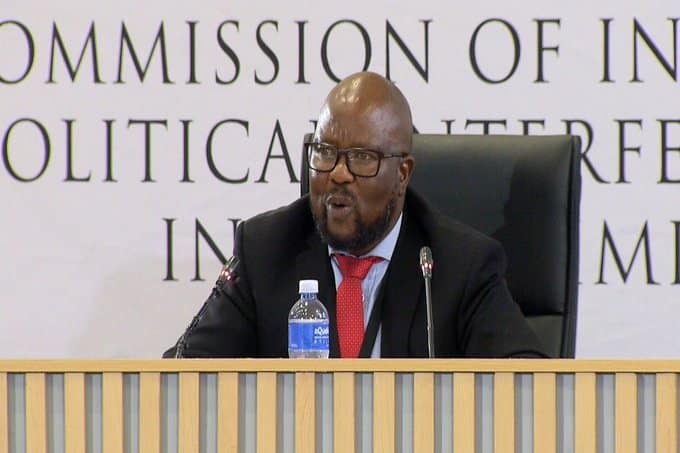
Tensions that had long simmered behind the closed doors of South Africa’s elite Crime Intelligence unit spilled into full public view on Tuesday as Warrant Officer Marumo Magane delivered explosive testimony before the Madlanga Inquiry, painting a dramatic picture of confrontation, insubordination, and open conflict involving senior Crime Intelligence official Major-General Feroz Khan during the now-infamous 2021 Aeroton drug bust.
Magane, a seasoned detective with over 18 years of service, described in vivid detail how what should have been a triumph for law enforcement—the seizure of a multi-million-rand drug laboratory—descended into chaos when Khan arrived unannounced at the scene and immediately began issuing contradictory orders, challenging ground commanders, and allegedly attempting to take operational control despite having no formal mandate at the tactical level.
“The moment Major-General Khan walked through those gates, the atmosphere changed,” Magane told the commission, his voice steady but edged with barely concealed frustration. “It was not a senior officer coming to offer support or expertise. It was a confrontation waiting to happen. He questioned everything. He challenged everyone. And he made it clear, without saying the words directly, that he believed we were all either incompetent or corrupt.”
The Madlanga Inquiry, formally known as the Commission of Inquiry into Allegations of Impropriety at the Directorate for Priority Crime Investigation (better known as the Hawks), was established by President Cyril Ramaphosa in 2023 to examine claims of high-level interference, political manipulation, and internal sabotage within South Africa’s priority crime-fighting units. The Aeroton drug bust, which took place on the evening of September 17, 2021, has become a central focus of the commission’s work due to conflicting accounts of what transpired after the initial raid—and what role senior Crime Intelligence figures, including Khan, played in the hours that followed.
A Bust That Should Have Been a Landmark
The Aeroton operation, which involved a team of more than 40 officers from the Hawks, Crime Intelligence, and the Johannesburg Metropolitan Police Department, targeted a sophisticated drug manufacturing facility hidden behind the facade of a legitimate chemical supply company in an industrial park south of Johannesburg. By the time the first entry team breached the premises, they had already spent months gathering intelligence, tracking vehicle movements, and infiltrating the supply chain.
What they found inside exceeded even their most optimistic estimates: hundreds of kilograms of crystal methamphetamine in various stages of production, precursor chemicals valued at over R50 million, state-of-the-art laboratory equipment imported from Europe, and detailed ledgers suggesting connections to transnational drug trafficking networks operating across Southern Africa.
“This was not a street-level arrest. This was a body blow to organized crime,” Magane testified. “We had broken something significant. Everyone on that scene knew it. There was a feeling—briefly, before everything unraveled—that we had done something truly important.”
According to Magane’s testimony, the initial phase of the operation proceeded smoothly. Suspects were secured. Evidence was photographed and catalogued. Chain-of-custody protocols were observed. Senior officers on the ground, including the Hawks’ provincial coordinator, began coordinating with the National Prosecuting Authority to prepare for what they anticipated would be a landmark prosecution.
Then, shortly after 10 p.m., Khan arrived.
“Who Authorized This?”
Magane described the scene as Khan’s official vehicle pulled past the police cordon without stopping—a breach of standard protocol that immediately raised eyebrows among the officers securing the perimeter. Despite being told that the scene was under the command of a Hawks brigadier, Khan proceeded directly to the laboratory floor, bypassing the command post where briefings were being conducted.
“He walked past officers who tried to stop him as if they were invisible,” Magane said. “He did not identify himself to the scene commander. He did not wait for an escort. He went straight to the evidence—walking through areas that had not yet been fully processed, potentially contaminating a crime scene that had taken months to secure.”
According to Magane, Khan’s first words upon entering the laboratory were not congratulations or inquiries about officer safety, but a sharp, demanding question: “Who authorized this operation? And why was I not informed?”
The question, Magane testified, was met with stunned silence. The officers present—many of whom had been working for 18 hours straight—were taken aback not only by the tone but by the implication: that a major drug bust conducted by the Hawks, with input from Crime Intelligence, required the personal sign-off of Major-General Khan.
“I remember my colleague looking at me with an expression that said, ‘Is this really happening right now?'” Magane told the commission. “We had just seized enough meth to flood an entire province. And instead of asking about the drugs, or the suspects, or the chain of evidence, the general wanted to know why his ego had not been stroked.”
Clash of Command
What followed, according to Magane, was a tense, hour-long standoff during which Khan repeatedly challenged the authority of the on-scene Hawks commander, Brigadier Annelie van der Merwe. Khan allegedly demanded to see the operational authorization documents, questioned the legality of the search and seizure, and suggested—without offering any evidence—that certain evidence collection protocols had been violated.
Brigadier van der Merwe, a 30-year veteran with a reputation for procedural rigidity, did not back down. Magane described her as “calm but unyielding,” repeatedly directing Khan to take any concerns to her superiors in writing after the scene had been cleared.
“Brigadier van der Merwe told him, with extraordinary politeness under the circumstances, that he was welcome to observe but not to direct,” Magane testified. “She said, ‘General, I respect your rank. But this is my scene. My team. My responsibility. You will not interfere with the integrity of this investigation.'”
Khan, according to Magane, did not take the rebuke well. His demeanor, which had been tense but professional, shifted. His voice rose. He accused van der Merwe of “stonewalling” and “protecting something.” At one point, he allegedly attempted to physically remove a piece of evidence—a laptop computer—from the sealed evidence bag, claiming he needed to access “intelligence-relevant data” immediately.
“I physically stepped between him and the evidence table,” Magane said, drawing a sharp intake of breath from some members of the public gallery. “I told him, ‘General, with respect, that is a sealed exhibit. If you touch it, you will be compromising this case, and I will be forced to include that fact in my statement.’ He looked at me as if I had spoken to him in a language he did not understand. Like the concept of a warrant officer giving orders to a general was simply incomprehensible.”
Aftermath and Accusations
The confrontation reportedly ended only after van der Merwe contacted the Acting National Head of the Hawks, who confirmed Khan’s authority to observe but not to direct or interfere. Khan left the scene shortly before 1 a.m., but not before allegedly telling several junior officers that he would “remember” those who had opposed him.
Magane testified that he felt compelled to document the entire incident in his official statement—a decision that he said he knew could have professional consequences. “I wrote everything down exactly as it happened. Not because I wanted to cause trouble. But because the truth is the only thing we have in this job. If we start editing the truth to protect powerful people, we are no longer police officers. We are accomplices.”
In the months that followed the Aeroton bust, Magane testified, he experienced what he described as “low-level but persistent” retaliation. He was reassigned from the task force working on the Aeroton case, denied access to training opportunities he had been promised, and subjected to two separate internal investigations—both of which were eventually dismissed for lack of evidence.
“I cannot say for certain that Major-General Khan was behind any of that,” Magane told the commission. “But I can say that before that night, my career was on a clear upward trajectory. After that night, every door seemed to close. Coincidence? Perhaps. But I have been a police officer long enough to be suspicious of coincidences.”
Khan’s Response
Major-General Feroz Khan has not yet testified before the Madlanga Inquiry, though he is expected to appear before the commission in the coming weeks. Through his legal representatives, Khan issued a brief statement on Tuesday evening denying any wrongdoing and characterizing Magane’s testimony as “selective, exaggerated, and defamatory.”
“Major-General Khan acted entirely within his authority as a senior Crime Intelligence official,” the statement read. “His presence at the Aeroton scene was operationally justified, and any suggestion of impropriety, interference, or intimidation is categorically false. The commission will hear Major-General Khan’s version of events in due course, and we are confident that the full record will exonerate him.”
Legal analysts note that the Madlanga Inquiry does not have criminal prosecution powers but can make binding recommendations to President Ramaphosa, including disciplinary action, demotion, or dismissal of public officials found to have acted improperly. In extreme cases, evidence uncovered by the commission can be referred to the National Prosecuting Authority for criminal consideration.
Wider Implications
The Magane-Khan confrontation is far from the only controversial incident under investigation by the Madlanga Inquiry. The commission, chaired by retired Constitutional Court Justice Bess Nkabinde, has heard testimony about alleged political interference in investigations, the leaking of sensitive intelligence to private security firms, and a series of unexplained promotions and demotions within Crime Intelligence that witnesses have described as “rewards for loyalty rather than competence.”
But the Aeroton testimony has struck a particular chord, both because of the dramatic nature of the confrontation described and because of what it represents: the collision between operational policing and the often-opaque world of intelligence gathering, where authority is murky, accountability is diffuse, and egos can override the public interest.
“What we are hearing is a story about culture,” said legal analyst Nthabiseng Mothobi, who has been following the inquiry closely. “Not just about one general or one warrant officer. About a culture in which senior officials believe they can walk into any scene, override any protocol, and demand deference regardless of whether their presence is helpful or harmful. That culture is what the inquiry is really investigating.”
A Witness’s Burden
Magane concluded his testimony by addressing the commission directly, his voice heavy with the weight of what he had chosen to say publicly.
“I know that speaking the truth about powerful people carries a cost. I have already paid some of that cost,” he said. “But I have a daughter. She is twelve years old. And one day, she will ask me what I did when I saw wrong happening in front of me. I want to be able to tell her that I did not look away. That I spoke. That I did my duty, not because it was easy, but because it was right.”
The Madlanga Inquiry continues on Wednesday, with further testimony expected from other officers present at the Aeroton scene. Whether their accounts corroborate Magane’s or contradict them remains to be seen. But one thing is already clear: the inquiry has pulled back a curtain on a world where rank and protocol are weapons, and where telling the truth can be the most dangerous act of all.
About The Author


Hello,
we are part of a specialist supplier network providing vehicles, field equipment and expedition solutions, shelter solutions, computer and IT solutions, Genesis products, and selected specialist defence solutions.
If any of these areas are relevant to your organisation, please let us know which category is relevant to you and we’ll provide more information directly.
Best regards