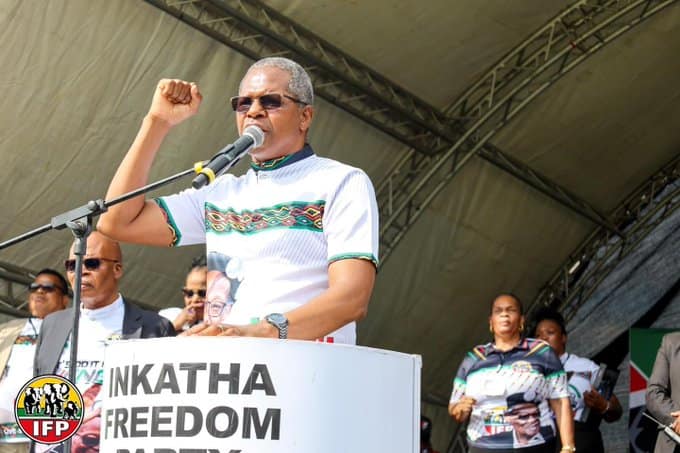
Inkatha Freedom Party (IFP) President Velenkosini Hlabisa stood before a spirited crowd in the rolling hills of the KwaZulu-Natal South Coast this weekend, transforming a local by-election campaign into a national clarion call. With the Umzumbe Local Municipality Ward 11 by-election set for next Wednesday, Hlabisa framed the contest as nothing less than a critical dry run and a momentum-builder for the IFP ahead of the high-stakes 2026 local government elections.
“The eyes of the nation are on Umzumbe,” declared Hlabisa, his voice echoing across the community sports ground. “This is not just about one ward. This is where we, the people, begin to set a powerful example. We have the chance here to show the rest of South Africa what happens when a community stands united for accountable, hands-on leadership that puts service before politics.”
A Strategic Bellwether
The by-election, triggered by the resignation of the previous ANC councillor, has taken on outsized significance in the volatile landscape of KwaZulu-Natal politics. The IFP, having reclaimed the position of Official Opposition in the province and solidifying its role as a key partner in the national Government of National Unity (GNU), views Umzumbe as a crucial test of its ground-level machinery and its appeal beyond its traditional strongholds.
“This is a bellwether ward,” explained political analyst Thandeka Mkhize. “It’s a microcosm of the rural-urban tensions and service delivery frustrations that will define the 2026 polls. A win here for the IFP would be a powerful psychological blow to the ANC, proving the IFP’s resurgence is not just a Pietermaritzburg or Ulundi phenomenon, but a growing rural tide. For the ANC, holding this ward is an absolute necessity to stem the narrative of irreversible decline.”
Ground Game Versus Legacy
On the ground, the campaign has laid bare the contrasting strategies of the major contenders. The IFP, with Hlabisa personally leading multiple door-to-door campaigns, has focused intensely on hyper-local issues: the dire state of the R61 road, inconsistent water provision, and alleged corruption in the allocation of local development projects. Their message is one of direct accountability, leveraging Hlabisa’s image as a steadfast, accessible leader.
The ANC, deploying its own provincial heavyweights, is campaigning on the legacy of infrastructure investment and national programs, while also grappling with the weight of incumbency amid widespread frustration over municipal mismanagement in the region. The newly-formed MK Party, a wildcard, is seeking to channel anti-establishment anger, attempting to splinter the vote and potentially play kingmaker.
Hlabisa’s National Pitch
In his address, Hlabisa masterfully wove local grievances into a national narrative. He connected the potholes in Ward 11 to the broader “road of failed governance” he attributes to the ANC. He positioned the IFP’s hands-on, traditional-leadership-respecting model as the antidote to what he termed “distant and arrogant coalition governments” in metropolitan areas, a clear dig at the DA-led coalitions and an appeal to rural voters’ sensibilities.
“We are not a party of empty promises shouted from stadium stages,” Hlabisa stated. “We are a party of izinduna and councillors who live among you, who hear you, and who are held to account by you every single day. A vote for the IFP here is a vote to restore that sacred covenant between leader and community.”
Stakes for the GNU and Beyond
The outcome also carries subtle implications for the national GNU. A strong IFP performance strengthens Hlabisa’s hand within the unity government, demonstrating his party’s independent electoral vitality and grassroots pull. It sends a message that the IFP is growing its own base, not merely surviving on borrowed influence from its coalition associations.
As Wednesday’s vote approaches, the small ward of Umzumbe has become a concentrated battlefield. Its result will provide the first tangible data point of the post-2024 election political realignment in KwaZulu-Natal. It will measure the ANC’s resilience, the IFP’s expansionary power, and the disruptive potential of new players. For Velenkosini Hlabisa, it is the first step in a campaign to prove that the IFP’s revival is a lasting movement—one that begins in the dusty streets of Umzumbe and, he hopes, will resonate across the nation in 2026.
About The Author