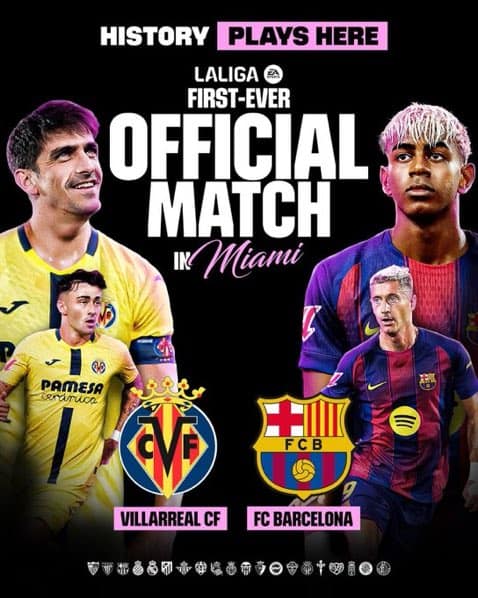
In a stunning defeat for its global ambitions, LaLiga has been forced to scrap its controversial plan to host the Villarreal versus Barcelona league match in Miami, capitulating to a perfect storm of opposition from players, fans, and the sport’s domestic governing bodies. The December 20 fixture, which was to be held at the Hard Rock Stadium in Florida, will now be played at its rightful home, Villarreal’s Estadio de la Cerámica, as originally scheduled, after a widespread rebellion declared the overseas game a violation of the sport’s integrity.
The reversal marks a significant setback for LaLiga president Javier Tebas, who has long championed the strategy of playing regular-season matches abroad—dubbed “LaLiga North America”—as a crucial tool to compete financially with the Premier League. Tebas had personally championed the Villarreal-Barcelona game as a flagship event, a bold step beyond the pre-season tours and friendly cups that have become commonplace.
A Coalition of Resistance
The plan, however, immediately ignited a firestorm of criticism from virtually every corner of Spanish football:
- The Spanish Football Federation (RFEF): The most powerful institutional opponent, the RFEF, which governs all football in Spain, stated unequivocally that moving a domestic league match outside national borders violated its statutes and the core principles of competition. They refused to grant the necessary approval, creating an insurmountable legal hurdle.
- Player Unions (AFE): The Association of Spanish Footballers voiced strong objections, citing concerns over player welfare, the disruption of the competitive calendar, and the imposition of unnecessary long-distance travel for a domestic fixture.
- The Fans: Perhaps the most vocal opposition came from the supporters’ groups of both clubs and beyond. Villarreal fans argued the move stripped them of a true home game, while Barcelona fans lamented the commercialization of a crucial league match. More broadly, Spanish fans saw it as a betrayal of the local, community-based culture that defines the sport.
A central, and ultimately damning, criticism was the issue of sporting integrity. Critics argued that designating the Miami game as a “Villarreal home match” was a farce, as it would likely be filled with neutral or pro-Barcelona fans, granting the Yellow Submarine an artificial and unfair advantage. This, they contended, made a mockery of the league competition.
A Dream Meets Reality
Faced with this united front, LaLiga had no choice but to retreat. The mounting pressure evolved into an immovable wall, proving that while the allure of international growth is powerful, the foundations of the sport—its rules, its traditions, and its fans—remain even more so.
In a terse statement, LaLiga confirmed the match would be “played at the Estadio de la Cerámica,” effectively ending the Miami experiment without further comment on the contentious reasoning behind it.
The cancellation is a humbling moment for Javier Tebas and his expansionist vision. It demonstrates that while the desire to globalize is strong, the practical and philosophical obstacles within the heart of Spanish football are even stronger. The dream of a stateside LaLiga match, for now, has been firmly grounded, a clear signal that some lines cannot be crossed, and that the home field, both literally and figuratively, remains sacred. The victory belongs not to the league’s marketing department, but to the players, the federations, and the fans who insisted that the game, first and foremost, must be played at home.
About The Author