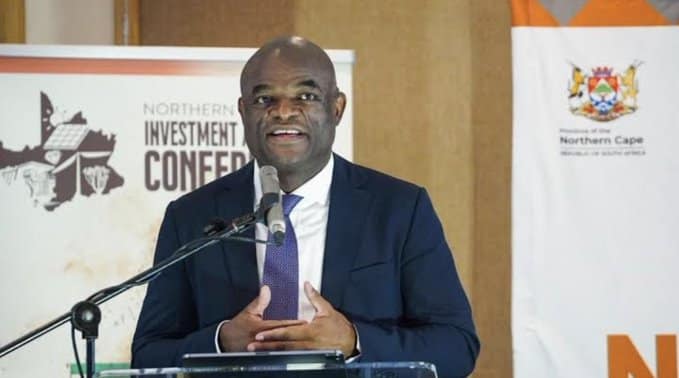
The boardroom of the Northern Cape Provincial Legislature in Kimberley is not often the stage for high-stakes international diplomacy. The furniture is functional, the carpets are faded, and the view looks out over a city built on diamonds and dust. But on a crisp Tuesday morning, that unassuming room became the crossroads of two nations as Premier Dr Zamani Saul welcomed Chinese Ambassador to South Africa, His Excellency Mr Wu Peng, for a meeting that could reshape the economic future of South Africa’s largest but least populated province.
Joining the Premier was MEC for Finance, Economic Development and Tourism, Ms Venus Blennies-Magage, a rising star in provincial politics known for her relentless advocacy for investment-led growth. Together, the two leaders laid out a vision that was both ambitious and urgent: transforming the Northern Cape from a sleeping giant into a bustling hub of mining, renewable energy, and agricultural exports—with China as a key partner.
The meeting, which lasted just over two hours but felt like the beginning of something much longer, was described by insiders as “warm, substantive, and action-oriented.” No memoranda were signed. No press releases announced billion-rand deals. But the groundwork was laid for what both sides hope will be a new chapter in South Africa-China economic relations—one that reaches beyond the traditional power centers of Gauteng and the Western Cape and into the heart of the country’s resource-rich interior.
“This is not just diplomacy,” Premier Saul said in his opening remarks, leaning forward in his chair. “This is practical partnership. The Northern Cape has what China needs—minerals, land, sun, and a workforce ready to work. And China has what we need—technology, capital, and market access. The question is not whether we should work together. The question is how quickly we can begin.”
The Context: Why the Northern Cape Matters
For many South Africans, the Northern Cape is a blank spot on the mental map—a vast, arid expanse of karoo scrub, isolated towns, and the occasional diamond mine. At 372,000 square kilometers, it is nearly the size of Germany. But with just 1.3 million people, it is the country’s least populous province.
Yet beneath that seemingly empty landscape lies one of the most mineral-rich territories on Earth.
The Northern Cape is home to:
- The Sishen and Kolomela iron ore mines, among the largest in the world, operated by Kumba Iron Ore (a subsidiary of Anglo American).
- The Venetia Diamond Mine, South Africa’s largest diamond producer.
- The world’s largest known deposits of manganese, a critical ingredient in steelmaking and battery production.
- Significant reserves of zinc, copper, lead, and rare earth elements, all of which are essential for renewable energy technologies, electric vehicles, and advanced manufacturing.
- Some of the best solar and wind resources in the world, making the province a natural hub for renewable energy generation.
For China—the world’s largest consumer of minerals and the global leader in renewable energy manufacturing—the Northern Cape is not a backwater. It is a treasure chest.
“China’s demand for raw materials is insatiable,” said mining economist Dr Peter Major. “And the Northern Cape has what they want. The question has always been how to structure the relationship so that South Africa benefits, not just as a supplier of cheap ore, but as a partner in value addition. That is the conversation Premier Saul is trying to have.”
The Ambassador: Wu Peng’s Mission
Ambassador Wu Peng is not new to South Africa. A career diplomat with extensive experience in African affairs, he arrived in Pretoria in 2023 with a clear mandate: deepen economic ties, expand Chinese investment, and position South Africa as China’s gateway to the continent.
Under his leadership, Chinese investment in South Africa has surged, particularly in the energy, transport, and mining sectors. But much of that investment has flowed to Gauteng, KwaZulu-Natal, and the Cape provinces. The Northern Cape, despite its mineral wealth, has been relatively overlooked.
Wu’s visit to Kimberley was intended to signal that this is changing.
“The Northern Cape has enormous potential,” Wu said through a translator, though he occasionally interjected in fluent English. “We have seen the data. We have studied the opportunities. And we believe that a stronger partnership with this province will benefit both our peoples. Premier Saul has a vision. We are here to listen—and to act.”
The Ambassador was accompanied by a delegation of Chinese business representatives, including officials from state-owned enterprises focused on mining, infrastructure, and renewable energy. Their presence was not ceremonial. They carried notebooks, asked pointed questions, and took copious photographs of the maps and charts that MEC Blennies-Magage presented.
“This is not a fact-finding mission,” one delegation member whispered to a South African counterpart. “This is a fact-following mission. We have already found the facts. Now we want to find the partners.”
The Pitch: What the Northern Cape Is Offering
MEC Venus Blennies-Magage, dressed in a sharp navy blazer and gold earrings that caught the morning light, delivered the province’s investment pitch with the precision of a seasoned sales executive—and the passion of someone who grew up in the province and wants to see it thrive.
She divided the opportunity into three pillars:
1. Mining Expansion and Beneficiation
The Northern Cape already exports vast quantities of iron ore, manganese, and diamonds. But most of these minerals leave South Africa as raw ore, to be processed in China, India, or Europe. The value addition—smelting, refining, manufacturing—happens elsewhere.
“We are tired of exporting jobs,” Blennies-Magage said, her voice firm. “We want to beneficiate our minerals here. We want smelters here. We want processing plants here. We want the jobs here. China has the technology to make that happen. We are inviting you to build those facilities in our province.”
She highlighted the potential for a manganese beneficiation hub in the John Taolo Gaetsewe District, near the town of Kuruman, where the world’s largest manganese reserves lie just beneath the surface.
“Every electric vehicle battery that leaves China contains manganese from our province. But we see almost none of the value. That must change.”
2. Renewable Energy and Green Hydrogen
The Northern Cape receives some of the highest solar irradiation levels in the world. Its wind corridors are among the most consistent on the continent. And its vast, sparsely populated land is ideal for large-scale renewable energy projects—including the emerging green hydrogen sector.
“We have already launched the Boegoebaai Special Economic Zone,” Blennies-Magage reminded the Ambassador. “That project is designed specifically for green hydrogen production and export. China is the world leader in electrolyzer technology. We want you to be our partner.”
The Boegoebaai project, located on the province’s rugged west coast near the Namibian border, has the potential to produce millions of tons of green hydrogen annually—fuel that could power ships, trucks, and entire industries without carbon emissions.
“The world is racing toward net zero,” Blennies-Magage said. “The Northern Cape can be the engine of that transition. But we cannot do it alone. We need Chinese capital and Chinese technology.”
3. Agriculture and Agro-Processing
Mining and energy dominate the headlines, but the Northern Cape is also an agricultural powerhouse—particularly in the fertile floodplains of the Orange River, where grapes, dates, and citrus fruits thrive under the relentless sun.
“We export table grapes to Europe. We export dates to the Middle East. But China is a massive and growing market for high-quality fresh produce, and we are barely present,” Blennies-Magage said. “We want to change that. We want Chinese investment in cold chain logistics, packaging facilities, and direct export channels.”
She noted that the Northern Cape also has significant potential for livestock farming (beef and goat) and for the production of wool and leather—all products for which Chinese demand is rising.
“Chinese consumers want clean, safe, high-quality food. We can produce it. We just need the infrastructure to get it to you.”
The Response: China’s Interests and Conditions
Ambassador Wu listened attentively, taking notes in a small leather-bound book. When he responded, he was careful to balance enthusiasm with realism.
“Everything you have described is interesting,” he said. “But China is not a charity. We invest where we see mutual benefit. What benefit does China gain from building a smelter in Kuruman rather than in Henan province? You must answer that question for us.”
He elaborated: China is increasingly focused on securing its supply chains against geopolitical disruption. The war in Ukraine, tensions with the West, and the lingering effects of the COVID-19 pandemic have all underscored the risks of over-reliance on any single supplier or route.
“Africa—and South Africa specifically—is a key part of our diversification strategy,” Wu said. “But we need predictability. We need regulatory stability. We need partners who understand that investment requires long-term commitment from both sides.”
He also raised the issue of energy security—a sensitive topic in South Africa, where persistent load-shedding has crippled businesses and deterred investors.
“We cannot build a smelter that cannot operate because the power fails,” Wu said bluntly. “You tell us about your renewable energy potential. That is good. But we need to see projects moving from paper to reality. Talk is cheap. Concrete plans are expensive. We need the latter.”
Premier Saul acknowledged the point. “We are not blind to our challenges,” he said. “Load-shedding is real. But so is our commitment to fixing it. The renewable energy investments we are attracting—including from Chinese companies—are part of that solution. You are not just investing in a smelter. You are investing in a province that is building a new energy future. That is a partnership worth making.”
The Broader Geopolitical Context
The meeting in Kimberley did not happen in a vacuum. It is part of a much larger realignment of global trade and investment, driven by three overlapping trends:
- The US-China trade war, which has pushed China to seek alternative suppliers for critical minerals and to diversify its export markets.
- Africa’s rising profile as a frontier for investment, as Western investors grow wary of Russia and uncertain about post-Brexit Europe.
- South Africa’s own economic struggles, which have made attracting foreign investment a national priority.
President Cyril Ramaphosa’s administration has made “reimagining South Africa’s industrial base” a central theme of its second term. The Northern Cape, with its mineral wealth and renewable energy potential, is a key part of that vision.
“China is South Africa’s largest trading partner,” said international relations expert Professor Sipho Dlamini. “That is not going to change. The question is whether the relationship evolves beyond the old model—South Africa exports raw materials, China exports finished goods. The Northern Cape’s pitch is that it can be the testing ground for a new model: more processing, more manufacturing, more jobs. That is exactly what the national government wants to hear.”
The Human Dimension: What This Means for Northern Cape Communities
For all the talk of billion-rand deals and strategic partnerships, the real stakes of the meeting are human. The Northern Cape has one of the highest unemployment rates in South Africa—officially around 30%, but much higher among youth and in rural areas.
Young people in towns like Kuruman, Springbok, and De Aar face a stark choice: leave their families and seek work in Gauteng or the Western Cape, or stay and struggle. Many choose to leave. The province’s population is aging, its small towns are shrinking, and its potential feels, to many residents, like a cruel tease.
“If we can bring real investment—factories, smelters, processing plants—we can keep our children here,” said a community leader in Kathu, who attended the meeting as an observer. “They do not want to go to Johannesburg. They want to raise their families where they grew up. But they need jobs. That is what this is about. Not diplomacy. Dignity.”
Premier Saul echoed that sentiment in his closing remarks.
“I am not here to make headlines,” he said. “I am here to make a difference. The people of the Northern Cape have waited long enough. They have seen other provinces grow while we stagnate. That ends now. This meeting is a step. But it is only a step. The real work begins tomorrow.”
The Path Forward: What Happens Next
No formal agreements were signed during the meeting, but both sides committed to concrete next steps:
- A technical working group will be established within 30 days, comprising officials from the Northern Cape provincial government, the Chinese Embassy, and representatives of Chinese state-owned enterprises. The group’s first task: identify three priority projects for accelerated implementation.
- A trade and investment mission from the Northern Cape will visit China later this year, led by MEC Blennies-Magage. The delegation will include provincial business leaders, mining executives, and renewable energy developers.
- A feasibility study will be commissioned for a manganese beneficiation hub in the John Taolo Gaetsewe District, with Chinese technical assistance.
- A memorandum of understanding on renewable energy cooperation is expected to be signed during Premier Saul’s visit to Beijing, tentatively scheduled for November.
Ambassador Wu also extended a formal invitation to Premier Saul to attend the China-Africa Economic and Trade Summit in Changsha later this year.
“Come with a list of specific projects, not general promises,” Wu said. “We will match you with serious investors. That is how partnerships are built.”
Reactions: Local and National
News of the meeting was welcomed by business and labor groups in the Northern Cape, though some expressed cautious optimism.
“This is exactly what we need—provincial leadership engaging directly with major investors,” said Bongani Ndlovu, chair of the Kimberley Business Chamber. “But we have seen many meetings lead to nothing. The proof will be in the implementation.”
The Congress of South African Trade Unions (COSATU) in the Northern Cape issued a statement calling for any new investment to include “clear commitments to local hiring, skills transfer, and fair wages.”
“Chinese investment is welcome, but not at any cost,” said COSATU regional secretary Thabo Mokoena. “We do not want to become a colony of extraction where the profits leave and the pollution stays. We want partnership, not exploitation.”
Nationally, the Department of Trade, Industry and Competition welcomed the initiative, with Minister Ebrahim Patel’s office issuing a brief statement: “Provincial-led investment promotion is critical to South Africa’s economic recovery. We support Premier Saul’s efforts and stand ready to provide technical assistance.”
Epilogue: A Province at a Crossroads
As the delegation filed out of the boardroom, cameras clicked, and aides scrambled to pack away documents, Premier Saul lingered for a moment by the window, looking out over Kimberley’s skyline—the famous Big Hole, the old mining headgear, the dusty streets where Cecil Rhodes once schemed and toiled.
The Northern Cape has been here before: rich in resources, poor in opportunity, waiting for someone to connect the two. Previous governments promised. Previous investments fizzled. Previous hopes faded.
But something felt different this time. Perhaps it was the directness of the Chinese delegation. Perhaps it was the intensity of Premier Saul’s focus. Perhaps it was simply the desperation of a province that has run out of patience with waiting.
“We have one chance,” Saul said quietly, almost to himself. “We cannot afford to fail.”
Outside, the sun blazed down on Kimberley’s red earth. In the parking lot, Chinese diplomats climbed into their black sedans, already on their phones, already planning the next meeting. And somewhere in the vast, empty expanse of the Northern Cape, a manganese deposit waited—untouched, valuable, and patient.
The meeting was over. The work had just begun.
For more information on investment opportunities in the Northern Cape, contact the Department of Finance, Economic Development and Tourism at 053 830 4000 or visit www.northern-cape.gov.za.
About The Author