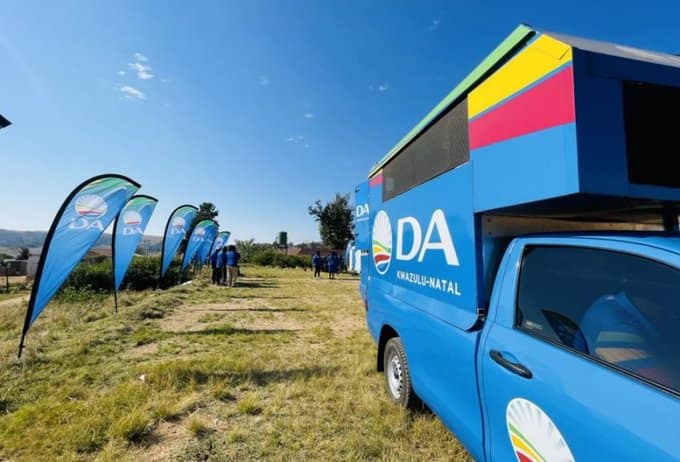
In the glass-and-steel atrium of a Sandton conference centre, the furniture has been rearranged. Rows of chairs now face a single podium. Microphones have been tested and retested. Branded banners—blue, yellow, and white—have been hung at precise intervals. The catering staff have been briefed on dietary restrictions. The security detail has mapped every entrance and exit.
This is not a wedding. This is not a corporate retreat. This is the Democratic Alliance’s Federal Congress, and the stakes could not be higher.
This weekend, hundreds of delegates from across the country will converge on Johannesburg for the party’s most consequential gathering since the tumultuous 2023 congress that saw John Steenhuisen fend off a challenge from then-party chairperson Helen Zille. Now, with the 2026 local government elections looming just eight months away, the DA is once again at a crossroads—and the leadership race that has been simmering for months is about to reach its boiling point.
“Congress is always a moment of reckoning for a political party,” said political analyst Susan Booysen, who has followed the DA for two decades. “But this one feels different. The DA is fighting for its identity, its relevance, and its future as the official opposition. The choices delegates make this weekend will determine whether the party enters the 2026 elections as a united force or a fractured coalition of warring factions.”
The Leadership Contest: Who Is Running?
At the heart of the congress is the election of the party’s federal leader—a position that carries enormous weight not only within the DA but in the broader South African political landscape. As the official opposition, the DA leader is the primary counterweight to President Cyril Ramaphosa and the African National Congress (ANC), leading parliamentary opposition, setting the party’s public agenda, and serving as the face of the alternative government-in-waiting.
The incumbent, John Steenhuisen, is seeking a third full term. Having taken over from Mmusi Maimane in 2019 after Maimane’s dramatic resignation, Steenhuisen has stabilized a party that was reeling from internal conflicts and electoral decline. Under his leadership, the DA has made incremental gains: it retained its position as the official opposition in the 2024 national elections, made inroads in previously ANC-dominated municipalities in the 2021 local government elections, and successfully governed coalitions in hung metros like Johannesburg, Tshwane, and Nelson Mandela Bay.
But Steenhuisen’s leadership has also drawn sustained criticism. Opponents within the party accuse him of being too cautious, too willing to compromise with the ANC in coalition arrangements, and too slow to articulate a compelling alternative vision for South Africa’s future. His approval ratings among the broader electorate have remained stubbornly flat, and some internal polls suggest that a significant portion of DA voters are “soft supporters”—loyal only because they see no better alternative.
Challenging Steenhuisen is a slate of candidates who argue that the party needs “renewal” and “energy.”
The most prominent challenger is Dr. Nazreen Pandor, the party’s shadow minister of health and a former Western Cape MEC. Pandor, 48, has built a reputation as a fierce parliamentary debater and a policy wonk with deep expertise in healthcare and social welfare. Her campaign has focused on broadening the DA’s appeal beyond its traditional white, middle-class base to working-class and black communities—a demographic that has largely eluded the party.
“The DA has become the party of the comfortable,” Pandor said during a campaign rally in Soweto last week. “We speak to people who already have jobs, who already have houses, who already have private medical aid. But there is a whole South Africa that the DA does not reach. I want to build a DA that speaks to the domestic worker, the taxi driver, the unemployed graduate. That is not a left-wing agenda. That is a winning agenda.”
Pandor’s campaign has energized the party’s progressive wing, but it has also alarmed traditionalists who worry that a shift leftward would alienate the DA’s core supporters—conservative suburban voters who prize fiscal discipline, property rights, and minimal state intervention.
A second challenger, Councillor Mzwandile “Mzwai” Ndlovu, the DA caucus leader in the eThekwini (Durban) municipality, has positioned himself as the candidate of the “new South Africa.” Ndlovu, 35, is a former youth activist who joined the DA in 2015 after becoming disillusioned with the ANC. He is young, charismatic, and openly critical of what he calls the “old guard” of the party—both Steenhuisen and Pandor.
“The DA has been led by white leaders for its entire existence,” Ndlovu told supporters in a Facebook Live address. “That is not a criticism. That is a fact. But South Africa is a black-majority country. If we want to be a majority party, we must look like the majority. It is time for the DA to have a black leader. Not a coloured leader. Not an Indian leader. A black African leader. That is not identity politics. That is demographic mathematics.”
Ndlovu’s directness has made him a polarizing figure. Supporters praise his willingness to speak uncomfortable truths. Detractors accuse him of racial essentialism that contradicts the DA’s founding commitment to non-racialism. Steenhuisen has declined to engage with Ndlovu’s framing, telling reporters that “the DA does not choose leaders by skin color.”
The Broader Slate: Chairperson, Deputy Leader, and Other Key Positions
While the federal leadership race captures the headlines, the congress will also elect a host of other key positions that collectively shape the party’s direction.
The race for federal chairperson is shaping up as a contest between incumbent Ivan Meyer and challenger Refiloe Nt’sekhe, a former deputy minister in the presidency. Meyer, a Western Cape stalwart, is seen as a Steenhuisen loyalist. Nt’sekhe, a seasoned parliamentarian, has positioned herself as a bridge between the party’s different factions—acceptable to both progressives and traditionalists.
The deputy federal leader position is also contested, with current deputy Solly Malatsi facing a challenge from Gauteng MPL Jack Bloom, a veteran of the party’s old guard. Malatsi, who is widely respected for his work on governance and anti-corruption, is favored to retain his position, but Bloom’s challenge has forced a debate about the party’s generational transition.
Perhaps the most closely watched contest after the leadership itself is the election of the party’s federal council—the body that governs between congresses. A slate of candidates aligned with Pandor has put forward a “renewal agenda” that includes term limits for all leadership positions, mandatory diversity quotas for candidate lists, and a commitment to spend 10% of the party’s budget on grassroots organizing in townships and rural areas. The Steenhuisen-aligned slate has countered with a “stability platform” emphasizing fiscal responsibility, coalition management, and incremental growth.
The Stakes: 2026 Local Government Elections
Behind the personality battles and policy debates is a hard electoral reality: the 2026 local government elections are coming, and the DA is fighting to hold ground.
In the 2021 local government elections, the DA won 22% of the national vote—a slight decline from 2016 but enough to remain the official opposition. More importantly, the DA emerged as the kingmaker in several hung metros, forming coalitions that allowed it to govern Johannesburg, Tshwane, and Nelson Mandela Bay, albeit with varying degrees of success.
But coalition governance has been messy. In Johannesburg, the DA-led coalition collapsed twice, leading to mayoral musical chairs that damaged the party’s reputation for competent administration. In Nelson Mandela Bay, the DA lost control of the metro in 2024 when a coalition partner defected. Only in Tshwane has the DA-led coalition shown consistent stability, with Mayor Cilliers Brink receiving praise for service delivery improvements.
“If the DA goes into 2026 looking divided and uncertain, voters will punish them,” said Booysen, the analyst. “The ANC is vulnerable. The EFF is fractured. ActionSA is still unproven. This is the DA’s best opportunity in years to grow. But opportunity requires unity. A messy congress, a bitter leadership contest, a prolonged factional war—that would be a gift to the ANC.”
The Federal Congress Agenda
Beyond the leadership elections, the congress will debate and vote on several policy resolutions that will shape the party’s manifesto for the 2026 local elections. Key proposals include:
- A “Basic Services Guarantee” : A commitment that every municipality governed by the DA will provide minimum standards of water, electricity, refuse removal, and sanitation to all residents, regardless of their ability to pay. The policy is seen as a direct response to ANC-run municipalities where service delivery has collapsed.
- A “Youth Jobs Corps” : A proposal to use municipal budgets to fund one-year employment placements for unemployed graduates in areas like data entry, customer service, and maintenance. The cost would be offset by reducing consultant contracts and cutting mayoral travel budgets.
- A “Crime-Free Precincts” program : A plan to use municipal by-laws and private security partnerships to create “high-intensity safety zones” in crime hotspots, including CCTV networks, rapid-response teams, and mandatory lighting upgrades.
- A “No-Bail for Violent Offenders” resolution : A controversial proposal calling on the DA to campaign for constitutional amendments that would deny bail to suspects accused of violent crimes involving firearms or repeat offenses. Critics say the proposal is populist and likely unconstitutional.
Each of these resolutions will be debated on the congress floor, with amendments offered, votes taken, and winners and losers declared. For political junkies, the policy debates are often more revealing than the leadership contests—they show where the party actually stands on the issues that matter to voters.
The Ghosts of Congresses Past
The DA has a complicated history with its federal congresses. The 2015 congress, held in Port Elizabeth, was a high-water mark: the party was riding high after the 2014 national elections, Mmusi Maimane had just been elected as the first black leader of the party, and there was genuine optimism that the DA could become a majority party within a decade.
The 2018 congress was a disaster. Held in the shadow of Maimane’s declining popularity and the rise of the Economic Freedom Fighters (EFF), the congress was marked by infighting, leaked emails, and open warfare between Maimane’s faction and the Zille-aligned “classical liberal” wing. Maimane resigned six months later, triggering the 2019 leadership race that brought Steenhuisen to power.
The 2023 congress was tense but ultimately stable. Steenhuisen defeated Zille’s challenge, but the margin was narrow enough to leave wounds that have not fully healed. Some of those wounds are reopening this weekend.
“We have a tendency to eat our own,” said a senior DA MP who requested anonymity to speak candidly. “We are so busy fighting each other that we forget we are supposed to be fighting the ANC. This congress needs to be different. We cannot afford another 2018. The country cannot afford it.”
What to Watch
As delegates begin to arrive in Johannesburg today, political insiders will be watching several key indicators:
- The margin of Steenhuisen’s victory (or defeat) : If Steenhuisen wins comfortably (60% or more), the party will likely rally behind him. If the vote is close (50.1% to 49.9%), expect a protracted period of internal strife.
- The composition of the federal council : Even if Steenhuisen retains the leadership, a federal council dominated by his opponents could hamstring his ability to set strategy and enforce discipline.
- The tone of the leadership speeches : Will candidates attack each other personally or focus on policy differences? The tone set on the podium will influence how the party behaves in the aftermath.
- The reaction of coalition partners : ActionSA, the Freedom Front Plus, and other parties that govern alongside the DA in various municipalities will be watching closely. A messy congress could destabilize coalition agreements.
The Final Word
As the sun sets over Sandton this evening, the final preparations will be made. The banners will be straightened. The microphones will be tested one last time. And in hotel rooms across the city, candidates will make their final phone calls, twisting arms and counting votes.
Tomorrow morning, the congress will convene. Speeches will be made. Votes will be cast. Winners will celebrate. Losers will plot their comebacks.
And when the last delegate has boarded the last bus back to the airport, the Democratic Alliance will have a new leadership team—or an old one, renewed. Either way, the direction of South Africa’s official opposition will be set, for better or worse, until the next congress.
For a party that has spent years defining itself as the competent alternative to ANC chaos, the irony is impossible to miss: this weekend, the DA must prove that it can manage its own internal chaos before asking voters to trust it with the country.
The eyes of South Africa’s political class are fixed on Johannesburg. The blue machine is about to rev its engine. Whether it roars or sputters will determine not just the DA’s future, but the shape of South African politics for years to come.
About The Author