The long-running “Blue Light Mafia” trial resumed at the Randburg Magistrates Court on Monday, reaching a long-awaited milestone as one of the accused South African Police Service (SAPS) officers finally took the stand. The testimony comes nearly 1,000 days after the now-infamous incident on the N1 highway—a violent altercation captured on video that ignited a firestorm of public outrage and exposed the alleged abuse of power by elite police units.
The case, which has become a symbol of impunity and institutional rot within law enforcement, has been plagued by delays, legal maneuvering, and procedural stalling since the fateful day in 2023 when a motorist’s cellphone camera captured a scene that would grip the nation.
The Incident That Shook the Nation
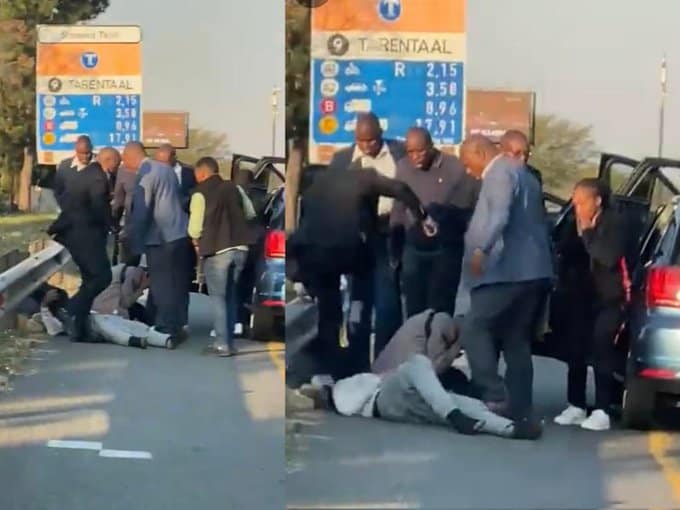
It was just after midnight when a convoy of luxury vehicles—escorted by police cars with flashing blue lights—descended upon a group of motorists on the N1 highway near the Randburg off-ramp. What began as a routine encounter quickly spiraled into violence. According to the state’s case, members of the SAPS Presidential Protection Services, allegedly moonlighting as escorts for a private VIP, set upon several civilians in a brutal assault.
The video, which spread rapidly across social media, showed uniformed officers kicking, punching, and dragging civilians across the tarmac while other members of the convoy looked on. The victims, who were traveling in a vehicle that the convoy had allegedly cut off, were left bloodied and traumatized. The footage was so damning that it prompted immediate calls for arrests and an intervention from the highest levels of government.
Five SAPS officers, along with several private security guards and civilians, were eventually arrested and charged with assault with intent to do grievous bodily harm, malicious damage to property, and defeating the ends of justice. The term “Blue Light Mafia” was quickly adopted by the public and the media to describe the alleged shadowy network of police and private security operatives who abuse state resources for private gain—a phenomenon that has long plagued South Africa’s roads.
The Long Road to the Stand
Monday’s proceedings marked a significant turning point in a trial that has become notorious for its glacial pace. Since the first appearance of the accused in late 2023, the case has been adjourned dozens of times. Defense lawyers have employed a range of tactics, from challenging the admissibility of the viral video to filing repeated applications for special pleas and jurisdictional arguments. For the victims and their families, the past 1,000 days have been a grueling exercise in patience.
The officer who took the stand on Monday—whose identity is being withheld due to ongoing proceedings—is one of the central figures captured on the viral footage. Under cross-examination, the officer attempted to contextualize the events of that night, testifying about the alleged conduct of the victims prior to the altercation and the perceived threat faced by the VIP convoy.
However, the state prosecutor pressed the officer on the glaring discrepancies between the testimony and the video evidence, repeatedly asking why—if the accused were acting in self-defense or in the line of duty—the footage showed uniformed officers initiating the physical confrontation against unarmed civilians. The atmosphere in the courtroom was tense, with the victims’ families seated in the public gallery watching intently as their version of events was challenged after years of waiting.
“A Test of Justice”
Outside the courthouse, civil society groups and activists gathered to mark the 1,000-day milestone, holding placards demanding accountability and an end to police brutality. The case has become a touchstone for broader frustrations about the state of policing in South Africa, where reports of rogue units operating with impunity have long been a feature of the national discourse.
“This trial was supposed to be a watershed moment—a sign that no one is above the law,” said one activist who has been following the case since its inception. “But 1,000 days later, we are only now hearing from the first accused officer. For the victims, justice delayed has felt like justice denied.”
The Independent Police Investigative Directorate (IPID), which initially investigated the case, has faced its own scrutiny over the handling of the matter. Critics have accused the oversight body of failing to act swiftly, allowing key evidence to be contested and witnesses to be intimidated. The state, however, maintains that it remains committed to securing a conviction, arguing that the video evidence alone is sufficient to prove the charges.
What Lies Ahead
With the first SAPS officer now on the stand, the trial is expected to continue for several more weeks as the remaining accused are called to testify. Legal analysts note that the coming days will be critical, as the defense is likely to focus on undermining the credibility of the state’s witnesses while attempting to paint the officers as victims of a politically motivated prosecution.
Magistrate Paul du Plessis, who has presided over the matter since its early stages, has signaled that he will not tolerate further delays. Monday’s session concluded with a firm reminder to both the defense and the prosecution that the trial must proceed expeditiously, given the time already elapsed.
For the victims—some of whom still bear the physical and emotional scars of the assault—the trial represents the final hurdle in a three-year ordeal. As they left the courthouse on Monday, they expressed cautious optimism that the wheels of justice were finally turning.
“We have waited 1,000 days to see the face of accountability,” said one of the complainants, speaking on condition of anonymity. “Today, we saw the beginning of that. We just hope it is not the end.”
The trial continues.
About The Author