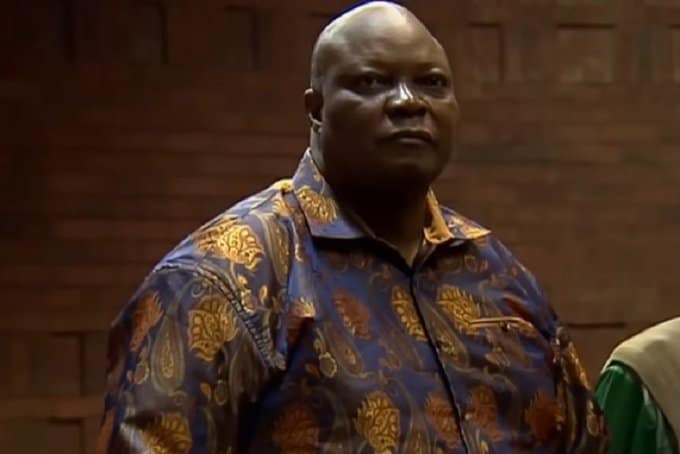
The morning air over the Pretoria Magistrate’s Court was cold and unforgiving, much like the journey that had brought him there. Just after 9 AM, a blue prison van pulled into the secured underground entrance. Inside, pressed against the cold metal bench, sat Job Sikhala—once the fiery vice-chairperson of Zimbabwe’s main opposition CCC party, now a man whose name has become synonymous with state repression, prolonged detention, and, most recently, a perplexing legal battle far from home.
On Monday, Sikhala appeared before Magistrate Nthabiseng Khumalo, dressed in a simple olive-green tracksuit—the uniform of remand detainees. But his eyes, even behind the thick glass of the accused dock, carried the same defiant spark that has filled Zimbabwean courtrooms for two decades. Beside him, also in custody, sat his elderly uncle, whose name remains protected by court orders. Together, they face a charge that has raised eyebrows across the Southern African legal community: possession of illegal explosives.
The details of the charge remain murky. According to the state’s summary, Sikhala and his uncle were allegedly found with commercial-grade detonators and a small quantity of blasting cartridges at a storage unit in a Pretoria suburb. The defense, led by veteran human rights lawyer Luvuyo Mgedezi, has dismissed the allegations as “preposterous” and “textbook political engineering.”
“My client is a professional politician,” Mgedezi told the court, his voice resonating off the wood-paneled walls. “He is a man of words, not weapons. He has spent 20 years fighting for democratic space in Zimbabwe using petitions, press statements, and parliamentary motions. To suggest that he suddenly transformed into a saboteur, carrying explosives in a foreign country while on a brief visit to see his sick mother, is not just unbelievable—it is offensive.”
The state prosecutor, Advocate Riana van Zyl, requested a further postponement, citing incomplete forensic analysis of the devices and outstanding cellphone data extractions. “The investigation is complex,” she said. “We are dealing with potential links to cross-border criminal networks. The State needs time to verify the origins of the explosives and any communication between the accused and third parties.”
Magistrate Khumalo, clearly wary of the case’s regional sensitivity, approved the postponement but warned: “This court is not a political theater. It is a court of law. The accused are entitled to a speedy trial, and the State is reminded of its obligation to finalize its investigations with deliberate haste.”
It was when the magistrate asked Sikhala if he had anything to say—an opportunity rarely granted to remand detainees—that the courtroom fell completely silent.
Sikhala rose slowly, gripping the railing of the dock. His voice, hoarse from months of detention in Zimbabwe before his recent release and subsequent arrest in South Africa, filled the room.
“Your Worship, I am 52 years old. I have been arrested more times than I can count. I have spent nearly 900 days in prison—first in Chikurubi Maximum, then in Harare Central, now here. My wife has raised our three children alone for two and a half years. My mother, who is 78 and ill, does not recognize me anymore because I have been absent so long.”
He paused, swallowing hard.
“Now I am accused of possessing explosives in a country where I came to seek medical help and to breathe free air for one week. I do not know anything about explosives. I am a politician. My weapon is the truth. The State is wasting this court’s time because someone, somewhere, wants me silenced before Zimbabwe’s next election cycle. I ask only for justice—swift, blind, and final.”
The public gallery, packed with Zimbabwean exiles, South African legal observers, and a handful of international reporters, sat frozen. A woman in the third row—later identified as Sikhala’s sister—wept quietly into a tissue.
Outside the court, after the brief proceedings concluded and Sikhala was led back to the holding cells, his lead attorney addressed a small crowd of supporters huddled against the cold.
“This is a political case dressed in criminal clothing,” Mgedezi told reporters. “We will file a formal application to have the charges reviewed and set aside. If the State had a shred of credible evidence, they would have presented it today. Instead, they asked for more time—time to manufacture a narrative. We will not give them that luxury.”
The postponement was set for six weeks’ time. In the interim, both Sikhala and his uncle remain in custody. Bail applications have so far been denied, with the magistrate citing the seriousness of the explosives charge and the risk of flight—a decision the defense has already indicated it will appeal.
As the crowd dispersed, a young Zimbabwean law student named Thando held up a handwritten sign that read: “You can arrest the man. You cannot arrest the idea.”
Sikhala’s case has become more than a routine criminal docket in a Pretoria courtroom. It is a litmus test for South Africa’s commitment to regional human rights, a mirror held up to Zimbabwe’s long shadow of political persecution, and a painful chapter in the life of a man who has given everything to a cause that seems to give back only prison walls.
Whether the explosives were real or imaginary, whether the evidence will materialize or evaporate—those questions will be answered in due time. But one thing was already clear to everyone who watched Job Sikhala rise from the dock: He has not been broken. Not yet. Not ever.
The magistrate’s gavel fell. The prison van’s engine started. And another week began for a man who has spent most of his adult life waiting—for justice, for freedom, and for the simple right to go home.
About The Author