The political truce, if there ever was one, is over. And it shattered not with a whisper, but with a demand for a head.
The South African National Civic Organisation (SANCO) in Gauteng has called for Premier Panyaza Lesufi to resign immediately, describing his latest cabinet reshuffle as a reckless, arrogant, and anti-democratic move that insults voters and undermines the African National Congress’s electoral mandate. The statement, released late Tuesday evening, landed like a grenade in an already fractious political landscape.
“Premier Lesufi has crossed a line from which there is no return,” read the blistering statement signed by SANCO Gauteng chairperson Thabo Mdluli. “This reshuffle was not about service delivery. It was not about improving governance. It was about settling scores, rewarding loyalty, and purging voices of reason. We demand his immediate resignation.”
The organisation, historically allied with the ANC and a powerful voice in townships and informal settlements, stopped just short of calling for mass action—but left the door wide open.
What Sparked the Fury?
Lesufi announced the cabinet shake-up on Monday evening in a brief, televised address that caught even senior ANC officials off guard. In the reshuffle, he:
- Fired three MECs perceived as aligned with rival factions within the ANC.
- Appointed two relatively unknown figures from his inner circle.
- Merged the Department of Economic Development with a new, vaguely defined “Future Planning and Innovation” portfolio.
- Removed the only two female MECs in key safety and social development roles, replacing them with male loyalists.
While Lesufi framed the changes as “a necessary step toward a leaner, more responsive government,” critics saw something else entirely: a consolidation of power ahead of the 2026 local government elections, with little regard for party process or public consultation.
“Premier Lesufi did not consult the ANC Provincial Executive Committee,” said a senior party source who spoke on condition of anonymity. “He did not consult alliance partners. He did not even consult some of his own cabinet. He woke up on Monday, made a list, and pressed send. That is not leadership. That is a dictatorship.”
SANCO’s Grievances: A Litany of Betrayals
SANCO’s resignation demand was not a spontaneous outburst. The organisation has been simmering with discontent for months, accusing Lesufi of:
- Ignoring community voices in key appointments, particularly in housing, policing, and education.
- Centralising decision-making around a small coterie of advisors, sidelining traditional ANC alliance structures.
- Failing to address service delivery collapse in townships like Tembisa, Soweto, and Alexandra while focusing on flashy but superficial “smart city” projects.
- Undermining the ANC’s electoral mandate by appointing MECs who lost their ward elections or were rejected by branch nominations.
“This reshuffle was the final straw,” Mdluli said in a follow-up radio interview on Wednesday morning. “We have been patient. We have raised concerns internally. But Premier Lesufi has made it clear: he does not care about the people who put him there. He cares about his own political survival. That is why he must go.”
ANC Reacts: Silence, Then Panic
The ANC’s national leadership has been conspicuously quiet, with party spokesperson Mahlengi Bhengu-Motsiri offering only a terse statement: “The ANC is aware of SANCO’s concerns. Internal processes are underway.”
But behind closed doors, sources describe frantic phone calls between Luthuli House and the Gauteng Premier’s office. The party is already bleeding support in Gauteng’s townships—historically its strongest base—and a public feud with SANCO could accelerate defections to the EFF, MK Party, or abstention.
“Lesufi is playing with fire,” said political analyst Professor Susan Booysen. “SANCO is not the ANC, but they have deep grassroots reach. When SANCO says ‘resign,’ thousands of community members hear ‘betrayal.’ The ANC cannot afford to lose that narrative battle in Gauteng—not now, not ever.”
Lesufi Fires Back
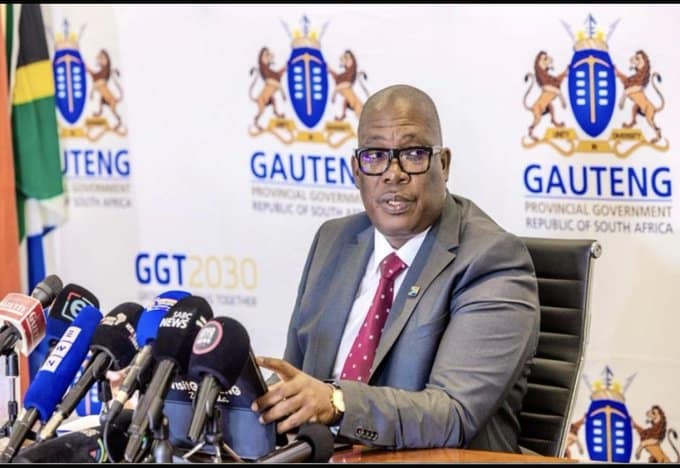
Premier Lesufi, never one to retreat from a fight, responded swiftly on social media and in a brief doorstop interview outside his office.
“I was elected by the people of Gauteng to lead,” he said, flanked by two of his newly appointed MECs. “And lead I will. No organisation—no matter how historic—will dictate to me who should sit in my cabinet. If SANCO wants a resignation, they can take it to the ballot box. That’s how democracy works.”
When pressed on whether he consulted alliance structures before the reshuffle, Lesufi pivoted: “Consultation does not mean permission. I listen. But I decide. That is leadership.”
The response drew immediate scorn from SANCO, which accused the Premier of “arrogance worthy of a banana republic.”
What Happens Next?
The coming days will be critical. SANCO has not yet announced any protest action, but sources suggest the organisation is considering:
- A march on the Gauteng Provincial Legislature in Johannesburg.
- A call for community imbizos (meetings) to “take the people’s verdict” on Lesufi’s leadership.
- Formal submissions to the ANC’s National Executive Committee demanding Lesufi’s recall.
Meanwhile, opposition parties have seized on the chaos. The EFF in Gauteng issued a statement calling Lesufi “a sinking premier clinging to debris,” while the DA has demanded an urgent sitting of the provincial legislature to debate a motion of no confidence.
The Voter’s View
On the streets of Soweto’s Vilakazi Street on Wednesday morning, opinions were divided—but frustration was universal.
“Lesufi talks a lot. He’s on social media every day. But my tap is still dry,” said Grace Mthembu, a pensioner. “If SANCO says he must go, maybe they know something we don’t.”
Others were more cautious. “Reshuffles happen. Politicians fight. But another premier? We just got this one,” said taxi driver Vusi Ngobeni. “Let them sort it out without collapsing the government. We are tired of instability.”
A Deeper Crisis
Beneath the headlines, this standoff exposes a deeper wound within the ANC-led alliance: the growing chasm between elected leaders who govern and civic structures that claim to represent the governed.
SANCO was once the ANC’s “eyes and ears” on the ground. But over the past decade, many civic leaders have accused the party of treating them as rubber stamps rather than partners. Lesufi’s reshuffle—perceived as unilateral and dismissive—may have been the breaking point.
“This is not just about Panyaza Lesufi,” said Professor Booysen. “This is about whether the ANC still believes in alliance politics or whether it has become a top-down machine. If SANCO walks away, the damage will outlast any premier.”
Conclusion: A Premier in the Crosshairs
For now, Premier Lesufi remains in his chair—defiant, unapologetic, and surrounded by loyalists. But the demand from SANCO is not a small crack in the wall. It is a warning shot across the bow of his political future.
In Gauteng, where every vote will be fought for in 2026, losing the blessing of township civic structures is not a minor inconvenience. It is a political earthquake.
And earthquakes, as Lesufi may soon discover, do not ask for permission to strike.
The ball is now in the ANC’s court. Will it back its premier and risk alienating its grassroots? Or will it quietly signal to Lesufi that no leader is bigger than the alliance?
One thing is certain: the next few weeks will determine not just Lesufi’s fate, but the shape of Gauteng politics for years to come.
About The Author