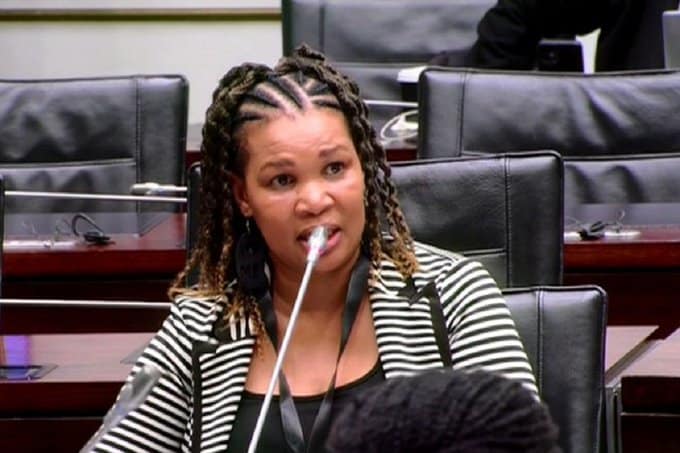
A firestorm of public outrage is sweeping across South Africa this week, fueled by whistleblower and activist Patricia Mashale’s bold public challenge to the legality of the recent arrest of National Coloured Congress (NCC) leader Fadiel Adams. Mashale has also condemned the heavy-handed raids conducted by state security forces on properties linked to the embattled Member of Parliament, describing the actions as “a dangerous overreach” that threatens the very foundations of democratic accountability.
Mashale, who has built a reputation as a fearless anti-corruption crusader—most notably for her relentless exposés on malfeasance within the National Student Financial Aid Scheme (NSFAS)—is now turning her gaze inward at the state’s own conduct. In a series of impassioned social media posts and a subsequent interview with a Cape Town-based community radio station, she questioned the legal basis for the operation that saw Adams handcuffed and dragged from his home in front of his family, followed by forensic teams sifting through his personal belongings.
“I am not here to say Fadiel Adams is a saint,” Mashale said, her voice taut with anger. “But I am here to say that the way the state came for him—the timing, the force, the public spectacle—stinks of something rotten. If they can do this to a sitting MP with a following, what chance does an ordinary citizen have?”
The Arrest and Raids: A Shocking Show of Force
The trouble for Adams began late last month, when a specialized unit of the police’s Priority Crimes Investigation Directorate (better known as the Hawks) descended on several addresses associated with the NCC leader. According to official statements at the time, Adams was arrested on charges including fraud, corruption, and money laundering related to community development funds allegedly misappropriated during his time as a grassroots organizer prior to entering Parliament.
But it was the manner of the arrest that first raised eyebrows. Witnesses in the Manenberg area, where Adams maintains a residence, described a pre-dawn raid involving more than a dozen heavily armed officers, a helicopter overhead, and the temporary cordoning off of the entire street. “They came like he was a terrorist,” said one neighbor, who asked not to be named. “Loud bangs, screaming, children crying. When they brought him out, he was in his pajamas, hands cuffed behind his back. They put him in a black van and sped off.”
Simultaneous raids were carried out at the NCC’s Cape Town headquarters and at the home of a close family relative. Computers, boxes of documents, cellphones, and even a family safe were seized. As of this week, no formal charges have been read in open court, and Adams remains in custody pending a bail hearing that his legal team has already signaled will be fiercely contested.
Mashale’s Challenge: Legality, Motive, and Double Standards
Mashale’s intervention has added a powerful new voice to a growing chorus of critics. In her public statement, she laid out three specific challenges to the operation’s legality.
First, she questioned the warrant. “Was the warrant properly obtained? Was it specific, or was it one of those ‘catch-all’ warrants that allow police to ransack an entire house for anything that might look useful? We’ve seen that trick before in this country—it’s how they silence activists.”
Second, she pointed to the timing. Adams has been a vocal critic of certain provincial government officials and has recently launched a campaign calling for a full-scale judicial inquiry into alleged tender irregularities affecting coloured communities across the Western Cape. “You silence the rooster that crows too loud,” Mashale said. “Fadiel was about to name names. Now he’s behind bars. Connect the dots.”
Third, she contrasted the state’s aggression toward Adams with its perceived leniency toward other public figures accused of far more serious crimes. “Where is the pre-dawn raid for the ANC officials who stole millions from VBS Bank? Where are the helicopters for the dodgy tenderpreneurs who are still sitting in their mansions in Constantia and Waterkloof? The law must apply equally, or it is not law. It is a weapon.”
Public Outrage: From the Cape Flats to Parliament’s Steps
Mashale’s challenge has landed on fertile ground. Across South Africa, and particularly in the coloured communities of the Western Cape, many see the Adams arrest as a political lynching dressed up as law enforcement.
Outside Pollsmoor Prison, where Adams is being held, a small but determined group of supporters has gathered daily, holding placards reading “Free Fadiel” and “Hands Off Our Voice.” On social media, the hashtags #JusticeForAdams and #MashaleIsRight have trended intermittently for three days.
“I voted for the NCC because they spoke for us—the forgotten people,” said Vanessa April, a 54-year-old grandmother from Bonteheuwel who joined the protest. “Now they take our leader away in the dark, like a criminal. But what crime? No one has told us. Mashale is right to ask questions. She is one of the few brave women left.”
Even some political opponents have expressed unease. The Democratic Alliance’s shadow minister for police offered a cautious statement: “While we do not condone any criminality, we must insist on due process. The manner of this arrest appears excessive. We call on the Hawks to release the full details of the warrant.”
The Economic Freedom Fighters went further, issuing a blistering press release that accused the state of “fascist tactics” and calling for Mashale to be invited to brief the Parliament’s Joint Committee on Intelligence.
Legal Experts Weigh In: A Fine Line
Legal analysts note that while Mashale’s questions are legitimate, the answers are not yet clear. “The Hawks are legally entitled to use force when they believe a suspect may destroy evidence or pose a flight risk,” said Cape Town-based attorney and legal commentator Michael Ngubane. “But ‘belief’ must be reasonable and based on facts, not suspicion. The courts will ultimately decide whether the warrant was valid and whether the execution was proportionate.”
Ngubane added that Adams’s status as a sitting MP complicates matters. “Parliamentary privilege offers some protections, but not against criminal prosecution. However, there is a long-standing principle that the state should not use criminal process to achieve political ends. That line has been crossed many times in our history. Mashale is right to ask us all to watch carefully.”
What Comes Next?
Adams is expected to appear in the Cape Town Magistrate’s Court on Monday, where his legal team is expected to file a formal challenge to the legality of both the warrant and the manner of arrest. Mashale has announced that she will be in the gallery, observing, and that she is compiling a dossier of what she calls “state overreach cases” to present to the Public Protector.
“I am not afraid of them,” Mashale said in her radio interview. “I have seen what happens to whistleblowers in this country. They get fired. They get silenced. Sometimes they get killed. But someone has to speak. If not me, who? If not now, when?”
As dusk fell over Cape Town, a single candle flickered on the pavement outside the magistrate’s court, placed there by an anonymous mourner not for a death—but for a principle. On a piece of cardboard beside it, someone had scrawled in black marker: “The law is a shield, not a sword. Don’t let them turn it around.”
Whether the state’s actions against Fadiel Adams constitute a shield or a sword is now the question that will not go away—thanks, in large part, to one woman’s refusal to stay silent.
About The Author