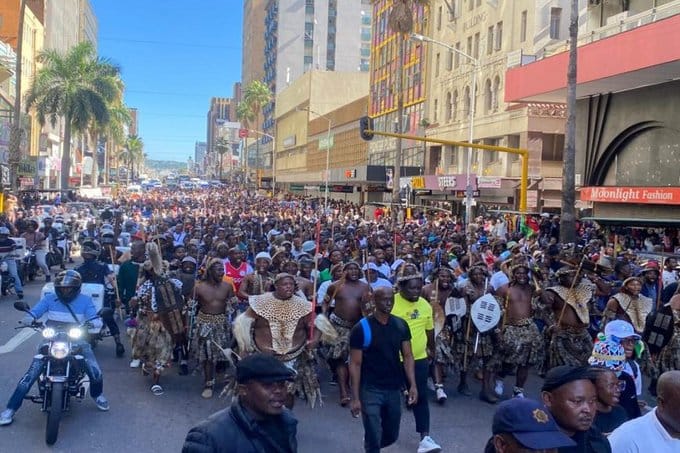
The morning sun casts long shadows across Mahatma Gandhi Road in central Durban, where shop shutters rattle open, spices scent the air, and the city’s heartbeat begins its daily rhythm. But beneath the bustle, a quieter, more defensive pulse has emerged. Foreign nationals living and working along this iconic street have broken their silence, forcefully rejecting allegations that have begun to stick to them like unwelcome labels: drug dealers, human traffickers, criminals.
“We are not those things,” says Ahmed, a Somali shopkeeper who has run a small grocery on the road for eight years. He points through his window at the passing crowd—mothers with children, office workers grabbing lunch, elderly residents shuffling home with bread and milk. “These are my neighbors. These are my customers. I sleep here. My children walk to school here. Why would I poison my own home?”
The allegations, which have circulated in local community meetings, WhatsApp groups, and even some media reports, have not been formally detailed in a police statement or court document. But the damage, residents say, is already done. A cloud of suspicion now hangs over the predominantly foreign-owned businesses and rental flats lining Mahatma Gandhi Road—and those who live there say they have had enough.
The claims they deny
While the exact origin of the allegations remains murky, several residents described whispers of “safe houses for kidnapped foreigners,” “drug dens,” and “stolen goods warehouses” allegedly operating from buildings along the road. Some local community leaders have reportedly called for increased police raids targeting foreign nationals specifically.
The problem, residents argue, is not crime—it’s stereotyping.
“There is a narrative that says: foreigner equals criminal,” says Fatima, a Congolese national who runs a hair salon on the road and rents a flat above her shop. “It is lazy. It is dangerous. And it is wrong.”
She pulls out her phone, scrolling through photos of her daughter’s recent birthday party—balloons, a cake, children of half a dozen nationalities laughing together. “This is what happens here. Not kidnappings. Not drugs. Birthday parties. Homework. Rent struggles. The same as any other street in Durban.”
Who actually lives on Mahatma Gandhi Road?
The street, named after the iconic peace activist, is a microcosm of modern urban South Africa. Long a hub for immigrant communities—from Somalia, Ethiopia, the Democratic Republic of Congo, Pakistan, Bangladesh, and Zimbabwe—it has also become a flashpoint for tensions around housing, informal trade, and xenophobia.
Property records and community estimates suggest that a significant majority of businesses along the stretch are owned by foreign nationals, while residential flats house a mix of immigrant families, South African citizens, and asylum seekers. Many have lived there for a decade or more.
“We contribute,” says Priya, a Pakistani-born textile trader who has operated from the same storefront for twelve years. “We pay rent to South African landlords. We pay VAT, income tax, municipal fees. We employ South African staff. When there was looting in 2021, who lost everything? We did. The foreigners. And we rebuilt without a single government grant.”
His voice hardens. “And now they say we are criminals? On what evidence? On whose word?”
The economic reality
Residents are quick to point out that Mahatma Gandhi Road is not a lawless enclave but a commercial spine of a struggling city center. At a time when many central Durban streets have seen businesses shutter due to load-shedding, the pandemic, and post-looting trauma, this strip remains alive—largely because of the immigrant traders who refuse to leave.
On any given weekday, the sidewalk is lined with hawkers selling fruit, phone chargers, and socks. Small restaurants serve shawarma, biryani, and sadza. Money transfer shops allow workers to send remittances home. A tailor stitches wedding dresses in a window. A barber chats with a customer about football.
“There is crime on this road,” admits Themba, a South African resident who has lived in a block of flats for five years. “Snatching phones. Pickpocketing. But that is not the shop owners. That is street kids, some drug users. The shop owners are the ones who call the police when something happens. They are the victims of crime, not the source.”
The fear of a raid
Behind the public denial is a quieter, more private fear. Several residents told this reporter they worry that the allegations are a prelude to “operation-style” police raids—like those seen in other cities, where officers sweep through foreign-owned properties, arrest people on minor documentation issues, and sometimes seize goods without proper receipts.
“When the police come heavy, they do not see the difference between a criminal and a family,” says Yusuf, a Ethiopian-born restaurant owner. “They see a brown face and they see guilt. We have learned this.”
He recounts a raid two years ago when officers entered his flat at 5 a.m., breaking a door and shouting. “They found nothing. They left. They did not fix my door. They did not say sorry. My children cried for a week. That is the justice we receive.”
A community pushback
Now, residents are organizing. A WhatsApp group called Mahatma Gandhi United has grown to over 200 members, sharing legal advice, documenting incidents, and coordinating a public response. A petition is circulating, calling on the Durban Central SAPS station commander to publicly clarify whether any formal investigation is underway—and if not, to issue a statement distancing the police from the rumors.
“We are not asking for special treatment,” says Ahmed, the Somali shopkeeper. “We are asking for equal treatment. Investigate crime wherever it happens, against whoever does it. But do not assume brown skin means criminal. Do not assume foreign accent means guilty.”
The group is also planning a community clean-up day next month, hoping to visibly demonstrate their investment in the street. “We will sweep the pavement. We will repaint a wall. We will show Durban: this is our home too,” Fatima says.
The broader context
The tensions on Mahatma Gandhi Road are not happening in a vacuum. South Africa has seen periodic waves of xenophobic violence, most notoriously in 2008, 2015, and 2019, often sparked by claims that foreigners are responsible for crime or taking jobs from citizens. Studies consistently show no evidence that foreign nationals commit crime at higher rates than South Africans—but perception, as one resident put it, “is stronger than statistics.”
In Durban specifically, the 2021 July unrest saw dozens of foreign-owned shops looted and burned, with many traders never compensated or able to return. Those who did return did so without insurance payouts or government aid.
“We are still standing,” says Priya, the textile trader. “But we are tired of standing and being blamed.”
What happens next?
For now, the police have not announced any operation targeting Mahatma Gandhi Road. The Durban Central SAPS station commander’s office said they are “aware of community concerns” but declined to comment on whether any formal investigation into crime on the road is active.
Local Ward Councillor [Name if available] has called for a public meeting next week to allow residents—both South African and foreign-born—to air grievances and separate fact from rumor.
“We need to talk to each other, not about each other,” the councillor said in a brief statement. “A street named after Mahatma Gandhi should be a symbol of peace, not division.”
The last word
As the sun sets over Durban, the shutters begin to close on Mahatma Gandhi Road. Men and women lock doors, check security cameras one last time, and head upstairs to small flats. Children do homework. Dinner is cooked. Phones buzz with WhatsApp updates.
“I am not a criminal,” Ahmed says again, softly now, almost to himself. “I am a father. A shopkeeper. A taxpayer. A neighbor. That is all I have ever been. That is all I want to be.”
He pulls down his metal shutter, turns the key, and disappears into the gathering dusk—a foreign national in a foreign land, asking for nothing more than to be seen for who he truly is.
About The Author