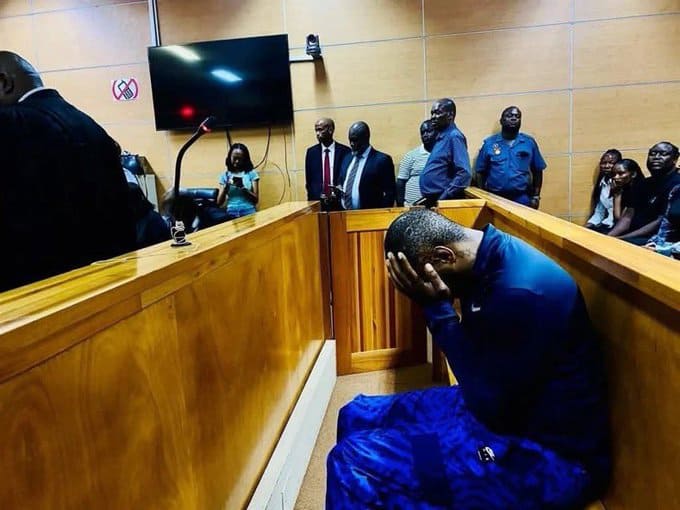
For the embattled rapper known to his legions of fans as Shebeshxt, freedom remains tantalizingly out of reach. Lehlogonolo Chauke, the platinum-selling musician behind the anthem “Ke Di Shxt Malume,” appeared briefly in the Polokwane Magistrate’s Court on Friday, hoping to make a fresh bid for bail. Instead, he left in handcuffs, his case delayed yet again and now transferred to a higher court, prolonging the legal limbo that has kept him behind bars since his arrest in October 2025.
The courtroom was packed with supporters clad in black and red, the signature colors of the artist whose meteoric rise from the streets of Limpopo to national stardom has been matched only by the gravity of the charges now threatening to derail his career. Chauke faces charges of attempted murder and assault with intent to cause grievous bodily harm following a road-rage incident in Polokwane that left a 34-year-old man with serious injuries.
But for the dozens of fans who gathered outside the courthouse, their idol is not a violent criminal but a victim of circumstance—a young man from humble beginnings who has been unfairly targeted by a justice system they believe is treating him more harshly because of his fame.
“He is not a monster,” said Tumelo Mokoena, a 24-year-old fan who traveled from Seshego to attend the hearing. “He made a mistake, yes. But he has been in jail for months now. How long must he suffer? We are praying for him. We are fighting for him.”
The Case: A Road-Rage Shooting That Shook Polokwane
The charges against Chauke stem from an incident that occurred on the evening of October 12, 2025, on the R71 road outside Polokwane. According to the police docket, what began as a routine traffic altercation escalated dramatically when Chauke allegedly produced a firearm and fired multiple shots at the vehicle of the victim, a 34-year-old man whose identity has been withheld for safety reasons.
One of the bullets struck the victim in the upper body, causing serious injuries that required emergency surgery and weeks of hospitalization. The victim has since been discharged but continues to receive medical care for the lasting effects of the gunshot wound.
Chauke fled the scene but was apprehended by police less than 48 hours later at a hideout in a neighboring province. He has been in custody ever since, with three previous bail applications denied by the magistrate’s court on the grounds that the state had established a prima facie case against him and that there were reasonable grounds to believe he might interfere with witnesses or flee if released.
The state’s case has been bolstered by ballistic evidence linking the weapon recovered from Chauke to the crime scene, as well as eyewitness testimony from other motorists who reportedly saw the altercation unfold. Chauke’s legal team has consistently maintained his innocence, suggesting that he acted in self-defense after being threatened by the victim and his companions.
A New Attorney, A Fresh Bid, A Familiar Outcome
Friday’s proceedings were expected to mark a turning point in Chauke’s legal saga. The rapper recently parted ways with his previous legal representation and retained Michael Khumalo, a prominent criminal defense attorney known for handling high-profile cases. Khumalo had signaled his intention to launch a fresh bail application based on what he termed “new facts”—a legal mechanism that allows for reconsideration of bail when circumstances have materially changed since previous denials.
However, the morning’s proceedings were derailed almost before they began. The prosecutor assigned to the case was unexpectedly absent, citing illness, and no colleague was immediately available to represent the state. With both sides unprepared to proceed on the substantive bail arguments, Magistrate Thabo Mokoena had little choice but to postpone the matter.
In a separate but equally significant development, the magistrate ruled that the case would be transferred to the Polokwane Regional Court, which handles more serious offenses and has the jurisdiction to impose harsher sentences. The transfer is a standard procedural step given the severity of the charges, but it carries significant implications for Chauke: bail applications in the Regional Court are subject to more stringent criteria, and any eventual trial will be conducted before a regional magistrate with broader sentencing powers.
“The matter is postponed to a date to be determined in the Regional Court,” Magistrate Mokoena announced, his voice cutting through the murmurs of disappointment from the gallery. “The accused remains in custody.”
Outside the courthouse, Khumalo addressed a throng of journalists and supporters, striking a tone of cautious optimism despite the day’s setback.
“We are disappointed that we could not be heard today, but the fight is far from over,” Khumalo said. “We believe there are compelling grounds for our client to be released on bail. He has strong community ties. He has no previous convictions. He has cooperated fully with the authorities. We will present these arguments to the Regional Court, and we are confident that justice will prevail.”
When asked about the “new facts” his team intended to present, Khumalo declined to elaborate, citing the sub judice rule. But sources close to the defense suggest that the new application will center on a combination of factors: the length of time Chauke has already spent in custody, the alleged deterioration of his mental health while incarcerated, and new evidence that the defense claims undermines the state’s version of events.
The #FreeShebe Movement: A Social Media Phenomenon
While the legal process grinds forward, a parallel campaign has erupted across social media platforms, galvanizing Chauke’s massive fan base into a coordinated movement demanding his release. The hashtag #FreeShebe has been trending intermittently for weeks, with supporters sharing photos, videos, and impassioned pleas for the rapper’s freedom.
At the heart of the movement is an online petition that has now surpassed 11,000 signatures. The petition, addressed to the National Prosecuting Authority and the Polokwane Magistrate’s Court, argues that Chauke’s continued detention amounts to “pre-trial punishment” and that he should be released pending trial.
“Shebeshxt is a son of the soil, a young man who rose from nothing to become a voice for the voiceless,” reads the petition text. “He has contributed positively to our society through his music, his philanthropy, and his commitment to uplifting his community. To keep him locked up like a hardened criminal is to punish him before he has even had his day in court.”
The movement has drawn support from a cross-section of the South African entertainment industry, with several prominent musicians and influencers expressing solidarity with Chauke. Some have gone further, alleging that the rapper is being targeted because of his fame and that the justice system is making an example of him.
But the campaign has also attracted sharp criticism. Victims’ rights advocates have expressed concern that the #FreeShebe movement is trivializing the seriousness of the charges and exerting inappropriate pressure on the judicial process.
“We understand that this is a popular artist with a devoted fan base, but we are talking about a man who allegedly shot another human being,” said Nthabiseng Mkhabela, director of a Limpopo-based victims’ support organization. “There is a victim in this case who is still recovering from his injuries. He has a right to justice. The court must be allowed to do its work without interference from social media campaigns.”
A Troubled Past: A Pattern of Violence?
For critics of Chauke, the current case is not an isolated incident but part of a troubling pattern of behavior that has long been overlooked by an adoring public. The rapper’s legal history, while not extensive, includes prior allegations of violence that have raised questions about his fitness to be released pending trial.
In 2023, Chauke was arrested and briefly detained following an altercation at a nightclub in Johannesburg, though charges were later dropped when the complainant failed to appear in court. In another incident in 2024, he was accused of assaulting a photographer at a music event, a matter that was resolved through mediation.
More significantly, Chauke has spoken publicly in interviews about his difficult upbringing in the rural areas of Limpopo, his involvement in gang-related activities as a youth, and his struggle to escape a cycle of violence. While he has portrayed these experiences as part of a redemption narrative—a young man who turned his life around through music—critics argue that the current charges suggest old habits die hard.
“We cannot ignore the fact that this is not the first time Mr. Chauke has been accused of violent behavior,” said a legal commentator who asked not to be named. “The question for the court is whether, given his history and the seriousness of the current allegations, there is a real risk that he might reoffend or intimidate witnesses if released. That is precisely what the bail inquiry is designed to determine.”
The Cultural Context: Fame, Violence, and Accountability
The Shebeshxt case has opened a wider conversation about the intersection of fame, violence, and accountability in South African popular culture. The rapper is far from the first celebrity to find himself on the wrong side of the law, but his case has resonated in ways that reflect deeper anxieties about the normalization of violence in certain corners of the entertainment industry.
For his supporters, Shebeshxt is a product of his environment—a young man who grew up in circumstances that few of his critics can imagine, who channeled his pain into music, and who now finds himself ensnared in a system that does not understand him.
“People want to judge him, but they don’t know where he comes from,” said a friend of the rapper who spoke on condition of anonymity. “He grew up with nothing. He fought for everything he has. Does that excuse what happened? No. But it explains why he might react differently than someone who grew up with privilege.”
But for victims’ rights advocates, the focus must remain on the alleged victim—a 34-year-old man whose life was upended in a moment of road-rage violence.
“We keep hearing about Shebeshxt’s career, Shebeshxt’s fans, Shebeshxt’s future,” Mkhabela said. “But what about the man who was shot? What about his future? He didn’t choose to be famous. He didn’t ask for any of this. He was simply driving home, and now he carries a bullet wound for the rest of his life.”
What Comes Next
With the case now transferred to the Regional Court, the timeline for Chauke’s bail bid remains uncertain. The defense will need to file a fresh bail application in the Regional Court, which will then schedule a hearing. Given the court’s busy docket and the complexity of the case, legal observers suggest that a hearing is unlikely to take place before late May or early June.
In the meantime, Chauke remains in custody at the Polokwane Correctional Centre, where he has been held since his arrest. Friends and family report that he is in good spirits but increasingly anxious about the toll the prolonged detention is taking on his career and his mental health.
“He is trying to stay strong, but it’s hard,” said a family member who visited him this week. “He misses his family. He misses making music. He feels like his life is on hold while the world moves on without him.”
For his fans, the waiting is also difficult. The #FreeShebe movement shows no signs of slowing down, with supporters planning further actions, including a possible peaceful march in Polokwane if the bail bid is denied again.
“We will not give up,” said Mokoena, the fan from Seshego. “Shebeshxt gave us hope. He showed us that someone from the township can make it. Now it’s our turn to fight for him.”
A Defining Moment
For Lehlogonolo Chauke, the coming weeks will be defining. If the Regional Court grants him bail, he will have the opportunity to rebuild his life and his career while continuing to fight the charges against him. If bail is denied again, he faces the prospect of remaining behind bars until his trial—a trial that, given the complexity of the case and the backlog in the Regional Court, may not take place for months or even years.
Whatever the outcome, the Shebeshxt case has already become a flashpoint in a broader debate about justice, celebrity, and accountability in South Africa. It has exposed the deep divisions between those who see a young man deserving of a second chance and those who see a pattern of violence that demands consequences.
As the sun set over Polokwane and the courthouse emptied, the supporters who had gathered to rally for their idol dispersed quietly, their chants fading into the evening air. But their determination remained undimmed. For Shebeshxt’s faithful, the fight is far from over. And for the legal system tasked with determining his fate, the scrutiny has only just begun.
In the corridors of the Polokwane Regional Court, where the next chapter of this saga will unfold, the question hanging in the air is one that has no easy answer: in a country where fame and violence so often intersect, how does justice strike the balance between accountability and mercy? For Shebeshxt, his victim, and a nation watching closely, the answer will come not in hashtags or petitions, but in the deliberate, painstaking work of a court of law.
About The Author